

























































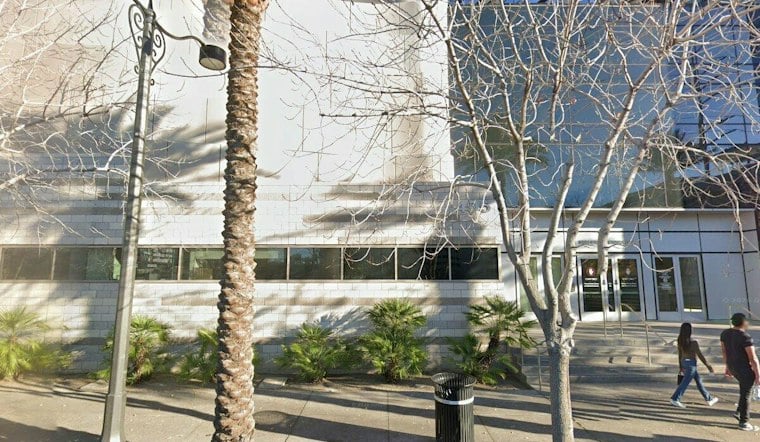
A one-acre vacant lot in the Las Vegas Arts District could soon become a charging station for autonomous vehicles, and the developer’s plan calls for an eight-foot fence running along the property line right next to a mural that took two months to paint. The Las Vegas City Council is scheduled to consider the proposal Wednesday, December 2, and the plan has already drawn pushback from neighbors who fear it could wall off a piece of public art that went up just this past July.
Fence Plans Raise Concerns Among Arts District Neighbors
According to a report from 8 News Now, the developer’s application specifies that the Main Street-facing side of the property would have an eight-foot black steel fence with a perforated concealment screening panel. The same application does not identify any specific autonomous-vehicle fleets or robotaxi operators tied to the project, leaving open exactly whose cars would be charged there. The one-acre site sits directly next to the sci-fi-themed mural painted on a cinderblock wall in the Arts District this past July, and the vacant lot itself is valued at around $2 million.
Paco Alvarez, a community activist and Arts District neighbor, told the station that artist Gear Duran and his partners devoted substantial time and effort to the piece, noting it took about two months to complete. Alvarez also raised a concern that a wall completely obscuring the mural could defeat its intended purpose, and he said anything that impacts the view of a mural could potentially be legally challenged by the artist — his own characterization of the situation, not a ruling from any court.
Developer Behind the Property, and What Federal Law Actually Says
County records cited in the report show the property was purchased over 13 years by Storybook Retail LLC, which is managed by Las Vegas developer Wayne Laska. Whether that history affects the council’s review was not addressed in the available reporting.
The legal question Alvarez raised touches on the Visual Artists Rights Act, enacted in 1990. Under the statute as published by the Cornell Legal Information Institute, an author may prevent destruction of a work of recognized stature, and intentional or grossly negligent destruction of such a work can violate that right. The statute separately allows an author to waive those rights, but only through a written instrument signed by the author that identifies the work and the specific uses covered. Whether the Arts District mural qualifies for that protection, or whether the proposed fence would even violate it, isn’t established by the available evidence — that determination would fall to a court, not to this reporting.
Community Meeting Set Ahead of Council Vote
Tony Chavez, co-founder of the Arts District Action Coalition, said the mural’s artist wants the community to help find a solution rather than dig in on one side. “[He wants] to find a neutral common ground where we can actually have a middle thing where both parties in the end are happy,” Chavez said. Per the same report, the community is asked to meet at 6 p.m. on November 30 at Las Vegas City Hall to voice opinions about the mural’s future before the council takes up the charging station item two days later.
The dispute arrives as autonomous and remotely driven vehicle services have already taken root in the city. Vay announced in January 2024 that it was launching a commercial teledriven mobility service around the University of Nevada, Las Vegas and the Arts District, describing a model in which a rider drives to a destination and a remote teledriver then moves the car to its next user or parks it, according to Vay. Separately, Motional and Uber have operated a robotaxi service in Las Vegas with rides available from designated spots including Downtown Las Vegas, per Motional, under a 10-year framework agreement the two companies struck in 2022. At launch, those robotaxis still carried a human operator behind the wheel, with a fully driverless version expected by the end of that year. Neither company’s service has been linked to the proposed Arts District charging station, and the city’s own application does not name any fleet operator at all.




