

























































A 2009 Toyota Yaris wrapped in a strange, AI-generated pattern managed to slip past a Flock Safety camera's detection software during a test in Las Vegas, but only after researchers covered its windows too. The vehicle still showed up on camera, recorded in plain video, yet the system meant to flag it as a car simply stopped recognizing it as one.
The test was carried out by the YouTube channel Donut, working with cybersecurity expert Bill Swearingen and security researcher Benn Jordan, according to tech.yahoo.com. The team drove the wrapped Yaris past a Flock automatic license plate reader connected to a laptop set up to show live detection confidence scores, with Flock's system logging a vehicle once it is at least 75% confident it is looking at one.
On the first few passes, the wrapped Yaris still registered above that 75% threshold, per the same account. It took covering the car's windows as well before the results changed, with the system's confidence dropping low enough that later passes went unlogged entirely — even though, as bitdefender.com reported from a related DEF CON demonstration in Las Vegas where Swearingen wrapped the same 2009 Yaris, the camera still correctly recorded the vehicle on video even as its detection software logged nothing.
Why the Windows Mattered
Wrapping just the body of the Yaris in the adversarial pattern was not enough on its own. The software kept recognizing the car by its windows and wheels, Donut's testers found, and Carscoops reported that with only the body wrapped, the camera still managed to detect the vehicle. It was only after the windows went dark that the camera failed to trigger, according to Carscoops.
The team repeated the test under different lighting conditions to rule out a fluke, and the pattern held up each time, per tech.yahoo.com's account. Bill's pattern uses what researchers describe as adversarial noise — a visual scramble built to confuse AI shape-recognition software rather than human eyes. Generating that specific wrap took around 48 hours of dual-GPU processing time, the outlet reported.
Other Tricks Fell Flat
Not every anti-surveillance gadget tested held up. A license plate cover and a spray marketed as a plate-camera blocker were both largely ineffective, and one product actually made the plate's letters easier to read through an infrared camera rather than harder, according to tech.yahoo.com. That matters because Flock systems can still collect a vehicle's color and other visible features even when a license plate itself can't be read.
The pattern used in the Las Vegas test is part of a broader project that has been tested against 11 open-source detection algorithms, including systems associated with Flock, Axon body cameras and Clearview AI, per bitdefender.com. The effort, known as noRecognition, aims to give people patterns that let them opt out of algorithmic tracking, TechCrunch reported. Mashable has cautioned that such patterns' effectiveness is not guaranteed, since each one has to be tested against specific detection algorithms and scenarios.
A Proof of Concept, Not a Loophole
Even Donut's own team was careful about what the test proved. It did not show that the Yaris would evade every Flock camera or vanish from an actual police database, and outside coverage has echoed that caution — Carscoops described the whole setup as an interesting but wildly impractical proof of concept, given the cost, time and conspicuous appearance involved in wrapping a car's windows along with its body.
Benn Jordan, who joined the discussion as a security researcher and YouTuber, pointed people toward a more conventional route if they're worried about local surveillance: speaking up at city council meetings and asking officials directly about camera programs in their area. He also encouraged residents to talk with neighbors and organize petitions around local camera use.
Flock's Growing Footprint in Las Vegas
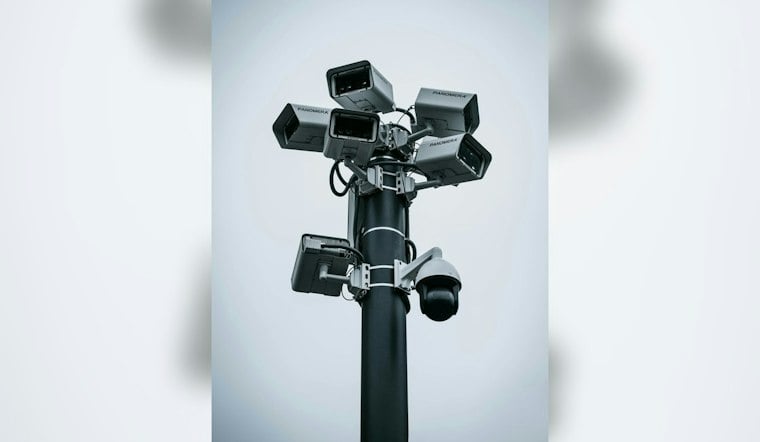
The timing lands amid a broader rollout of license plate readers across Nevada. The state has nearly 1,000 automated license plate readers scattered across it, with the heaviest concentration in Las Vegas, according to KNPR. The cameras are largely operated by the Las Vegas Metropolitan Police Department, which relies on two vendors — Flock Safety and Motorola — to capture license plates, vehicle characteristics, and the time and location of vehicles passing by.
Metro quietly entered its agreement with Flock Security in 2023, and the department told The Nevada Independent it now operates roughly 200 Flock cameras on city or county infrastructure. Metro shares that data with hundreds of state and local law enforcement agencies around the country, the outlet reported — part of a nationwide network in which Flock operates more than 80,000 AI-powered cameras. News 3 Las Vegas has counted as many as eight Flock cameras positioned at a single valley intersection to capture vehicles moving in multiple directions.
That expansion hasn't gone unchallenged elsewhere. Flock has lost dozens of city contracts across the country amid declining public support for its license plate readers, Futurism reported. The Las Vegas wrap test is also just the latest in a string of attempts to dodge automated detection systems, following efforts like the traffic cones San Francisco activists once placed on the hoods of Waymo and Cruise robotaxis, as noted by Decrypt.





