

























































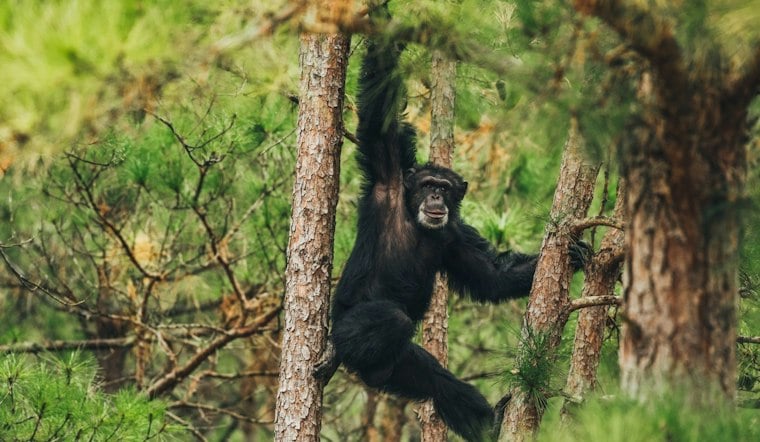
The National Institutes of Health says it will transfer its last government-owned chimpanzees awaiting retirement to a sanctuary in Louisiana, with transfers expected to begin in early 2027. The chimpanzees currently live at the Keeling Center for Comparative Medicine and Research in Bastrop, Texas, where some were used in research on AIDS and other infectious diseases. Once the move is complete, it would leave no NIH-owned chimpanzees in U.S. laboratories.
Accounts differ on exactly how many chimpanzees make up this final group. According to UPI, the transfers involve “the final 33 chimpanzees,” a figure also reported by Humane World for Animals. But The Hill reports that 34 chimpanzees, currently housed at the Keeling Center, will be transferred to Chimp Haven. The New York Times separately reported that as of October 1, 34 chimps remained at the Keeling Center. The dossier does not resolve which number reflects the final transfer group.
NIH says it will plan and carry out the transfers with the chimpanzees' health, welfare and social groupings guiding every decision, per UPI's reporting. The agency has also warned that the animals' health conditions pose risks during transport and the transition to sanctuary life. KBTV Fox 4 Beaumont reported that NIH said Wednesday it plans to transfer its last NIH-owned chimpanzees awaiting retirement to the Louisiana sanctuary.
Fulfilling a Decade-Old Promise
The move traces back to a pledge NIH made in November 2015, when the agency announced it would no longer conduct or fund invasive research involving chimpanzees. NIH Director Jay Bhattacharya said completing these transfers will fulfill that commitment, telling STAT, “Completing their transfers will fulfill NIH's commitment, announced in November 2015, to retire all NIH-owned chimpanzees to sanctuary.” Since that pledge, more than 200 chimpanzees have already been relocated to Chimp Haven, according to the same STAT report.
The chimpanzees will go to Chimp Haven, a sanctuary in Keithville, Louisiana, that the New York Times describes as spanning 200 acres of forested land. It is the federal sanctuary designated for chimpanzees retired from government research. This latest transfer follows the relocation of the remaining Alamogordo Primate Facility chimpanzees, which UPI's report notes were moved to the sanctuary by spring 2025.
A Legal Fight Behind the Relocation
That earlier Alamogordo transfer followed years of legal pressure. A federal judge ruled in 2022 that NIH had violated the Chimp Act by denying sanctuary retirement to government-owned chimpanzees held at the Alamogordo facility. The plaintiffs asked the court to direct NIH to transfer each and all of the chimpanzees remaining at that facility to Chimp Haven as space became available, but the court declined to order those transfers, according to an order excerpt from the U.S. District Court for the District of Maryland, reviewed via GovInfo.
Beyond the chimpanzees NIH owns, questions remain about how many chimpanzees used in research remain outside government custody. Humane World for Animals estimates that as many as 100 privately owned chimpanzees remain at three U.S. laboratories, while a separate report from Science put the figure at 101 privately owned former research chimpanzees living at research centers in Louisiana and Georgia. NIH has not provided its own count of privately owned chimpanzees remaining in U.S. laboratories, according to the dossier's reporting.
Science has also reported that NIH pledged in 2015 to move the roughly 300 chimpanzees it then owned or supported to sanctuary, and that more than 200 have been sent to Chimp Haven in the years since. For the chimpanzees still waiting at the Keeling Center, the coming transfers mark what NIH officials describe as the final chapter of that decade-long commitment — one that will, for the first time, leave no NIH-owned chimpanzee in a U.S. laboratory.





