

























































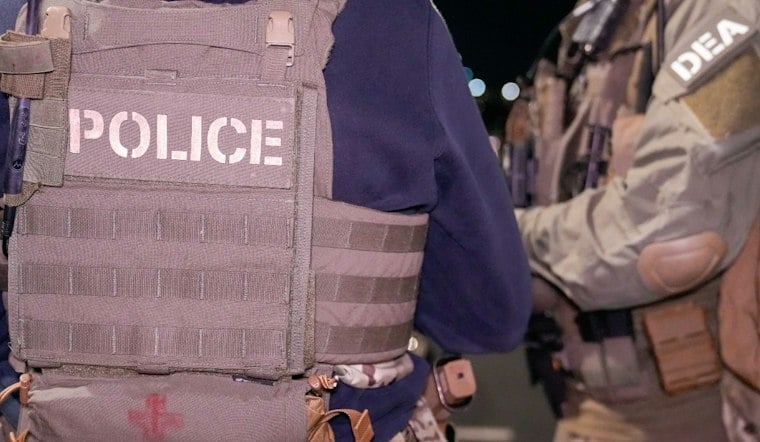
Two Blair County police departments have formally agreed to help enforce federal immigration law, with Logan Township supervisors approving their department's memorandum of understanding with Immigration and Customs Enforcement this past Thursday and Duncansville's borough police department having entered a similar deal roughly two months earlier. Officers in both municipalities will receive 40 hours of online training and gain the power to exercise limited immigration authority while performing routine police duties.
The agreements, first reported by the Altoona Mirror, are built on the task force model under Section 287(g) of the Immigration and Nationality Act, a provision added in 1996 that empowers local and state police to enforce federal civil immigration laws during their regular duties, according to an ICE webpage cited in that reporting. Duncansville's police department, which consists of three part-time officers plus Chief Rodney Estep, is still in the middle of training under the new arrangement.
What Each Department Says the Deal Actually Does
Estep said the agreement gives his small department the ability to assist ICE agents with enforcement involving people in the country illegally. He described it as a good tool and another resource for officers who encounter someone suspected of being undocumented, though he acknowledged he is unsure exactly how that process would unfold in practice. Estep suspected that in such a case, Duncansville officers would contact the ICE office in Pittsburgh, which he believed would then provide resources and assistance, with the person ultimately handed over to ICE for processing.
Duncansville Mayor Eric Fritz authorized the department's entry into the agreement, Estep said. No money changed hands: ICE provided the training for free but is not paying Duncansville to participate. Estep said the agreement does not change how borough officers interact with people they encounter, and the department is not pursuing targeted immigration enforcement or altering its patrol practices. He added that no Duncansville officer has encountered an undocumented immigrant since the department entered the memorandum.
Logan Township Police Chief Devon Moran framed his department's version differently, saying the agreement will enhance the department's investigation and enforcement abilities rather than create a standalone immigration unit. Moran said Logan will not form a special immigration enforcement team and will not pursue immigrants through administrative or civil warrants. Instead, he said, any immigration enforcement would happen only in the course of investigating crimes.
What the Authority Allows, and What's Unclear
Per the ICE webpage referenced in the Altoona Mirror's reporting, the Section 287(g) task force model is meant to let ICE collaborate with state and local law enforcement to arrest and remove people who undermine community safety or immigration laws, delegating specified immigration officer functions to local officers under ICE direction and oversight. ICE says the program benefits participating agencies by helping keep communities safe from potentially dangerous individuals in the country illegally. An online summary of Immigrant Legal Resource Center information cited by the Mirror indicates deputized officers under the task force model may question people about immigration status, check federal databases, make civil or felony immigration arrests, issue detainers and conduct field stops — though the Mirror noted that the ICE website denies access to several related materials, including a fact sheet, the police department application form and monthly encounter reports.
Not everyone in Blair County welcomes the move. According to the Mirror's reporting, Indivisible Blair County criticized Duncansville's decision to sign the memorandum, arguing the agreement makes local officers act as ICE does and hands them investigative, database-access and arrest capabilities they didn't previously have. The group said ICE operations' lack of due process and cruelty should not be imported into local enforcement, warning the arrangement risks racial profiling, undermines community trust and makes local police complicit in constitutional-rights violations.
Part of a Statewide Surge in ICE Partnerships
Logan Township and Duncansville are joining a wave of similar agreements across Pennsylvania. As of mid-October, 146 agencies statewide had signed cooperation deals with ICE, more than triple the 42 agreements that existed at the start of the year, according to PennLive. Nationally, 287(g) partnerships have ballooned from 135 agreements to more than 2,600 since the start of President Donald Trump's second term, the outlet reported, citing federal data; it also found Pennsylvania has the most such agreements in the Northeast and the sixth-most of any state.
The consequences of that expansion are already visible elsewhere in the state. The Philadelphia Inquirer reported that Pennsylvania recorded 1,216 arrests under the 287(g) program in the first seven months of 2026, ranking fourth nationally, and that an expert found roughly 70% of people arrested by Pennsylvania police and turned over to ICE under the program had no criminal record or pending charges. The Inquirer also reported that nationwide, arrests involving local police under 287(g) rose from less than 3% of the total under President Joe Biden to about 15% at the time of its reporting.
Schuylkill County has emerged as a focal point of that trend, though source counts diverge: the Inquirer reported 14 law enforcement agencies there had signed 287(g) pacts, the most of any Pennsylvania county, while a PennLive excerpt put the figure at 11 agreements. The Inquirer reported more than 100 arrests leading to ICE detention and deportation cases in the county since the start of the year, with most resulting from 287(g) cooperation, and said Schuylkill Haven alone saw at least 59 immigration arrests in about four months.
In western Pennsylvania, PublicSource reported that 209 immigrants were detained across Rep. Chris Deluzio's district between Jan. 1 and Aug. 6, with local law enforcement assisting in about half of those arrests. The outlet found nine municipalities in Beaver County had ICE agreements during that seven-month span, compared with just three in Allegheny County. Beaver County Sheriff Tony Guy told PublicSource his office had signed a 287(g) agreement but had not yet executed on it.





