

























































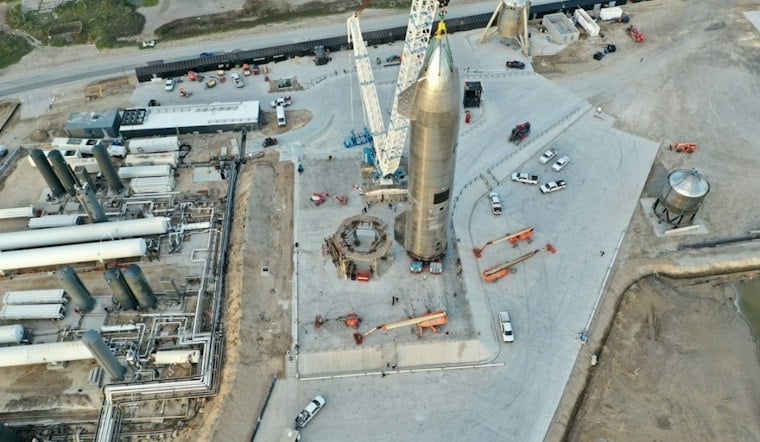
A Long Beach aerospace and defense company has landed a $75 million federal contract to keep testing a missile interceptor it says could eventually be built by the hundreds each year. Long Wall, headquartered in Long Beach, California, says the Missile Defense Agency awarded it the funding to complete flight testing of its Cyclops interceptor, with the company planning to match that sum with another $75 million of its own money toward the program's design and development.
The award, reported by the Los Angeles Business Journal, comes about a year after Long Wall first unveiled Cyclops. According to the company's own announcement, Long Wall began developing the interceptor in 2024 and formally announced the product in December 2025. The company describes Cyclops as a surface-launched, exoatmospheric interceptor built to defeat missiles during the midcourse phase of flight, according to a separate Long Wall announcement.
Long Wall's pitch centers on affordability as much as performance. Co-founder and chief executive Dan Piemont said demand for interceptors has surged while low production capacity and high unit costs remain major obstacles to replenishing depleted missile-defense stockpiles, per the company's statement. The Business Journal's reporting frames Cyclops as aimed at solving a long-standing problem in missile defense: systems that often cost more than the missiles they're meant to stop.
A Company Rebuilt From a Rocket Launcher
Long Wall wasn't always in the interceptor business. The Business Journal notes the company was rebranded in February 2026 from ABL Space Systems, a satellite launch operator, as it pivoted toward missile defense work. Today Long Wall says it is headquartered in Long Beach with additional operations in Alaska and Alabama.
The company says its facilities could support serious scale if fully utilized. Per an announcement carried by New Science Ventures, Long Wall states that its existing facilities, spanning more than 160,000 square feet, could produce over 100 Cyclops rounds per year when fully utilized. Long Wall's own award announcement separately describes broader development, test and production infrastructure of more than 180,000 square feet across three major facilities — a figure the company has not reconciled with the 160,000-square-foot number used elsewhere in its materials.
What the Contract Doesn't Say
Several basic details remain under wraps. As defense outlet SOFREP reported in October, the contract's length, the test schedule, and the missile's price were not disclosed in Long Wall's announcement. That leaves open questions about how long the government's money is expected to last and what a single Cyclops interceptor might eventually cost taxpayers.
SOFREP's reporting also places the award in context against other recent interceptor contracts. The outlet noted the MDA awarded X-Bow Systems a contract worth almost $11 million in August to flight-test a solid-fuel interceptor, a far smaller sum than Long Wall's deal. By comparison, the same report notes the MDA selected Lockheed Martin in April 2024 for a $17 billion development and initial-production contract covering the Next Generation Interceptor — illustrating the vast range in scale across the missile-defense contracting landscape.
Golden Dome Looms Over the Industry
The Business Journal's reporting ties Long Wall's award to the Pentagon's broader push to scale up its Golden Dome missile defense initiative, describing the Long Wall contract as part of that ongoing effort. Per the Business Journal, the U.S. Space Force had awarded $3.2 billion in agreements to 12 companies to develop space-based interceptor prototypes as of April. Defense trade outlet DefenseScoop reported those space-based interceptor prototypes are slated for demonstration and integration into the Golden Dome architecture by 2028.
The price tags attached to Golden Dome as a whole dwarf any single contractor's award. The Business Journal reports that, per the Congressional Budget Office, the Golden Dome project is expected to cost more than $185 billion, with an estimated $1.2 trillion needed to maintain, replenish and sustain the system over two decades. Scientific American, citing CBO analysis, has reported that a fully space-based interceptor layer would require around 7,800 interceptor satellites just to counter a small attack of 10 intercontinental ballistic missiles launched nearly at once — a scale that underscores why the Pentagon is courting smaller, lower-cost contractors like Long Wall alongside its established prime contractors.





