

























































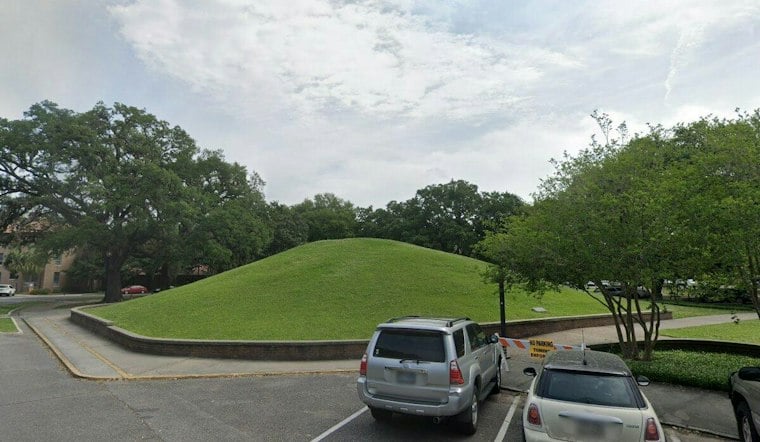
LSU's two ancient earthen mounds have been quietly crumbling for years — faded grass, exposed dirt, and one mound so deformed it no longer holds its cone-like shape. Now, a roughly $440,000 preservation project aimed at halting that erosion has cleared planning and design, with contractor bids expected to be accepted in the next few weeks and no firm date yet for when the work will wrap up.
Project manager Hayden Hammons of Carbo Landscape Architecture laid out the restoration plans Thursday afternoon at a public meeting in Baton Rouge, according to The Advocate. Hammons told attendees the project would begin accepting bids in the coming weeks and said the scope has stayed consistent with its original proposal, calling the work straightforward so far. Still, he noted the mounds themselves present unusual challenges: “This site, it's a different beast for sure,” he said, per the outlet's report, adding that the project demands more cultural sensitivity and collaboration than typical landscaping work.
The mounds are considered among the most visible representations of Indigenous people's continued presence in Louisiana, and some accounts describe them as among the oldest human-made structures on the continent. Experts believe Indigenous tribes likely used the sites for trade or special ceremonies, though the mounds' precise age remains a point of dispute. LSU has credited researcher Brooks Ellwood's work with the finding that construction on the first mound began about 11,000 years ago, while a separate LSU account states both mounds were completed around 6,000 years ago, according to lsu.edu.
Questions Over the Mounds' True Age Persist
That 11,000-year estimate has drawn pushback from archaeologists. A 2022 article in The SAA Archaeological Record called it “the most extraordinary claim” in the Ellwood team's research, specifically challenging the idea that Mound B construction began as early as 11,000 years before present. Separately, new optically stimulated luminescence testing aimed at settling the debate is underway and could take up to a year to complete, according to The Reveille.
Regardless of their exact age, the mounds were listed on the National Register of Historic Places in 1999, per lsu.edu. LSU has said that foot traffic — people walking, sliding, and biking across the mounds — has accelerated their deterioration over time, and drought has caused further damage, campus landscape architect Dennis Mitchell said, according to The Advocate's report.
What the Restoration Work Will Actually Do
The preservation effort is designed to address erosion and improve the mounds' long-term stability, with work including revegetation, a new irrigation system, and removal of sidewalks near the mounds, per the same account. A 2026 report from inregister.com described the first phase as regrading the mounds and planting a fresh layer of drought-tolerant zoysia grass, along with installing a new irrigation system.
That irrigation overhaul matters because of what came before it. A sprinkler once used atop the mounds caused oversaturation in their modern history, and Mitchell said the old method potentially created more problems than it solved. The new irrigation approach is intended to address drought-related damage while avoiding that oversaturation, watering dirt and sediment from the bottom up instead, The Advocate reported. Once a contract is finalized, Mitchell said construction itself should last a couple of months — though, as the outlet's more recent report makes clear, no overall completion timeline has been set for the project.
Funding and Tribal Partnerships Behind the Project
The project is funded in part by a National Park Service grant, which LSU has matched with its own funds. LSU's own release puts the total investment at $441,742, including a $220,871 Save America's Treasures grant from the agency, according to lsu.edu. Separately, inregister.com described the first phase of work as supported by $442,000 from the National Park Service and LSU combined, a rounded figure from that outlet's own reporting.
LSU has said the project aims to mitigate erosion, repair damage, and bolster the mounds' long-term stability through drought-resistant grasses. The university names the Chitimacha Tribe of Louisiana, the Tunica-Biloxi Tribe of Louisiana, and the Louisiana Division of Archaeology as key partners on the effort. Project leaders reached out to a handful of tribes with jurisdiction when the preservation planning began and have worked closely with the Chitimacha Tribe of Louisiana since, The Advocate reported, and tribal consultants are expected to help ensure that sidewalk removal near the mounds happens with minimal impact to the site.
A Lawmaker and an Indigenous Advocate Weigh In
Dixon McMakin, the Louisiana state representative for House District 68, Republican, attended Thursday's meeting and voiced support for measures to shore up the mounds. But he also questioned why the mounds continued to erode even after being fenced off for several years, and he pushed back on the idea of restricting pedestrian access altogether, arguing that people should be able to use and see the mounds to learn about Indigenous Louisiana history. LSU had used temporary barriers on game days during the 2010s to keep people off the mounds before installing the fencing that surrounds them today.
Hali Dardar, a member of Bvlbancha Public Access — a media group focused on Indigenous representation in the Gulf South — told The Advocate that Indigenous people remain present in Louisiana and that the mounds visibly represent that continuing presence. Dardar emphasized that the mounds matter well beyond the LSU community itself. Mitchell, for his part, said the broader goal of the restoration is to draw attention to the mounds as a historic artifact on campus, raising awareness of their significance as the project moves from planning into construction.




