

























































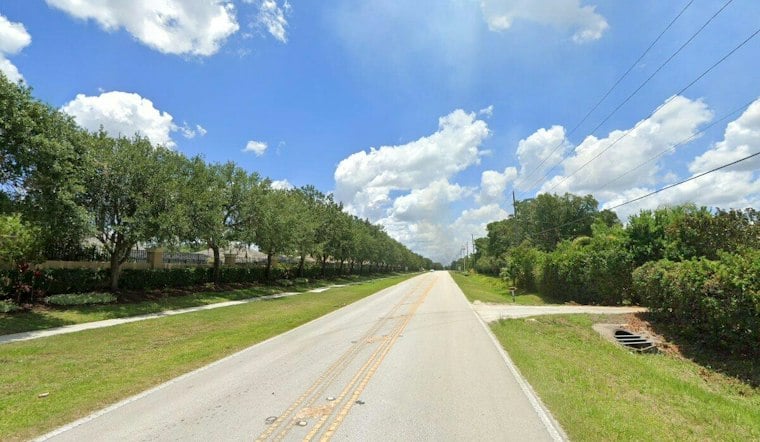
Sand that Manatee County stockpiled for public road projects near the Fort Hamer Bridge was hauled instead to Watercolor Place, a private residential development, on April 24, 2026. The material had been recovered from hurricane debris and was supposed to help rebuild Upper Manatee River Road, but county records reviewed by a local newspaper show it never made it into that public project.
Sand Trucks Caught Moving Material Off-Site
According to The Bradenton Times, reporter Dawn Kitterman documented sand trucks loading at the county's Hidden Harbor Park staging site and unloading at Watercolor Place, a private subdivision. The sand had originated as debris recovered from Anna Maria Island after Hurricanes Helene and Milton struck the area in 2024. Manatee County had stockpiled construction-grade recovered sand at Hidden Harbor Park specifically for future public infrastructure projects.
County officials had been public about those plans. Charlie Hunsicker, Manatee County's natural resources director, said in April 2025 that the sand stored near the Fort Hamer Bridge would be used to rebuild Upper Manatee River Road, and reported that more than 65,000 cubic yards of recovered sand had been transported to Hidden Harbor Park by that point. Hunsicker said using the recovered material would avoid wasting it, and the county had also planned to raise Upper Manatee River Road several feet above flood elevation while using the sand for Lena Road construction and the Fort Hamer Bridge approaches. Officials anticipated more than $1 million in savings on backfill costs for future road work. A separate report from AMI Sun noted that roughly 27,000 cubic yards of that construction-grade sand had been transported to the Hidden Harbor staging site, separated from beach-quality sand that was returned to Anna Maria's shoreline because sand on private property could carry nails, debris or household contaminants that made it unsuitable for the beach.
County Engineer Says Compaction Problems Led to the Swap
So what happened to the sand meant for the road? Manatee County engineer Scott May told the newspaper that the recovered sand was not used in the Upper Manatee River Road expansion or any other county roadway project. The Upper Manatee River Road expansion itself is governed by a September 2024 reimbursement agreement between Manatee County and Manatee Land Investors LLC, which is identified as the developer of Watercolor Place and is responsible for constructing roadway improvements while the county reimburses eligible costs. Manatee Land Investors retained Woodruff & Sons as the construction contractor for that work.
Per May, Woodruff & Sons attempted to incorporate the recovered sand into the roadway project but could not achieve the compaction required by mixing it with other materials. Facing the prospect of hauling the stockpiled sand to the county landfill at additional expense, the county instead reached a verbal arrangement with Woodruff & Sons that was never formalized in writing, according to May. Under that arrangement, Woodruff & Sons proposed removing the sand for approximately $1 per cubic yard, with the county receiving a credit against Upper Manatee River Road construction costs rather than a direct payment. May estimated the deal involved roughly 65,000 cubic yards and a credit of about $65,000, and said the deduction would appear in the county's next payment application once the sand was removed.
Quantities Still Don't Match Up
Months later, the numbers still haven't settled. Manatee County public works communications coordinator Ogden Clark said the county received a preliminary removal quantity of 60,210 cubic yards from Woodruff & Sons in May, but trucking tickets at that time documented only 5,742 cubic yards, with the rest of the supporting tickets still outstanding, per Clark. On October 30, Woodruff & Sons reported a new total of 62,514 cubic yards on an updated load-count sheet. Woodruff project manager Eric Epler said supporting tickets would follow once they were scanned.
As of the newspaper's reporting, Manatee County had not applied any credit to the Upper Manatee River Road project and had not provided a final verified quantity of removed sand or a finalized credit amount. The county told the Bradenton Times it typically reconciles quantities, credits and supporting documentation through its regular billing process, with final amounts confirmed near project completion.
Road Widening Carries a High Price Tag and Uncertain Finish Date
The stakes around Upper Manatee River Road are considerable. The project calls for reconstructing and widening the road from north of State Road 64 to the Fort Hamer Bridge from two lanes to four, according to Manatee County's capital-improvement plan, which lists total project funding at $65,404,974. The county cites growth as the driving need, saying traffic from existing and approved-but-not-yet-built development is expected to exceed the road's capacity. Nearby, the county has approved UMR Sports for 232 apartments and Carlos Beruff's North River Land LLC for 496 residential units and 300,000 square feet of commercial space, as reported by Your Observer.
Timelines for finishing the widening don't agree. The county's capital-improvement schedule lists construction running from October 2024 through December 2028, but a 2024 report from Your Observer said construction was expected to be completed by fall 2027. A Manatee County public works spokesperson told that outlet the widening is expected to improve traffic flow south of the Fort Hamer Bridge, though the bridge itself and Fort Hamer Road on the other side remain two lanes, a potential bottleneck once the wider road reaches them.
Watercolor Place, the development where the sand ended up, is no small project itself. County development records list Watercolor Phase IV as consisting of 72 single-family attached units built as four-plexes and 119 single-family detached units, for a combined 191 residential units in that phase alone.



