

























































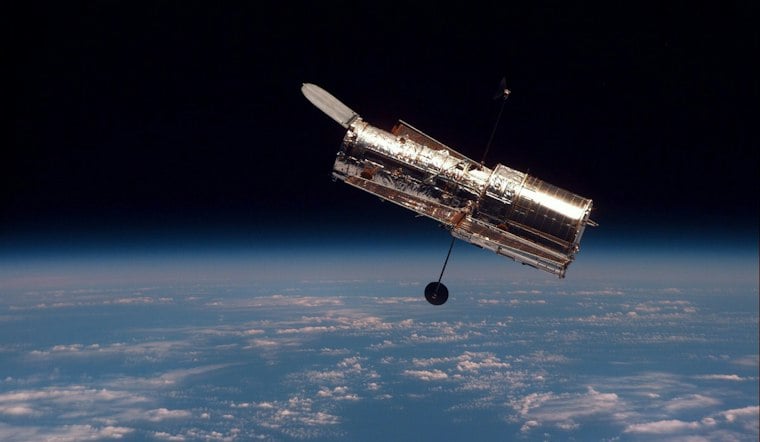
NASA is turning to private industry for help keeping the Hubble Space Telescope aloft, or at least bringing it down safely, as the three-decade-old observatory edges closer to an uncontrolled plunge through Earth's atmosphere. The space agency issued a formal request for information on Oct. 29, asking commercial companies what they could realistically offer to service, boost, or deorbit the telescope.
According to NASA Science, the request was meant to gauge industry capabilities for in-space servicing to support Hubble. As reported by Ars Technica, NASA is seeking concepts that could raise Hubble to an altitude of at least 373 miles, enhance the telescope's performance, or guide it to a controlled reentry instead. Companies have until Nov. 30 to respond.
NASA has stipulated that whatever mission moves forward cannot harm the telescope itself and should happen by 2032, the outlet's reporting notes. Crucially, the agency has not set aside any funding to actually buy a reboost or servicing mission, meaning the request is an information-gathering exercise rather than a commitment to act. NASA Administrator Jared Isaacman, speaking about the effort, said cost-effective options deserve a look: “we owe it to the American taxpayer and the scientific community to explore them,” per the same account.
Why Hubble Can't Save Itself
Hubble's predicament comes down to basic physics: the telescope was never built to course-correct on its own. It is, as KeepTrack describes it, a 13-meter cylinder with no rocket engine of its own, meaning it cannot raise its orbit without outside assistance. Left alone, atmospheric drag will keep pulling it lower until it eventually falls out of orbit.
Just how soon that happens is genuinely uncertain. Ars Technica reports that orbital dynamicists expect reentry in 2033 or 2034 without intervention, though forecasts can shift based on solar activity. KeepTrack's own analysis puts the median reentry forecast at mid-2033 if nothing changes, while separately citing astronomer Jonathan McDowell's assessment that the earliest plausible reentry could come as soon as 2028 — an outlier low-end estimate, not the expected timeline. The Register has reported that increased solar activity has sped up Hubble's orbital decay by causing Earth's atmosphere to expand.
A Long History of Near-Misses and Reboost Talk
This isn't NASA's first attempt to crowdsource a Hubble fix. The agency received eight responses to a similar 2022 request, including a joint robotic reboost proposal from Astroscale and Momentus, the same Ars Technica report notes. That same year, NASA and SpaceX signed an unfunded agreement to study whether a crewed Dragon capsule could rendezvous with Hubble and push it into a higher orbit, according to KeepTrack. By June 2024, NASA had decided not to pursue a reboost at that time, the outlet adds.
The last time anyone actually raised Hubble's orbit was in 2002, when the Space Shuttle Columbia visited the observatory for a servicing mission, Ars Technica reports. NASA science associate administrator Nicky Fox pointed to how much has changed since then, noting that commercial industry has rapidly evolved in recent years to offer new capabilities for in-space satellite capture and servicing.
A Cautionary Tale From a Different Telescope
NASA's commercial servicing ambitions have already hit turbulence elsewhere. The agency awarded a $30 million contract to startup Katalyst Space Technologies for an attempted rescue mission targeting the Swift telescope, Ars Technica reports. Katalyst's rescue satellite got to within about 6 miles of Swift before ground teams decided not to move any closer, after problems emerged with the spacecraft's power and reaction-control systems, according to the outlet's account — a reminder of how difficult these rendezvous missions can be even when a company gets close.
As FOX 35 Orlando reported, NASA is looking to private space companies to help save Hubble as the telescope faces the prospect of an eventual fiery plunge into Earth's atmosphere. Ken Kremer, managing editor of Space UpClose, joined the station's Garrett Wymer to discuss what it would take to carry out such a mission. For now, nothing is settled: no provider has been chosen, no mission has been approved, and NASA's own documents make clear the Nov. 30 deadline is just the start of figuring out what, if anything, is possible.





