

























































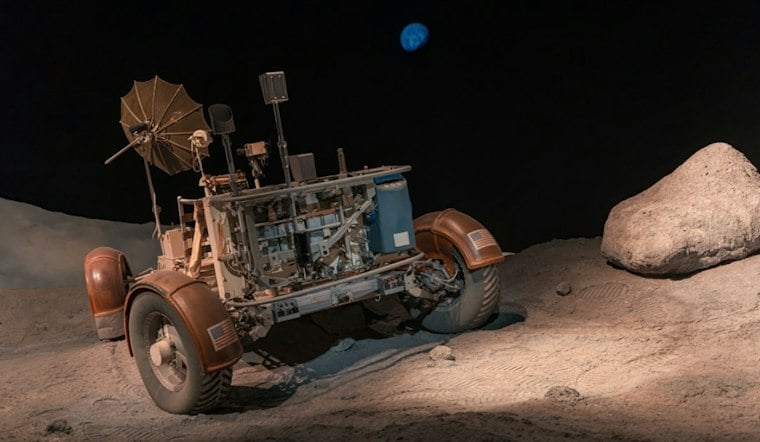
NASA has given the green light to a new lunar rover built largely from spare parts of its Mars rovers Curiosity and Perseverance, with a target launch of late 2028 and an 18-month primary mission near the Moon's south pole. The rover, called PROMISE, is designed to survive the frigid lunar night and drill into the lunar surface in search of frozen water and other resources that could one day support astronauts.
PROMISE stands for Polar Rover for Observation, Mapping and In-Situ Exploration, and as reported by the Orlando Sentinel, it is directly related to the Curiosity and Perseverance Mars rovers. According to Scientific American, the rover is modeled after those two Mars missions, which have become some of NASA's most enduring robotic explorers. Curiosity launched from Cape Canaveral in 2011 and landed on Mars in 2012, while Perseverance launched from Earth in 2020 and arrived on the Red Planet in 2021, per the Orlando Sentinel's reporting.
NASA Science Mission Directorate Associate Administrator Nicky Fox is identified with PROMISE, which combines spare flight components and engineering test units in an effort to deliver more science faster and at lower cost, according to the Orlando Sentinel. The rover itself began life as an engineering development unit used to test software and maneuvers for Mars rovers, the outlet reports, and now carries spare flight components and test hardware from both Curiosity and Perseverance. NASASpaceFlight.com reports that PROMISE's electronics, body structure, and mobility system are built on a Curiosity test-bed foundation, supplemented by flight spares and test-bed components from both Mars missions.
A Nuclear Heart Borrowed From Cassini
Rather than relying on solar panels, PROMISE's power system does not depend on sunlight at all, the Orlando Sentinel notes. Instead, NASA plans to power the rover with a radioisotope thermoelectric generator that uses heat from a decaying nuclear isotope, which will let the rover keep working through the Moon's two-week-long nights of extreme cold. Notably, the rover's RTG fuel was originally processed for the Cassini mission to Saturn, according to the Orlando Sentinel. NASASpaceFlight.com separately reports that a flight-spare multi-mission radioisotope thermoelectric generator will provide PROMISE's power and heat.
Once on the surface, PROMISE will put a drill to work extracting lunar regolith and investigating frozen water and other volatiles down to a depth of one meter below the surface, per the Orlando Sentinel. Three spectrometers aboard the rover will perform chemical analysis of the extracted material, while additional instruments will measure radiation levels and help NASA see what the rover sees and pinpoint its precise location on the surface. NASASpaceFlight.com adds that the payload includes copies of VIPER's TRIDENT drill, MSOLO mass spectrometer, Near-Infrared Volatiles Spectrometer System, and Neutron Spectrometer System — four instruments originally built for NASA's VIPER rover.
Catching a Ride on Blue Origin's Blue Moon
PROMISE will travel to the Moon aboard Blue Origin's Blue Moon Mark 1 lander, according to the Orlando Sentinel. NASASpaceFlight.com reports more specifically that PROMISE is slated to fly on Blue Moon Mark 1 serial number five. The same lander line is also tasked with carrying the VIPER rover to the Moon, the Orlando Sentinel notes — tying PROMISE's hardware heritage and its ride to the surface to the same canceled-then-revived VIPER program.
Fox Business reports that Blue Origin secured a separate $94 million base contract to deliver NASA's nuclear-powered PROMISE rover to the lunar South Pole, with an additional $140 million available through a performance-based option. That figure stands apart from an earlier, preliminary estimate from The Planetary Society, which projected PROMISE could cost NASA between $700 million and $1.3 billion and might not launch until the early 2030s if the agency pursued the project — an estimate the organization described as not a detailed engineering assessment. NASA's Moon Base program manager, Carlos García-Galán, has said separately that PROMISE's cost is projected below $400 million, per the Orlando Sentinel.
Spare Parts, Real Limitations
The Planetary Society has raised questions about relying so heavily on recycled hardware, noting that PROMISE's test-bed components could be upwards of 17 years old. The organization's reporting adds that the test-bed rovers used as a foundation lack flight-ready scientific instruments and have no plutonium power source or communications system of their own — meaning much of what makes PROMISE spaceflight-ready still has to be newly engineered and integrated, even as it borrows its bones from Mars-tested hardware.
NASA's Broader Shift to CLPS 2.0
PROMISE is only one piece of a larger announcement. NASA detailed six new task orders and announced a shift in its Commercial Lunar Payload Services mission-launch approach, which it is calling CLPS 2.0, according to the Orlando Sentinel. The revised approach includes task orders.
NASASpaceFlight.com frames the shift as NASA moving from individual missions toward an interconnected network of transportation, prospecting, power, and communications capabilities. The outlet also reports that NASA awarded six Venture-Class Acquisition of Dedicated and Rideshare (VADER) task orders and selected eight companies as eligible to compete for future CLPS 2.0 deliveries. Separately, Fox Business reports that NASA's new CLPS framework carries a maximum combined value of $10 billion over 10 years, a ceiling for future task orders rather than money already committed.
By the end of 2026, NASA expects to have 22 lander task orders in place, according to the Orlando Sentinel, with the agency potentially awarding new task orders to Blue Origin, Firefly, Intuitive Machines, ispace U.S., Lockheed Martin, Northrop Grumman, SpaceX, and Voyager Technologies.
Hopping Drones and a Communications Network
Beyond PROMISE, NASA's lunar south pole ambitions include small hopping robots called MoonFall drones, which aim to jump around hard-to-reach locations in that rugged terrain, according to the Orlando Sentinel. A Blue Origin New Glenn rocket may help deliver those drones to the lunar surface. The broader effort includes communications satellites from Intuitive Machines, future Blue Ring capabilities and SpaceX Starlink testing.
PROMISE still faces conversion and qualification challenges as the agency works to turn a collection of individual missions into a more durable, interconnected presence at the Moon's south pole.





