

























































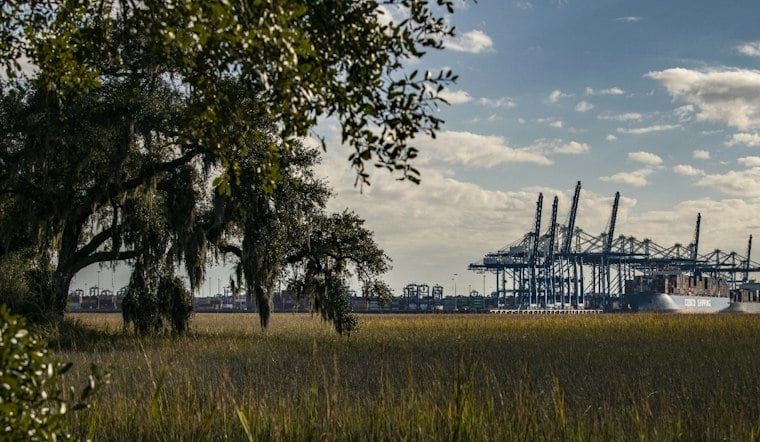
Nearly 130 drivers and 15 carrier companies that haul shipping containers between Charleston-area port terminals and rail yards stopped work Monday. The drivers and owners say falling pay rates and rising costs are making it harder to operate safely. Company owners say the action affected more than half of the roughly 200 drivers who typically move cargo through North Charleston each day.
The stoppage disrupted a link that handles about 1,200 containers a day between Charleston marine terminals and local rail yards. According to WCBD News 2, the loads can weigh up to 90,000 pounds. Carrier owners say the rate they receive per container move has been nearly cut in half, while insurance, labor, parts, maintenance and fuel expenses have climbed.
Lyn Gibson, a local trucking company owner, put a number on what that squeeze looks like at the pump. He said he used to spend at least $600 a week on fuel for each truck, but is now running about $1,200 to $1,300 a week per truck after fuel prices rose, per the same account.
Coalition 18 Frames the Stoppage as a Safety Stand
Juan Gordon, president of Coalition 18, a local advocacy group for port truck drivers, said safety is central to the action. Gordon and other Coalition 18 members say they are not affiliated with the International Longshoremen's Association and argue that the original per-container rate was the minimum needed to operate safely.
Drivers and carrier owners say they want to keep equipment they consider unsafe off the road while they seek a solution, according to the station's report.
Coalition 18 has raised concerns about working conditions before. The Post and Courier reported that Gordon said terminal congestion had cut drivers' daily round trips to local railheads from five to two.
Fuel Costs Have Squeezed the Whole Supply Chain
The pressure on drayage operators has been building for months. The South Carolina Daily Gazette reported in September that the statewide average price of diesel hit an all-time high of $6.17 a gallon, according to AAA, a nearly 75 percent jump since the start of the year. That report noted moving a single container from the port to a warehouse typically costs between $395 and $595, with fuel surcharges alone pushing bills up by as much as 55 percent.
The South Carolina Ports Authority, which oversees terminal operations in the region, said it has been working with local motor carriers on operational improvements and strengthening competitiveness. The authority said it recognizes that motor carriers face real challenges, including fuel costs and operational changes, and said it remains committed to working with the local motor carrier industry, which it described as playing a critical role in moving freight and connecting goods to customers and consumers.
Some drivers were scheduled to meet with Ports Authority CEO Micah Mallace Monday afternoon in an effort to find a path forward, according to WCBD. The authority has described itself as one of South Carolina's largest economic entities.
A Pattern of Disruptions at Charleston's Terminals
A software glitch previously affected South Carolina port operations, according to ABC News 4. During a separate threatened labor strike in September 2024, the Ports Authority planned to keep the gates at its Wando and North Charleston terminals open from 6 a.m. to 5 p.m. on a Saturday, Live 5 News reported.
What past disruptions and safety data can show
The sources cited here do not establish whether Coalition 18’s planned July 2021 stoppage disrupted terminal operations or how the Ports Authority described operations that day. In a separate interruption, Coalition 18 founder Juan Gordon told Live 5 News that local truckers were unable to work for three or four days during an ILA strike in 2024; that stoppage was tied to the ILA strike, not initiated by the port drivers.
The Federal Motor Carrier Safety Administration makes inspection and violation data used in its monthly Safety Measurement System calculations publicly available. But the agency’s general data page does not establish inspection results for the drivers or trucks involved in Monday’s stoppage.
The Hugh K. Leatherman Terminal, which reopened in 2024 after a labor dispute, was also temporarily paused this year, with South Carolina Ports citing an uncertain trade outlook for the back half of 2026 and a need to lower costs, according to FreightWaves. Container work was consolidated at the Wando Welch and North Charleston terminals, which the authority said had enough capacity to manage short-term growth. Charleston is not alone in facing pressure on drayage pricing; trade publication JOC.com has reported that drayage rates in Houston have been rising faster than in other U.S. port markets, underscoring how fuel and rate pressures are squeezing trucking operations well beyond the Lowcountry.





