

























































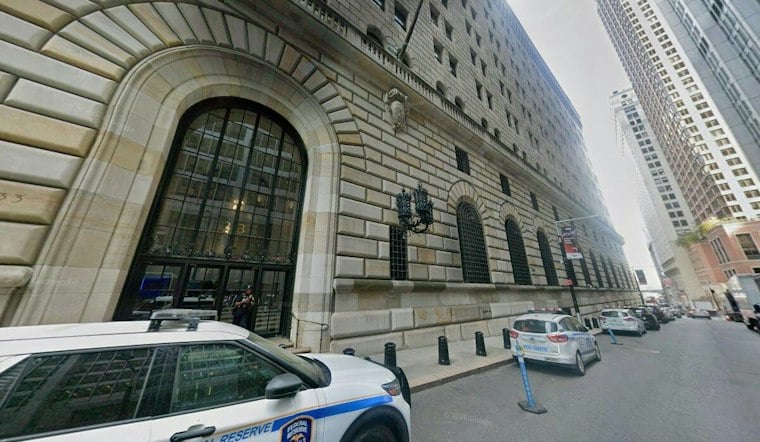
You badged into the office, grabbed a desk, and spent the day on Zoom calls anyway. According to a new survey from the Federal Reserve Bank of New York, that is not a fluke, it is the new normal: nearly half of college-educated workers who showed up in person had zero face-to-face meetings on their most recent office day, and more than two-thirds had at least one teammate who simply wasn't there.
The findings come from a September survey of 1,835 college-educated workers, conducted by New York Fed research economist Natalia Emanuel and University of Virginia economics professor Emma Harrington, as reported by CNBC. The topline numbers are striking: 48.8% of respondents said they had no in-person meetings on their most recent in-office day, 70.6% had at least one teammate absent, and 37% reported sitting through a virtual meeting even though everyone attending was physically in the same building.
The researchers call this phenomenon “remote work from the office,” and they say it's being driven by more than just stubborn habits. Per the underlying New York Fed staff report, the single biggest driver is geographic distance between teammates, compounded by dispersed team structures, the very technology tools meant to connect people, workers who skip office mandates, and employers who don't bother enforcing them. Put together, the paper estimates, roughly half of in-office days now get spent entirely on Zoom calls or solo work.
A Conservative Snapshot, Not a Worst Case
The timing of the survey wasn't incidental. The researchers deliberately picked September, reasoning that the stretch between Labor Day and Thanksgiving tends to show less remote work than holiday-heavy periods, which means these numbers likely understate the problem rather than exaggerate it, the same CNBC report notes. That matters because measures that only track work-from-home arrangements, the New York Fed paper argues, may be missing up to three-quarters of remote work's true prevalence, since they ignore all the commuting workers who are effectively still working remotely once they're at their desks.
The irony at the center of the research is hard to miss: companies have spent the past few years pushing return-to-office mandates specifically to restore the kind of spontaneous, in-person contact that email and chat apps can't replicate. But the study's authors say that promise is increasingly hollow. Since the rise of remote work, they argue, the office itself has increasingly failed to deliver the one benefit, seeing colleagues, that justified the commute in the first place. Seeing colleagues in person remains a major draw for workers who do go in, the researchers found, but a commute no longer guarantees it.
Pushback Instead of Payoff
That gap between mandate and outcome may be fueling friction rather than easing it. The researchers suggest that post-pandemic organizational structures, with teams scattered across offices, time zones, and remote arrangements, may simply not be built in a way that makes in-office mandates work as intended. Rather than restoring collaboration, strict attendance rules could just generate more employee pushback, according to the same staff report.
The human cost shows up elsewhere in the broader research landscape cited alongside the New York Fed's work. CBS News reports that remote work overall quadrupled from 7% of U.S. workers in 2019 to 28% in 2023, and that over roughly a decade spanning the pandemic, remote workers saw a 58% rise in hours spent alone compared with their in-office counterparts. Gallup, meanwhile, found that U.S. employee engagement sank to 29% in the third quarter of 2026, its lowest level since 2011.
Even Full-Time Office Workers Aren't Immune
The isolation isn't confined to people working from home. The Atlantic cites an analysis of one Fortune 500 company showing that about 60% of corporate employees had at least one distant teammate after the pandemic, up from just 20% before it. That same outlet's own September survey found more than 70% of respondents had at least one teammate missing from the building on their last office day, and among workers who did have meetings that day, 52% had at least one held online despite everyone being under the same roof.
There's a documented cost to that drift toward screen-mediated collaboration even when people are physically close. A study referenced by The Atlantic found that pairs brainstorming in person generated about 14% more ideas than pairs doing the same exercise online, a reminder that physical proximity and genuine interaction aren't the same thing. A separate analysis, reported by Yahoo News, examined five national surveys from 2011 to 2024, excluding the pandemic years of 2020 and 2021, and found that workers in jobs that could be done remotely were more likely to spend entire days alone and go stretches with no social contact at all.
For now, the New York Fed researchers are careful about the limits of their own data. Their survey doesn't capture relationships workers have with people outside their immediate team, nor does it measure in-person interactions with clients, which often happen outside the office altogether. What it does capture is a workforce that, by the numbers, increasingly experiences the office the same way it experiences home: alone, online, and only nominally together.





