

























































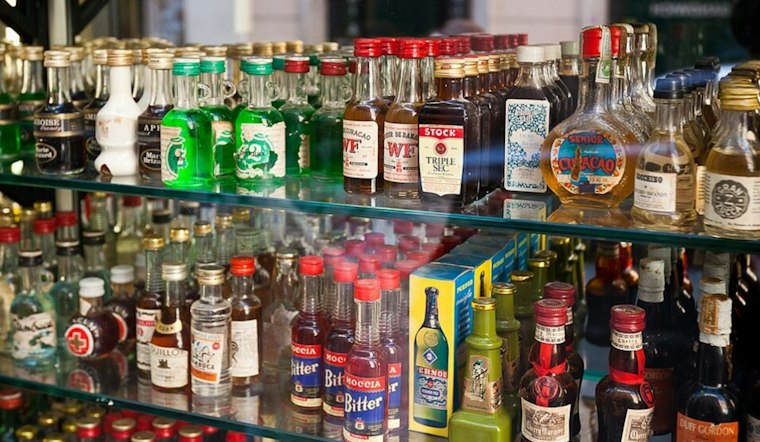
New Haven's City Services and Environmental Policy Committee voted 6-0 to send the full Board of Alders a resolution seeking state authority for municipalities to prohibit nip sales. The resolution would not ban the bottles, also called shooters or minis, in the Connecticut city that already sells more of them than any other municipality in the state.
The average is about 4.4 million nips a year. Even a yes from the full Board, which was set to discuss the resolution Monday night, Nov. 16, would still be a request to Hartford for a power the city does not have. The New Haven Independent reported the Nov. 12 committee vote and the limit that makes the resolution a request rather than a rule: "Under state law, cities and towns can't prohibit nip sales on their own."
Permission, Then A Local Choice
The Nov. 12 agenda stated the request in the language of authority, not prohibition: "RESOLUTION OF THE NEW HAVEN BOARD OF ALDERS TO ALLOW MUNICIPAL AUTHORITIES TO BAN THE SALE OF NIPS." Alders have said they want each municipality to make that decision, rather than a statewide ban.
They plan to ask the governor and state lawmakers to amend the Liquor Control Act of 1933, which they argue inadvertently keeps cities and towns from prohibiting nip sales. The committee vote is the local start of that ask. It does not rewrite the statute, and it does not hand a package store a new rule for Tuesday.
One draft of the permission is already on paper. Senate Bill 646, from the 2025 session, is described on the General Assembly's bill-status page as allowing municipalities to prohibit the sale of plastic nip liquor bottles through a vote of their legislative body. Plastic, and only after that local vote. The New Haven agenda title is not limited to plastic. A 2025 bill description is a proposal, not a power the Board can turn on.
Five Cents Back To The Town That Sold It
Since 2021, Connecticut has charged five cents on each nip and returned the money to the municipality where the bottle was sold, for litter cleanup. The customer does not redeem the nickel. The town that sold the bottle receives it.
Connecticut News Junkie reported that the program has brought in $25 million for municipalities since it began, with $2.56 million in the latest six-month distribution. More than 51 million nips were sold statewide in the six months that distribution covers.
New Haven's share was more than 2.36 million bottles and $118,115 back. That is fee money, not the retail price of the liquor. Five cents on more than 2.36 million sales sits in the same range as the check. Next to the Independent's annual average, about 4.4 million nips and more than any other Connecticut municipality, the city is the state's biggest market for a container the cleanup fee follows bottle by bottle.
A ban, if the legislature ever allowed one and a city imposed it, would cut the sales that fee counts. The resolution headed to the full Board does not make that cut. It asks for legal room to decide whether New Haven, or any other municipality, should.
Half A Liquor Store
WFSB reported that Kelvin Heredia, manager of Temple Wine & Liquor, opposes a ban because nip sales are half the store's business. He said Temple Wine & Liquor could not stay in business under a full ban.
Half is one manager's account of one counter. It is not New Haven's citywide sales mix. Business owners told The New Bedford Light that in Massachusetts the bottles make up 15% to 25% of liquor store sales. That is owners talking about their own registers, not an audit, and not this city's books. Heredia's share sits above the top of that range.
The alders have described a narrower target than the shutdown he described. They want each municipality to choose. A town that left the sales alone would not touch Temple Wine & Liquor. A city that used new authority for a full local ban would be writing the rule he says the store cannot survive. In New Haven, that choice would land on the state's highest-volume nip market.
Bans, Lawsuits, And 71 Pounds Of Bottles
Connecticut cities have to ask. A run of Massachusetts communities did not.
CBS Boston reported that Chelsea, Newton, Falmouth, Wareham and Mashpee had passed nip bans, and that Boston City Councilor Ricardo Arroyo filed a motion for a hearing on a proposal to ban them citywide. Nantucket took a related question to town meeting. In May 2022, residents approved a ban on single-use alcoholic beverages in containers of 100 milliliters or smaller, 496-73, MassLive reported. Legislators there had also proposed expanding the Bottle Bill to cover small liquor bottles, which would bring them under that deposit law rather than bar the sale.
New Bedford is where a local ban met a lawsuit before it met a customer. The Licensing Board voted unanimously in 2023 to ban nip sales after litter complaints. Liquor store owners sued in April 2024, halted the ban before it took effect, and argued the city had not followed proper procedures. The New Bedford Light reported that nips were still free to sell there even as neighboring Fairhaven had succeeded in banning them. Unanimous, and still not the rule.
Fairhaven's ban did not empty the bags. Over five days on Marsh Island, volunteers picked up 71 pounds of nip bottles, nearly 168 pounds of empty plastic water bottles, and 70 pounds of other plastic beverage bottles. The minis were a separate count. They were not the heaviest plastic in the pile.
Still A Request To Hartford
The full Board of Alders was set to discuss the resolution Monday night, Nov. 16. A yes in that room would not clear the bottles off a shelf the next morning. Alders have said the follow-through is a resolution to the governor and state lawmakers, asking them to amend the Liquor Control Act of 1933 so each municipality can decide.
What an amendment would cover is not settled by a committee title. SB 646's description limited a prohibition to plastic nip bottles and required a vote of the municipal legislative body. New Haven's agenda title asks for authority to ban the sale of nips, without that plastic limit. State permission first, a local decision after, and the question of which bottles in between.
None of that changes a purchase this week. The nickel still follows the bottle back to the town that sold it, and New Haven remains the Connecticut municipality moving the most of them, about 4.4 million a year. The committee has asked for an option. The nip is still on the shelf.



