

























































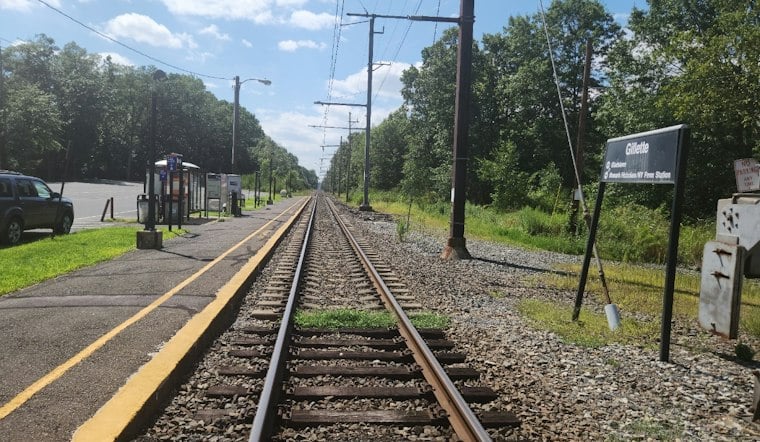
A New Jersey assemblywoman wants the state to explore a funding tool that could let rising property values near future train stations help pay for the trains themselves. Assemblywoman Katie Brennan has introduced bill A-5386, which would direct the state's Economic Development Authority to study how land value capture could generate supplemental funding for public transit projects across New Jersey.
According to Hudson County View, the bill is co-sponsored by Assemblyman Clinton Calabrese, who represents the 36th Legislative District. As introduced, the bill text filed with the New Jersey Legislature would require the EDA to consult with the Division of Taxation and public transit operators, including NJ Transit and PATH, while studying financing mechanisms and making recommendations for generating supplemental transit funding.
Brennan argues that development springing up near transit lines captures a windfall it never has to repay. She pointed to the wave of development that followed the Hudson-Bergen Light Rail and PATH trains in Jersey City, saying none of the value created by that growth has gone back into transit, and that new developments benefit from increased land value without contributing anything to the infrastructure that made them possible.
What Value Capture Could Pay For
Brennan said value capture could help fund an expansion of the Hudson-Bergen Light Rail into Bergen County, along with transit growth in Newark and Paterson and the Glassboro-Camden Line in South Jersey, per the same Hudson County View report. She also floated the tool as a way to pay for new infill stations on existing tracks, specifically citing proposed light rail stops at 18th Street in Jersey City and 15th Street in northern Hoboken, where new buildings are already going up nearby.
The bill defines value capture broadly. Per the legislation's text, it may include tax increment financing, special assessments, joint development between public and private entities, and development impact fees. The assemblywoman has said land value capture could unlock billions of dollars for new train lines statewide and allow New Jersey to expand transit independent of funding decisions in Trenton and Washington, the Hudson County View report states. Brennan also released an explainer video the same day walking through how the mechanism works in practice.
How the Financing Tools Would Work
Tax increment financing, one mechanism named in the bill, locks in property tax revenue near a future station at its current level and then directs any revenue growth above that baseline to the transit project as property values rise, according to The Transit Friendly Planning Newsletter. Special assessments work differently, requiring property owners closest to a future station to pay a modest surcharge toward construction. A national survey of 55 transit agencies found more than half, 32, had used joint development as a funding source, while 17 used special assessment districts and 13 used tax-increment financing, per a paper published by the American Planning Association.
The Federal Transit Administration has also noted that value capture revenue can be used beyond construction, potentially covering transit operations and maintenance costs as well.
Precedents From Chicago to Fairfax County
Brennan's bill points to cities outside New Jersey already using these tools. Chicago is using tax increment financing to fund its Red Line extension into the Far South Side, the Hudson County View report notes. In 2023, the city committed to contributing $959 million toward that project by funneling a portion of property tax revenue growth from designated areas into the extension over 35 years, according to WTTW. Even with a federal grant announcement that year, the project still faced a funding gap of about $400 million, the same report found.
In northern Virginia, Fairfax County used a special assessment to help extend the Washington Metro's Silver Line to Tysons and Dulles. Hudson County View describes that assessment as covering commercial, industrial and multifamily properties, while FFXnow describes the tax as applying to commercial and industrial real estate without mentioning multifamily properties. FFXnow reported the tax rate at 20 cents per $100 of assessed property value, capable of funding up to $330 million of the county's $527.3 million obligation for that phase of the project. Copenhagen has used a related approach, financing its metro system through revenue generated by developing publicly owned land, per The Transit Friendly Planning Newsletter.
Open Questions for Bergen County and South Jersey
The proposed Hudson-Bergen Light Rail extension into Bergen County has been studied before. NJ Transit received a nearly $600,000 federal grant in December 2022 to study transit-oriented development along the long-proposed 9-mile extension, according to NJ.com. Separately, Passaic and Essex counties have conducted a transit market study exploring improved service between Paterson and Newark, per Passaic County.
Further south, the Glassboro-Camden Line is a proposed 18-mile light rail route carrying an estimated $2 billion price tag, and how the project will ultimately come together remains an open question, according to The Philadelphia Inquirer. Nothing in the available record indicates that A-5386 has advanced beyond introduction, nor does it establish a funding commitment for any of the projects Brennan named.
What the Bill Would Require
If the EDA study moves forward as written, the agency would have to hold at least one public hearing, offering a chance for public discussion and comment, before publishing its findings, according to the bill text. For each financing mechanism it examines, the report would need to assess estimated revenues, economic effects, implementation options, who would benefit, and potential legal or logistical challenges.
The completed report would go to the Governor and the Legislature and be published online, the bill states. It also directs the Commissioner of Community Affairs to issue guidance or model ordinances to help municipalities put any of the financing tools into practice, giving towns a starting point if the state eventually decides land value capture is worth pursuing for New Jersey's next generation of rail projects.



