

























































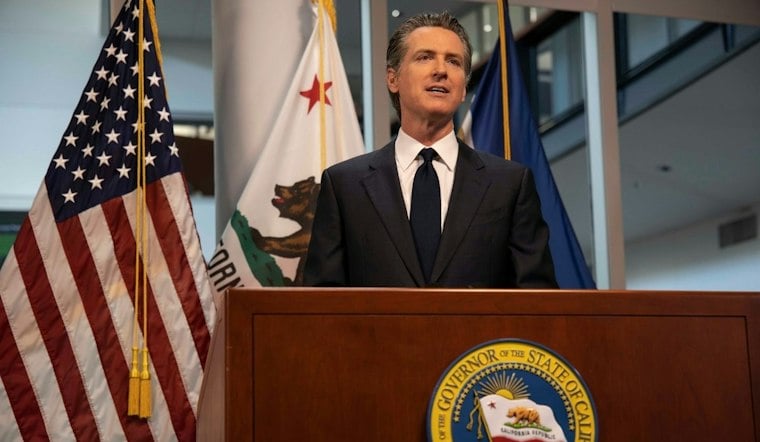
Gov. Gavin Newsom is preparing to seek commutations for all 548 people on California's death row, converting their sentences to life in prison without parole, according to a letter obtained by reporters. The move, which would need court sign-off for inmates with multiple felony convictions, comes as California has not executed anyone in 20 years and has kept executions on hold since Newsom issued a moratorium in 2019.
According to The Sacramento Bee, which first reported the letter, Newsom is preparing to spare the lives of more than 550 people serving death sentences in the state, and the New York Times has reported he is considering commutations for 548 prisoners specifically. Accounts of the action vary: the Associated Press has reported Newsom says he will commute all death sentences in the state, while the New York Times reported he was considering commutations for 548 prisoners specifically. Other reporting describes the move as a request still subject to review rather than a completed act.
Newsom's office said the proposed commutations would benefit 529 men and 19 women, per the The Marshall Project. In his letter, Newsom said he believes state-sanctioned killing is incompatible with California's values and undermines the foundations of its legal system, arguments he has made before as a longtime opponent of capital punishment.
A Legal Process With No Deadline
Not every sentence can be commuted by the governor's signature alone. Newsom may commute sentences for inmates with a single felony conviction on his own authority, but anyone with more than one felony conviction requires approval from the California Supreme Court, which needs four of its seven justices to sign off, according to the Governor of California's clemency guidelines. The court faces no deadline for ruling on commutation requests.
That open-ended timeline matters because Newsom leaves office on January 3, 2027, and any commutation requests not approved before then will lapse rather than carry over to his successor, according to anti-death-penalty advocate Natasha Minsker, as reported by the Sacramento Bee. Minsker said the blanket request would be the largest clemency act of its kind, noting that California holds one-quarter of all death sentences in the United States and has the largest death row in the Western Hemisphere.
Notorious Names on the List
The Bee reported that the commutation request includes some of California's most notorious prisoners, among them Charles Ng, Richard Allen Davis and Cary Stayner. Ng, extradited from Canada in 1991, was sentenced to death in 1999 after he and Leonard Lake tortured and killed at least a dozen people at a Calaveras County cabin in the 1980s; Lake died by suicide after his arrest. Stayner killed four women in Yosemite in 1999, and the California Supreme Court upheld his conviction and death sentence in July.
Davis received the death penalty in 1996 for kidnapping and killing 12-year-old Polly Klaas in 1993. Her father, Marc Klaas, has criticized Newsom before over the execution moratorium and the 2021 recall effort, and told Fox News that Newsom sided with the most heinous individuals in society, according to the seed reporting. The California District Attorneys Association opposed the blanket commutation in October.
Disparities and Costs Behind the Push
Black people make up almost a third of California's death row prisoners despite comprising just 5% of the state's population, the Bee reported. The Los Angeles Times has reported that the state spends more than $200 million a year on automatic death-penalty appeals and habeas corpus petitions, citing a 2025 report, and the Los Angeles Times separately noted the state has not executed anyone since 2006.
San Quentin's death row chambers have already been dismantled by the California Department of Corrections and Rehabilitation, with the facility renovated into a rehabilitation center and prisoners formerly held there transferred to other state prisons. Governor-elect Xavier Becerra has said he would maintain the execution moratorium regardless of how the commutation request is resolved.
National Context and Religious Voices
If approved, the Marshall Project's analysis found the move would be the largest mass commutation of death sentences in U.S. history, dwarfing Illinois Gov. George Ryan's 2003 commutation of 167 death sentences and President Joe Biden's 2024 decision to commute the sentences of 37 of 40 federal death row inmates, according to the AP. Only about 440 people on death row nationwide have received commutations since 1972, the Marshall Project noted, and the outlet's analysis found the U.S. death-row population could drop by nearly a third if California's request is approved.
Rev. Dr. Jeff Hood, who wrote to Newsom in October asking him to consider sparing death row inmates, said the commutations would represent moral leadership. Hood, who has witnessed 14 executions, pointed to Tennessee's recent pause on executions after Christa Pike survived two rounds of a botched lethal injection; Pike was convicted of torturing and killing a classmate in 1995. A Pew Research Center poll conducted in August found about two-thirds of voters nationally still favor the death penalty for people convicted of murder, and the Death Penalty Information Center’s 2026 execution list reports 33 executions across the country this year.
California voters have twice rejected efforts to repeal the death penalty outright, and the Chronicle noted that abolishing capital punishment in the state can only happen through a public referendum — something a governor's commutation cannot accomplish on its own. Newsom has discussed his opposition to the death penalty with Pope Francis I in 2024 and signed legislation in 2020 easing challenges to convictions based on racial bias in sentencing, part of a broader record that includes opposing 2024's Proposition 36, which imposed harsher penalties for petty crime, and resisting calls to fund it since its passage.




