

























































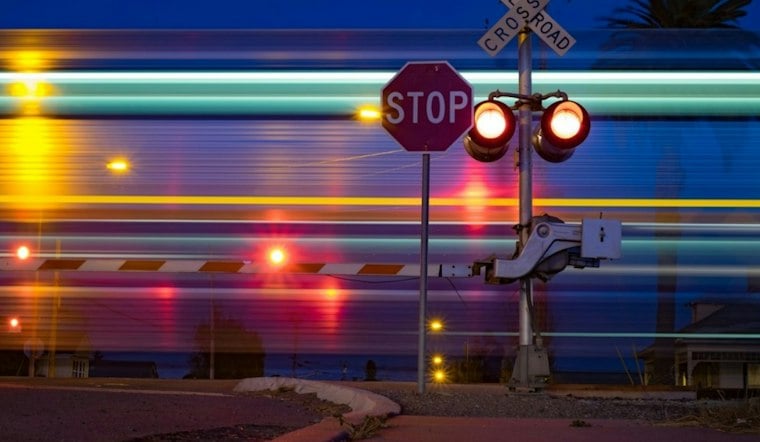
A westbound Norfolk Southern train crashed into an occupied vehicle on Southport Road near E Croft Circle in Spartanburg County around 12:25 p.m. Saturday. No injuries were reported among the train crew, but the condition of the vehicle's driver remained unknown at the time of the initial report.
According to WSPA 7News, the station reached out to the South Carolina Highway Patrol for more information following the crash, though further details on how the collision happened have not yet been released. The outlet's report did not specify what led the vehicle into the train's path or whether any crossing warning devices were involved.
The crash adds to a string of recent collisions between trains and vehicles in Spartanburg County. In one earlier incident, a woman driving a Hyundai crossed Southport Road near Whitestone Glendale Road and was struck by a passing train around 5:40 a.m. on a Thursday, the station's report notes. The driver, identified as Courtney Smith of Spartanburg, was taken to Spartanburg Medical Center with non-life-threatening injuries, per the same account.
A Pattern of Close Calls on Local Tracks
In another Spartanburg County case, from August 2024, a vehicle got stuck on the tracks at West Cleveland Street and Hayne Street after long gate arms trapped it in place, unable to continue driving. The vehicle's owner managed to escape before a freight train struck the car at 5:53 p.m. that Thursday evening, and nobody aboard the train was reported injured, the station's report states.
These recurring incidents come as South Carolina ranks among the top 10 states nationally for train and railroad crashes and crossing deaths, according to the Federal Railroad Administration, as reported by ABC News 4. Federal statistics cited in that report showed seven people killed while crossing tracks and 62 crashes recorded in a single recent year.
Why Trains Can't Simply Stop in Time
A South Carolina Department of Public Safety sergeant explained to ABC News 4 that a train traveling around 55 mph can take roughly a mile to come to a stop, and that trains themselves can weigh millions of pounds. That physical reality helps explain why even a train crew with no injuries can still be involved in a serious collision with a much smaller vehicle.
Federal transportation officials maintain a highway-rail grade-crossing database that tracks incidents, fatalities and injuries nationwide, allowing the data to be filtered by state, county, city, railroad or type of warning device. No official incident report or law-enforcement account confirming further details of Saturday's Spartanburg County crash had been made public as of this writing.



