

























































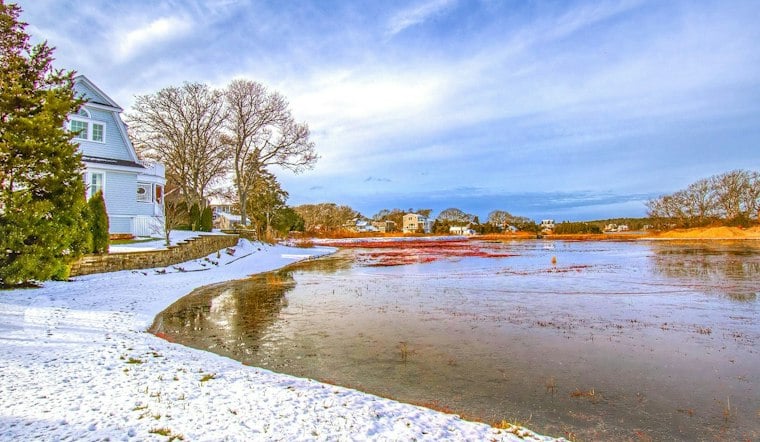
A 40-acre spread of land in Norwell that once grew cranberries is now being developed for a very different crop: a subdivision planned for 26 custom-built houses starting at $2.295 million. Two homes at Cranberry Crossing are already finished, two more are expected to wrap up by the end of the year, one has sold, and another is under agreement, with construction continuing on land that still sits beside an active cranberry farm.
The project is the work of Highland Estates Old Oaken Bucket LLC, a developer that has built three other South Shore subdivisions, according to Boston.com. Each of the eventual 26 houses will sit on its own one-acre lot, measure roughly 6,000 square feet, and come with four or five bedrooms and a three-car garage, the outlet reports. Home styles range from classic colonials to modern farmhouses, with some including walk-out basements with full bathrooms, en-suite bathrooms, formal dining rooms, and high-end appliances. Buyers who reserve a lot early can weigh in on paint colors, upgrades, and countertops before their house is finished.
Built Around Two Cul-de-Sacs and a Working Bog
Cranberry Crossing is arranged around two cul-de-sacs and oriented toward the adjacent Cross Street Cranberry Bogs, with homes designed to have views of the bogs themselves. Project manager Andrew Nader said the home designs pull from popular styles used in previous Scituate, Norwell, and Cohasset projects, refined specifically for this development, per the same account. The subdivision is meant to feel like the kind of neighborhood where kids can still ride bikes in the street, even with a working farm next door.
Cross Street itself is shared by the new residential development and Webster Cranberry, LLC, the farm operation still growing berries on the surrounding acreage. The farm sells its cranberries to local markets as well as larger brands including Ocean Spray, a detail attributed to Sen. Patrick O’Connor in the Boston.com report. That overlap between new rooftops and an operating farm is central to how the project was designed and permitted.
Separating New Lots From Old Bogs
To make way for houses while keeping the farm intact, the developer drew new property lines to legally separate the bogs from the house lots and worked with Norwell's Conservation Commission to meet wetlands and conservation requirements. Each created lot meets the commission's requirements, and the developer initially agreed to build just four houses to avoid negative impacts on wetlands and conservation land. Every house lot also has a new septic system so that nothing drains into the bogs or adjoining wetlands, according to Boston.com.
The development also removed invasive species from the reservoirs and bogs on the property. The main bogs are fed by natural springs, while the former back bogs were flooded annually at considerable cost, per sales associate Jessica Flynn. The Cross Street Cranberry Bogs include two reservoirs that hold water between harvests — engineering that dates back to a growing method still used across the region today, where ripe berries are flooded because they float and are easier to harvest.
A Front-Row Seat to Harvest Season
The cranberry beds themselves were originally kettle holes carved by retreating glaciers, later layered with sand, peat, gravel, and clay to support cultivation. Cranberry cultivation in Massachusetts began commercially on Cape Cod in the 1800s, and the state still has thousands of acres of cranberry bogs and roughly 375 growers today. Flynn said future residents will get an unusual bonus each year: “every fall, people will have a front-row view of the cranberry harvest,” she said, with the season typically starting in September.
The Cross Street bogs are also described as a historic site that doubles as a community resource, and Boston.com reports there is an easement allowing public use of the bog space, where visitors walk dogs, skate in winter, watch wildlife, and take in the seasonal cranberry colors. Project manager Andrew Nader said future homeowners will face no limitations or restrictions.
Living Next to a Working Farm
Not everything about bog-adjacent living is scenic. Karen Cahill, deputy executive director of Massachusetts Cranberries, said cranberry transports can make the area noisy later in the fall. “It can be noisy, but it’s part of living in an agricultural community,” she said. Cahill believes residential and agricultural uses can coexist on Cross Street, arguing that existing regulations will protect production even as new neighbors move in, and she advised anyone with questions to contact Massachusetts Cranberries or speak directly with the farmer.
The farm itself got a boost in 2025, receiving a $100,000 Massachusetts Cranberry Bog Renovation Grant from the Massachusetts Department of Agricultural Resources to support renovation of four acres of bog. The state's cranberry industry remains a significant piece of its agricultural economy: growers harvested 2.26 million barrels in 2022, worth $82.16 million, a 31 percent jump over 2021 production, according to the Cape Cod Times. Massachusetts ranks second nationally in cranberry production behind Wisconsin, and nearly 95 percent of the crop ends up in processed foods, the paper reports.




