

























































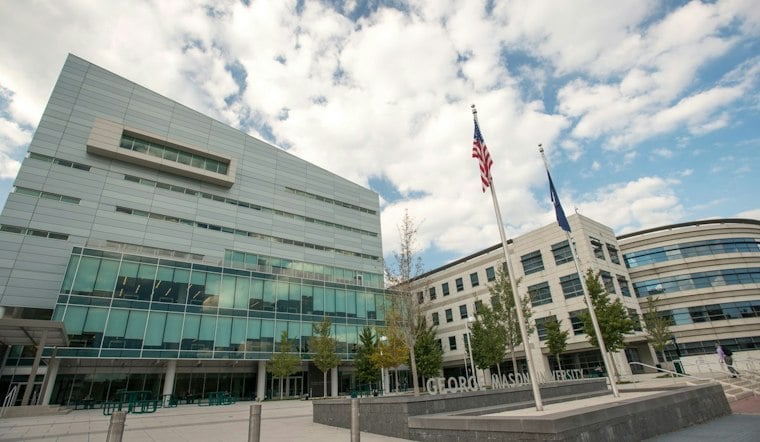
Dwight Schar, founder of homebuilder NVR Inc., has committed $30 million to George Mason University for two policy institutes scheduled to launch in fall 2027. The gift will also rename the plaza at Mason Square in Arlington the Dwight Schar Plaza at Mason Square, connecting the university’s planned research expansion with a public space used for campus and community events.
A $30 Million Expansion of an Already-Named School
George Mason says the gift will support the Schar School of Policy and Government’s work on national security, intelligence and economic statecraft, according to George Mason University. The plaza hosts programming for the university and the surrounding Arlington community. Schar previously gave the university $10 million in 2016, when the gift went to what was then called the School of Policy, Government, and International Affairs, as reported by InsideNoVa.
University President Gregory Washington described the investment in students and faculty as a contribution to the region and Virginia. Schar said he hopes the institutes will help prepare future leaders to address difficult national questions, the university’s announcement says. Trishana E. Bowden, the university’s vice president for advancement and alumni relations and president of the George Mason University Foundation, said philanthropy can help universities take on pressing challenges.
What the Security Institute Will Study
The Institute for Security, Intelligence, and Defense will develop research around issues including Indo-Pacific security, nuclear, biological and chemical threats, emerging technologies, and the national security role of major technology companies, according to the university’s announcement. The institute is also expected to broaden public programming at the Michael V. Hayden Center for Intelligence, Policy, and International Security. The center was founded by Michael V. Hayden, a former director of both the CIA and NSA, according to George Mason University Schar School of Policy and Government. Hayden said open discussion can help people understand national security decisions and public service.
Economic Statecraft Gets Its Own Institute
The Institute for Economic Statecraft will study how governments use economic measures to pursue foreign policy and national security goals, the university says. Its areas of focus are expected to include export controls, financial sanctions, tariffs and restrictions on critical technologies, as well as the trade-offs those measures create for businesses, markets and international relationships. The gift is also expected to support faculty recruitment, a research initiative on illicit financial flows, an annual summit and new research on economic statecraft.
Existing programs and regional context
The Schar School already offers an International Security Program to prepare professionals to assess and manage traditional and emerging threats. Its existing Hayden Center presents 10–15 public events each year, most drawing more than 500 people, according to the Schar School of Policy and Government; the school describes the International Security Program on its master’s programs page. The planned institutes would add dedicated research on security and economic statecraft, with the security institute also expected to expand the Hayden Center’s public programming.
Regional industry data offer a broader measure of the area’s defense economy: the Fairfax County Economic Development Authority reports $17.3 billion in FY23 Department of Defense contract awards in its defense and aerospace industry profile. That county-level figure is context for regional activity, not a measure of George Mason’s partnerships or the gift’s impact.
George Mason says Schar’s earlier philanthropy helped establish the Washington Post-Schar School polls, recruit academics and policy experts, and broaden the school’s research and programs. The university says it will share further details on the institutes and other priorities as planning continues. The $30 million commitment is part of Mason Now: Power the Possible, the university’s $1 billion comprehensive fundraising campaign.




