

























































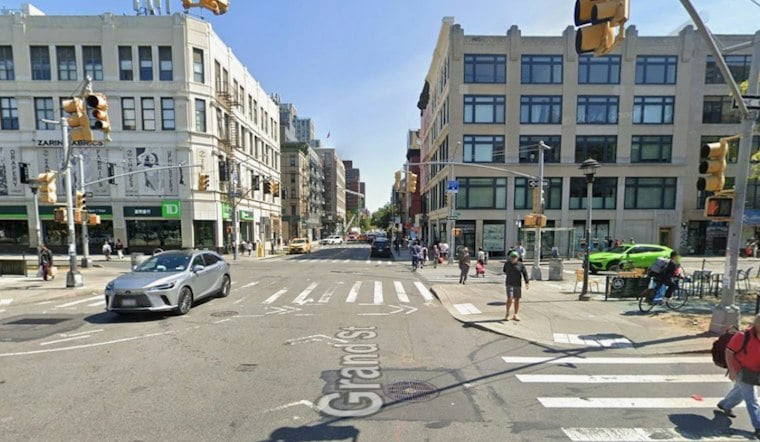
New York City's Department of Transportation is studying whether to turn two of Williamsburg's busiest corridors into a one-way pair, a move that would send Grand Street traffic eastbound and Metropolitan Avenue traffic westbound between Union Avenue and the Metropolitan Avenue Bridge. Both streets currently run two-way with a single travel lane in each direction, and the agency says it has not proposed a formal redesign, only a feasibility study responding to community concerns about speeding, blocked bike lanes, and crawling buses.
A Study, Not Yet a Plan
According to the NYC DOT project page, the agency is examining the conversion specifically to address community concerns about pedestrian safety, parking and loading headaches, bike lanes blocked by vehicles, and sluggish bus speeds along Grand Street. DOT says potential upsides include fewer turning conflicts, more room for future street improvements, and possibly higher vehicle throughput with safer turns managed through signal timing. But the agency also lists real trade-offs on the table: bus service reroutes, relocated bus stops, and changes to curb rules that could hit parking and loading for nearby businesses.
As Streetsblog New York City reports, DOT has completed a preliminary analysis and gathered roughly 1,500 survey responses plus another 200 submissions through a feedback map before the survey closed on September 30. The agency is still analyzing that outreach and, per the same report, has not proposed any formal plan. DOT spokesperson Will Livingston said the agency is developing a redesign intended to improve safety and protect New Yorkers while providing more space for all transportation modes, and that DOT expects to share outreach findings in the coming months.
The Numbers Driving the Study
The stakes are grounded in recent crash data. In 2025, the Grand Street corridor DOT is studying saw 103 reported crashes, injuring 26 cyclists and eight pedestrians, Streetsblog New York City reported. The corresponding stretch of Metropolitan Avenue logged 50 reported crashes over the same year, injuring two cyclists and five pedestrians. Longer-term figures tell a messier story: North Brooklyn News reported that Grand Street, Metropolitan Avenue, and Morgan Avenue combined for 54 serious injuries from 2016 to 2020, while Gothamist put the same total of 54 serious injuries, plus 14 fatalities, across the same three roadways from 2016 through 2023 — two different reporting windows for a similar tally, attributed here to each outlet separately.
The idea of flipping the streets to one-way traffic isn't new. It was first formally discussed at a Street Improvements Workshop back in 2023, according to the same Streetsblog account, where DOT also floated removing a parking lane and reducing travel lanes as alternative approaches, per North Brooklyn News.
Advocates Worry About Speed, Businesses Want Truck Access
Street safety advocates are wary that a straightforward conversion could create two faster roadways instead of two safer ones. Brent Bovenzi, who has lived on Grand Street for four years, said a one-way plan would most likely leave two travel lanes on each street and encourage more speeding, especially at night. He's also concerned DOT will prioritize vehicle movement in its planning, telling the outlet that DOT outreach teams discussed traffic congestion improvements more than other topics. Bovenzi further warned that a one-way bike lane could encourage wrong-way cycling by delivery workers and commuters, noting that food-delivery workers ride up and down Grand Street at all hours. Advocates say that without side-street traffic calming, parking reform, a road diet, and two-way bike infrastructure, a conversion alone won't fix underlying safety problems.
On the other side, Evergreen Inc., which represents industrial and manufacturing businesses in the area, wants two-lane traffic preserved on both streets. Leah Archibald said businesses on the streets and in the wider area rely on trucks, and both Grand Street and Metropolitan Avenue are designated local truck routes that allow trucks to reach inter-borough destinations. The Grand Street BID, which represents storefront businesses between Union and Bushwick avenues, strikes a more cautious middle ground: spokesperson Francesca Bruce said the BID is cautiously optimistic about the proposal, and the group supports a one-way conversion in theory, pending a feasible alternative that accounts for all users.
Bike Lanes, Bus Riders, and a Four-Block Relocation
Grand Street's current infrastructure illustrates why cyclists and bus riders are paying close attention. The eastbound bike lane has concrete barriers with breaks that let vehicles double-park and trap cyclists, while the westbound lane is a narrow, parking-protected strip frequently blocked by construction, forcing cyclists to leave the lane between Union and Bushwick avenues. East of Bushwick, the bike lane largely disappears where industrial businesses treat it as an extension of their garages. Riders on the Q59 and Q54 bus routes, meanwhile, crawl through traffic on Grand Street, one of the slow-bus complaints DOT cites as motivating the study.
One wrinkle in the conversion proposal: a new protected bike lane would move to Metropolitan Avenue, roughly four blocks away from where cyclists currently ride on Grand Street. Grand Street itself is lined with bars, coffee shops, grocery stores, clothing stores, and gyms, making it a heavily trafficked commercial strip where any lane reshuffling would ripple widely. DOT has classified both Grand Street and Metropolitan Avenue as Vision Zero priority corridors, underscoring the safety stakes the agency says it's weighing as it reviews the outreach data.
What Research Says About One-Way Streets
The underlying debate over one-way conversions isn't unique to Williamsburg. A 2017 study published in Local Environment, drawing on a citywide, five-year analysis of collisions in a mid-sized city, found a higher incidence of collisions and injuries on multi-lane streets than on comparable two-way streets for motorists, cyclists, and pedestrians alike. Another 2017 study in Transportmetrica B: Transport Dynamics found a trade-off baked into street-network design: two-way networks offer the shortest travel distances but are hampered by intersection capacity limits, while one-way networks allow longer trips but handle much higher volume at intersections.
A 2019 study by Penn State and ETH Zurich researchers, cited by Streetsblog, adds further nuance, finding that two-way streets give drivers route redundancy when a path is blocked, and that two-way streets with prohibited left turns can actually be more efficient. One-way networks, that research found, are the best option only in a few scenarios, largely because they force vehicles to travel longer distances on average.
Comparable fights over Brooklyn street redesigns have played out before. Gothamist has reported that DOT scaled back its original plans for the McGuinness Boulevard redesign after influential neighborhood businesses launched an aggressive campaign against the changes, a precedent that looms over how DOT and local stakeholders might navigate the Grand Street and Metropolitan Avenue study in the months ahead.




