

























































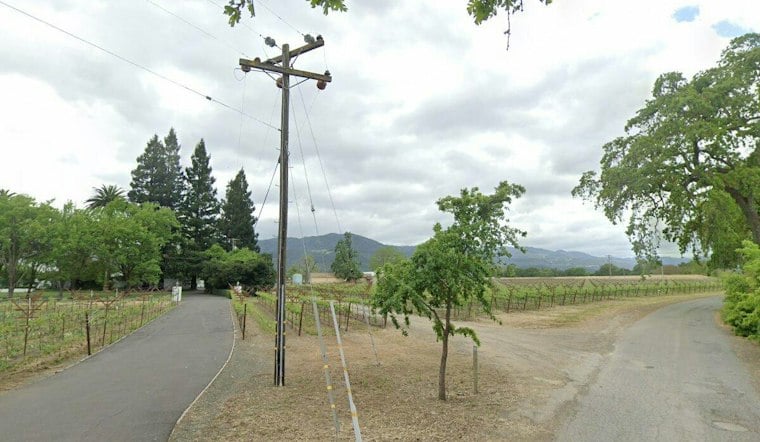
The Napa County Planning Commission voted 4-0 on Wednesday to approve the Castellucci Estate Winery, clearing the way for a new wine production facility at 7900 Money Road in the Oakville area that could draw more than 11,000 visitors a year. The approval came despite objections from longtime Money Road residents who say the winery's proposed hours and traffic will upend the character of their rural, dead-end road.
The winery, proposed by the Antonio and Rita Castellucci Family Trust, will be allowed to produce up to 20,000 gallons of wine annually, according to The Napa Valley Register. The approved operating schedule runs 10 a.m. to 6 p.m., seven days a week — the same hours that drew the sharpest pushback from neighbors in the lead-up to the vote.
The county’s permit file sets daily and weekly visitor caps. The county’s project description also lists 10 on-site parking spaces.
Neighbors Say Road Can't Handle the Traffic
Twenty-two Money Road residents submitted a letter outlining their concerns, which centered on traffic from winery visitors, employees, vendors and delivery vehicles, per the Register's reporting. Sharon Gmelch, one of the residents who spoke up, described Money Road as an irregularly paved, unstriped, dead-end county road where people walk and ride bicycles — not the kind of route built for steady winery traffic.
Gmelch said at least a dozen families have lived on the road for 20, 30, 40 years or longer, and that residents are simply trying to protect its residential character. She argued the seven-day schedule would leave no quiet day on the road, and said traffic and related safety concerns remained even after commissioners heard the objections. Neighbors had instead proposed limiting visitor operations to five days a week with a 4 p.m. closing time, an alternative that was not adopted.
The debate also centered on whether Money Road could accommodate winery-related traffic.
Not every concern went unaddressed. Megan Dameron said Castellucci worked through many neighbor issues ahead of the hearing, including signage, amplified music and lighting, according to the same Register account.
Water Audit California Flags Process, Not the Winery Itself
Water Audit California, a nonprofit that has repeatedly scrutinized the county's winery permitting process, also weighed in. William McKinnon wrote a letter alleging flaws in the proposed groundwater use and potential effects on Conn Creek and a nearby stream. But McKinnon clarified that the group did not oppose a winery being built on the parcel — only approval moving forward before the county completed required analysis, the Register reported.
The dispute centered on groundwater use and possible effects on Conn Creek and a nearby stream.
The county’s environmental review treated the project as a mitigated negative declaration under the California Environmental Quality Act, concluding that impacts would not be potentially significant after mitigation.
Rob Anglin, speaking on the applicant's behalf, said Water Audit California was really seeking changes to county policy rather than asking Castellucci to meet standards that already exist. The exchange reflects a now-familiar pattern: the organization has continued its practice of critiquing how Napa County handles winery applications more broadly, rather than singling out individual projects.
A Familiar Flashpoint for Napa Water Fights
Water-use disputes have become a recurring theme in Napa County winery oversight. Castello di Amorosa became the subject of a lengthy compliance fight after county officials discovered its actual groundwater use far exceeded earlier estimates. According to pressdemocrat.com, Castello di Amorosa's total groundwater use reached nearly 39 acre-feet in 2024 — more than twice the roughly 16 acre-feet it had estimated and close to the 40.5-acre-foot recharge limit for its two wells.
That discrepancy led Napa County to halt a planned deal that would have brought the winery's unpermitted activity into compliance, pressdemocrat.com reported. Napa County Board Chair Anne Cottrell said the episode showed the need for a full audit of water use across the entire property. A later, updated compliance proposal floated well metering and a 27.34-acre-foot annual cap on groundwater use from the two wells. Castello di Amorosa and Water Audit California have also been associated with a Nash Creek monitoring study.
A Family Winery Decades in the Making
For the Castellucci family, the Oakville approval caps decades of growing roots in Napa Valley. The family began growing grapes in the Carneros area in 1989 before expanding to other parts of the valley. Maria Castellucci Moore, daughter of Antonio and Rita Castellucci, said the family views itself as stewards of property reminiscent of Italy.
Antonio Castellucci is also pursuing a separate project in downtown St. Helena, seeking to build a luxury hotel on the former Bank of America site, according to the Register's reporting. Whether the newly approved Oakville winery eases into its 10 a.m. to 6 p.m. daily schedule without the traffic problems Money Road residents fear remains to be seen.





