

























































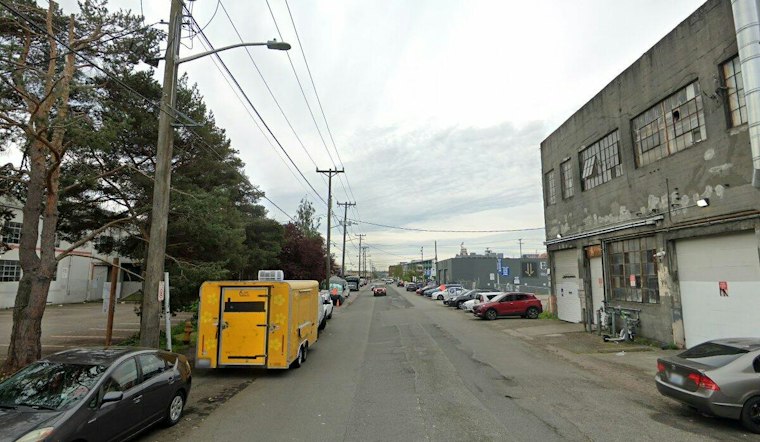
Occidental Avenue South was lined up as Seattle's first major test of a people-first stadium street, with a published goal of finishing near-term improvements by spring 2026, ahead of the World Cup. It is now November, and the promenade remains a plan, not a finished street.
The Seattle Parks Foundation says that spring deadline was the project team's goal. The Pioneer Square Preservation District agenda for its November 4 meeting included an Occidental Promenade presentation, plan set, and staff report. The Urbanist had already identified the promenade as the first major project moving under the People Streets and Public Spaces program.
A Working Street, Not a Blank Canvas
A quick-build treatment was pitched as a way to test a longer corridor vision without pretending the street only exists for pedestrians. Jessa Timmer has described Occidental as a working mix of stadium freight, foot traffic, and restaurant and business operations. She has also described concert freight that can run to 20 to 25 semi-trailers, the Taylor Swift show included.
The promenade paths are expected to get their heaviest use on event days. The Seattle Parks Foundation, which manages the project and coordinates with the Pioneer Square Alliance, describes the work as street amenities and flexibility for different users and venues. The Seattle Department of Transportation is handling design.
Vendor management has been in the conversation longer than the latest plan set. Surveys collected by MIG from a stakeholder group, and reported by The Urbanist, put vendor management among the top priorities for Occidental. The promenade project is aimed at improving how street vending is managed along the avenue. That is a narrower job than redesigning the whole district, and a harder one on a street that also has to clear trucks.
Six Million Dollars, and a Larger Price Tag
The foundation says the promenade is funded through the 2024 Seattle Transportation Levy. The Urbanist reported that the project received a $6 million earmark in the eight-year levy after lobbying from SoDo figures, including Seahawks chief operating officer David Young, who supported the proposal.
Six million dollars is not the cost of the street people have been drawing for a decade. An internal SDOT memo, cited by The Urbanist, put a permanent festival street on Occidental at about $30 million, using recent public-realm projects as the comparison, including work along Pike Street and between the waterfront and Pioneer Square. The quick-build is the version that fit the levy line. The permanent version is the one that explains why the city is testing paint, planters, and barricades before it commits to a rebuilt street.
The foundation ties the current project to the city's 2015 vision for Occidental Avenue South as a year-round promenade. This round is traveling through the transportation levy.
What the Early Concepts Actually Tested
Concepts previously taken to the Pioneer Square Preservation Board were tactical in the literal sense. The Urbanist described ideas for activating specific nodes along Occidental with movable tree planters, chairs, tables, and barricades. An earlier SDOT proposal kept parking and tried a west-side walkway between the parked cars and the roadway.
That is a modest rearrangement of a street that still has to function on non-event Tuesdays. The walkway test did not clear the curb lane. It asked whether pedestrians could be given a defined edge without taking the parking that businesses and event operations already use.
The project uses surface treatment and edge delineation to calm traffic and make more room for uses that are not driving. Temporary treatments can test options before the city commits to a longer-term design. The treatments are described as temporary and reversible. Chicanes in the plans are intended to keep drivers from building speed down a straight run. The near-term phase is meant to work as a pilot for pedestrian space in ordinary street operations, not only on game days.
A Certificate Still Stands Between Plan and Construction
SDOT needs a certificate of approval from the Pioneer Square Preservation Board before construction. Final near-term plans were presented to the board for approval. The promenade was on the board's November 4 agenda.
Planning launched in early 2025. From that start to implementation is expected to take more than two years, which puts the construction sequence well past the spring 2026 date the foundation published as its goal. Seattle City Light plans work along Occidental in 2027, and the promenade work is slated to follow that utility work. A World Cup finish and a post-utility build are different projects wearing the same name.
The preservation step is not a formality on this street. Pioneer Square's board reviews changes inside a historic district, and a reversible traffic treatment still has to clear that gate before crews can build it. Until a certificate is in hand, the nodes, planters, and walkway test remain a proposal with a levy earmark behind it.
The Rest of the People Streets Queue
Occidental is the prominent levy project, not the only one. SDOT is advancing pedestrian plazas in Upper Queen Anne, Admiral, and Delridge, growing out of neighborhood support for pedestrian-focused space. The department also has active surveys on SW Lander Street, 18th Avenue SW, and W Crockett Street.
Westside Seattle reported that SDOT invited neighbors to help shape new pedestrian spaces in Delridge and Admiral.
That 2027 window is the practical comparison. Occidental had the earlier political push, the named levy project, and the spring 2026 goal. The other streets have a published design-and-build sequence that still runs into next year. On Occidental, the next documented gate is the preservation certificate, with board approval still expected before this year ends and construction sequenced after City Light's 2027 work.





