

























































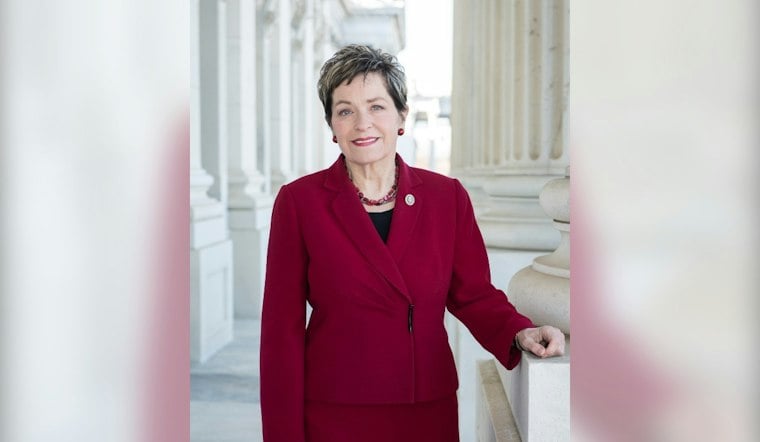
Outside groups spent more money trying to sway Ohio voters this year than almost anyone in the state's political history, and the fallout has already reached Washington. Toledo Democrat Marcy Kaptur has teamed up with a California colleague to introduce a bill that would force the super PACs behind those ads to start naming names.
Kaptur, who represents Ohio's 9th Congressional District, joined California Democrat Kevin Mullin to introduce the Sunlight on SuperPACs Act, according to cleveland.com. The bill would require certain super PAC-funded ads to identify the group's three largest donors. Kaptur wants voters to know who is actually funding the political spending flooding their airwaves and mailboxes, and she said disclosures in campaign ads give voters information they deserve, adding that transparency is a first step toward returning control of democracy to the American people.
The scale of the spending that prompted the bill is staggering by any measure. Outside groups spent $424.5 million in Ohio's U.S. Senate race alone, according to OpenSecrets figures cited by cleveland.com — nearly five times the $88.1 million the candidates themselves raised. A separate accounting from the Ohio Capital Journal, citing AdImpact data, put outside-group spending in that race above $325 million, with AdImpact estimating the total cost of the Senate race — including candidate and outside spending combined — at $422.6 million. The two outlets' figures differ, and neither account reconciles the gap.
Millions Aimed at Brown, Husted
The same Ohio Capital Journal report found outside groups had reported spending $113.5 million attacking Democratic Senate candidate Sherrod Brown, versus $58.4 million supporting Republican Jon Husted. The spending wasn't confined to the Senate race. Kaptur's own 9th District saw $20.8 million in outside spending, the most of any Ohio House race, while candidates there raised just $9.7 million, per the same cleveland.com account.
Ohio's 7th District saw $20.4 million in outside spending against $7.4 million raised by candidates, the report notes. The 10th District had the highest ratio of outside spending to candidate fundraising among Ohio races tracked by OpenSecrets, with $12.3 million spent against only $2.5 million raised. In the 15th District, outside spending totaled $11.6 million compared with $6.2 million raised by candidates.
A National Spending Surge
Ohio's numbers are part of a broader national pattern. OpenSecrets projected that outside spending in the 2026 midterms would reach $3.9 billion, an 85 percent jump over the roughly $2 billion spent during the 2022 midterms. The organization estimated total spending across the 2026 midterm elections — covering candidates, parties and outside groups — would hit a record $11.9 billion, surpassing total spending on 2024's congressional elections.
Dark-money contributions to super PACs have also climbed, with OpenSecrets reporting the 2026 midterm total had already reached $1.47 billion, topping the $1.35 billion recorded in 2024. As of Oct. 30, the two largest outside-spending groups nationally were the Senate Leadership Fund at $489 million and MAGA Inc. at $353 million, and conservative groups had outspent liberal groups overall by $360 million — $2.03 billion to $1.67 billion.
AI Industry Ads Draw Scrutiny
A recent opinion piece by Jon Golinger, affiliated with Public Citizen, and Michael Beckel, affiliated with Issue One, argued that AI industry super PACs spent more than $69 million on ads this year while hiding behind generically named groups such as Defending Our Values, Think Big, American Mission and Jobs and Democracy, cleveland.com reported. The pair described the spending as legal and outrageous, and said voters need information to make informed decisions. Writing in The Hill, the authors characterized the practice of concealing sponsors behind generic group names as a bipartisan problem, not one favoring either party.
Not every group running Ohio ads has disclosed anything at all. In the 7th District race, a spokesperson for Affordable Ohio told cleveland.com the group was not required to file reports with the Federal Election Commission because its ads did not advocate for a candidate's election or defeat — a distinction that keeps such spending outside current disclosure rules even as it shapes the airwaves.
What the Bill Would Actually Require
The Sunlight on SuperPACs Act would cover ads that expressly advocate for or against a candidate, as well as electioneering communications. Covered ads would have to be paid for by a super PAC that spent at least $10,000 on independent expenditures in a calendar year, or gave at least that amount to other such committees. Those ads would have to identify the three people who gave the committee the most money in the 12 months before the ad’s disbursement, showing each donor’s name and contribution amount, with donors required to have given at least $5,000 to be named.
If one of a committee's top donors is itself a political committee, the bill would require disclosure of that committee's own top two funders instead. In the event of a tie for the final disclosure slot, the group paying for the ad would get to choose which donor to list. The requirements would apply to ads made on or after Jan. 1, 2027, according to cleveland.com's reporting, though the measure's path through Congress remains at an early stage.
Federal election rules already require certain notices on political ads. The Federal Election Commission says such notice is required on independent expenditures and electioneering communications not authorized by a candidate or a candidate's campaign — the category the new bill seeks to expand with donor-specific detail.
Modeled on State and Local Laws
Kaptur's office said the legislation was modeled on disclosure laws approved by voters in Alaska in 2020 and in San Francisco in 2019. The Supreme Court declined to review challenges to both laws in 2024, leaving them in place — a point Kaptur's office has pointed to as precedent for the federal proposal's legal durability.
Records show H.R. 10566, formally titled the Sunlight on SuperPACs Act of 2026, was introduced in the House on Sept. 24, 2026, according to GovInfo. A Congress.gov listing shows the bill was referred to the House Committee on House Administration that same day, with no further action reflected in that record. Original cosponsors include Reps. Sanford Bishop of Georgia, Ed Case and Jill Tokuda of Hawaii, Adelita Grijalva of Arizona, and Eleanor Holmes Norton of the District of Columbia. Kaptur's office, in a statement posted by the Office of Rep. Marcy Kaptur, described the measure as requiring Super PAC-funded federal election ads to disclose the names and dollar amounts contributed by their top three donors of $5,000 or more.





