

























































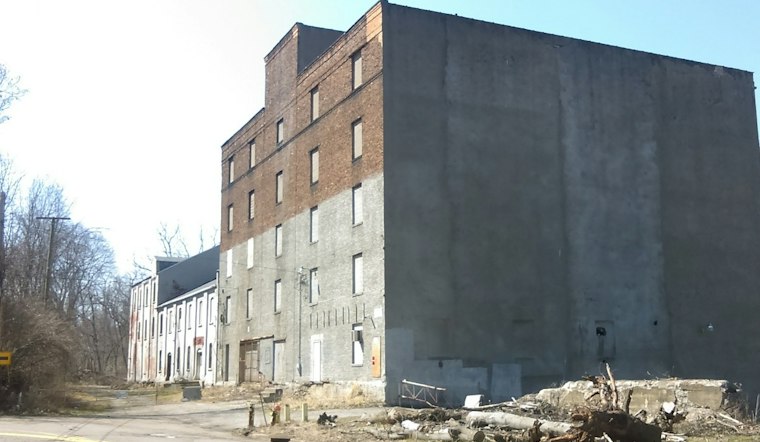
A 133-year-old soap factory near downtown Akron has a new life as Furnace Street Flats, a 53-apartment development carved out of the 1893 Akron Soap Company building and its attached 1919 warehouse. About a dozen units had already been rented as of this week, and the rest of the complex is expected to welcome tenants within several weeks.
The transformation, first reported by Signal Akron, sits in Akron's Cascade Valley neighborhood, less than a mile from downtown and about half a mile northeast of Luigi's. The project cost roughly $14 million and relied on historic tax credits to pencil out, according to the outlet's reporting. Oriana House, the nonprofit behind the renovation, acquired the former factory at 243 Furnace St. in 2022, marking the agency's first venture into market-rate housing.
From Soap Suds to Stand Mixers
The building once churned out roughly 1.1 million pounds of soap a week in July 1893, according to a Summit County Beacon report cited in the same reporting, with Akron Soap Company products reaching customers in Ohio, Michigan, Indiana, Pennsylvania and New York. Today the complex includes a five-story warehouse and a three-story soap factory, now stitched together into apartments that mix one- and two-bedroom layouts with open floor plans, separate bedrooms, and in-unit combined washer-dryers. Two accessible two-bedroom units sit on the soap factory side, and two apartments with outside-only access are intended for short-term rentals.
Bernie Rochford, Oriana House's executive assistant for special projects, said the project helps address a housing shortage in the area. The warehouse's ground floor now holds dozens of storage units, bike storage and a dog-washing station, and Rochford said a gym is also planned. Architectural details were preserved throughout the conversion, including exposed beams, vaulted ceilings in some units, red brick walls and arched windows, while the warehouse itself retains freight-elevator doors, concrete floors, ceilings and pillars, 12-pane windows and exposed brick.
A Penthouse and a Patchwork of Earlier Plans
Rents vary widely across the building: a 646-square-foot one-bedroom goes for $1,425 a month, a larger 710-square-foot one-bedroom rents for $1,600, and a 1,600-square-foot penthouse could fetch $3,500 a month. The unit count has shifted across several accounts of the project over the years. A 2024 Akron Beacon Journal report described plans for 54 market-rate apartments across the complex, while a 2025 Ohio Historic Preservation Tax Credit Program listing described 11 residential units within the Soap Company building itself, with additional apartments planned for the upper floors of the adjacent Federal Warehouse. The reasons behind the changing plans aren't detailed in available records, but the finished project now stands at 53 units.
That same Ohio tax-credit listing put the total project costs at $13,998,049 and total tax credits at $3,135,131 — figures Signal Akron had previously rounded to $14 million and $3.1 million. The listing also notes the Akron Soap Company Building was rehabbed once before, in 2016, for office use, in a separate $2.5 million renovation.
One Owner's Unfinished Vision
Before Oriana House took over, the building belonged to Keeven White, who lived there for three years and replaced its roof, windows and doors. White stopped pursuing his own redevelopment plans after the HVAC system failed, but he toured the finished apartments last month, seeing the project carried across the finish line by someone else.
Oriana House plans to direct rental income back into its own operations once the project's debt is paid off, with proceeds benefiting the agency's correctional services. The nonprofit already operates other residential buildings converted from former schools, according to Linda Weyandt, and Rochford said Oriana House has bought land in the area for decades. A coffeehouse called Brewed Awakening operates nearby, helping clients adjust to sober entertainment. Rochford said further development in the area is possible, and that Oriana House may assess the project's progress again in five years.
Part of a Bigger Downtown Push
Furnace Street Flats lands amid a broader apartment boom near downtown Akron. Suzie Graham Moore, the city's director of economic development, said downtown Akron has delivered or has under construction 1,069 housing units since 2018, with another 694 units announced. She said adding market-rate apartments like Furnace Street Flats complements the wave of downtown residential conversions already underway.
Demand appears to be there. Steve Millard, president and CEO of the Greater Akron Chamber, has said downtown apartment occupancy sits above 90 percent, and told the Beacon Journal's editorial board in a piece published earlier this year that the market could absorb 1,000 more units. Separately, Signal Akron has reported that three projects in or near downtown Akron were awarded more than $12 million in combined Ohio historic tax credits to support more than 140 housing units total.
Furnace Street itself has become something of a proving ground for adaptive reuse. A 2022 report from Cleveland.com described an earlier buyer, Green Harvest Capital, planning 50 to 52 apartments in the warehouse complex at 236–243 Furnace St. along with leased commercial space, before that iteration of the plan gave way to the Oriana House project. Just down the street, another former Akron soap factory at 234 Furnace St. was converted into offices for the WhiteSpace marketing and advertising firm, the Beacon Journal has reported. And a few blocks over, the 24-unit Cascade Lofts development, carved out of a restored former tire factory and built for about $3.5 million with roughly $1.5 million in state and federal tax credits, filled up and developed a waiting list within about a year of opening, according to the same report. Developers financing these conversions typically sell their federal and state historic tax credits to outside investors, who use them to reduce their own tax bills, the Beacon Journal has noted — a financing structure central to how projects like Furnace Street Flats get built at all.





