

























































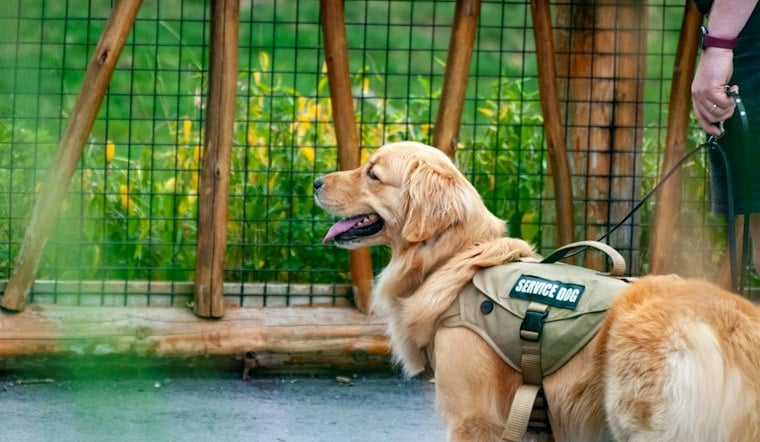
Tony Escue spent nearly a decade in the U.S. Army before PTSD ended his career in 2023, leaving the 32-year-old Orangevale resident struggling to walk into crowded rooms or even show up at his own job. Today he moves through those same spaces with Hugh, a nearly 4-year-old Labrador mix trained to climb onto him starting at his feet the moment a nightmare begins.
A Decade in Uniform, Then a Breaking Point
Escue joined the military in 2013 and served as a nurse during his time in the Army, according to the Sacramento Bee. He studied for a year at Sacramento State, where he met his wife, and in 2016 he lost his newborn son, Austin, who died at a military hospital in Texas. By 2023 he had served nearly 10 years, and that year he was diagnosed with PTSD and medically retired from the Army, the outlet reports. He described heightened anxiety that made it difficult to go out in public, navigate crowds, or function at work.
That same year, Escue applied to Canine Companions, the Santa Rosa-based nonprofit that connects veterans and others with service dogs trained for their specific needs and disabilities, per the Sacramento Bee's reporting. He waited more than 18 months before he was finally matched with Hugh.
Training in Santa Rosa, on Land Donated by the Schulz Family
Before Escue ever met him, Hugh was raised from about 8 weeks old by volunteer Leslie McAllister in Portland, Oregon, for roughly 16 months, learning basic cues and socialization with help from another volunteer. At 18 months old, Hugh began advanced training at Canine Companions, the Sacramento Bee notes, eventually learning to turn on lights and even ride in an airplane carry-on space beneath a seat.
Escue then completed training with Hugh at a Canine Companions facility in Santa Rosa over about two weeks, staying in dorms on property donated by Charles M. Schulz and his wife, according to the outlet's account. The pair graduated together in March 2025, and Escue delivered a commencement speech at the ceremony. “My mind is my prison, but Hugh has been my freedom,” he said, per the Sacramento Bee.
Small Victories, One Cue at a Time
Since graduating, Escue says Hugh has helped him regain independence and given his family newfound freedom. Hugh now gets him to his office before anyone else arrives in the morning, the Sacramento Bee reports, and Escue is teaching the dog the cue “soda” so Hugh can fetch him a drink from the refrigerator. Escue works at Unitek Learning helping onboard new staff, and he says a Canine Companions dog once calmed his 2-year-old son during a radiology appointment.
At night, Hugh is trained to interrupt Escue's nightmares by climbing onto him starting at his feet, a task designed to pull him out of distress before it escalates. “You are not just changing lives. You are saving them,” Escue told Canine Companions staff, according to the Sacramento Bee. He said he hopes sharing his story helps other struggling veterans find a program that can help them too.
A Nationwide Network Built Over Five Decades
Canine Companions was founded in 1975 and has connected more than 660 veterans with service dogs since then, per the Sacramento Bee. The organization launched its Veterans Initiative in 2018 specifically to provide service dogs to veterans with PTSD at no cost, according to Canine Companions, which says it has now placed hundreds of service dogs with veterans across the country. Some of those dogs, including Hugh, are trained to tug blankets off a veteran in response to nightmare behaviors.
Daryl Sager, a 47-year-old Woodland resident who serves as Canine Companions' veteran programs manager, knows the toll firsthand. He served in the U.S. Marine Corps and U.S. Air Force, including deployments tied to the war on terror and Kosovo, and is himself partnered with a service dog named Adria, who is trained to interrupt his nightmares by pulling off his covers. Sager has said that PTSD can be managed and that people can improve, according to the Sacramento Bee.
The Sacramento area currently has five people with Canine Companions service dogs for PTSD symptoms, the outlet reports. Nationally, the U.S. Department of Veterans Affairs has found that about 7 out of every 100 veterans experience PTSD during their lifetimes, with rates around three times higher among those who deployed to war compared with those who did not, per VA statistics cited in the Sacramento Bee's report. The stakes around veteran mental health remain stark: an often-cited estimate puts veteran suicide at 22 per day, or roughly 8,000 annually, the outlet notes.
Separate reporting has profiled other veterans who went through similar matches, including Tarik Griggs, a Gulf War veteran with PTSD who applied and was matched with a service dog named Walter, trained in up to 45 tasks such as interrupting nightmares and disrupting anxious behavior, according to Canine Companions. For now, the organization says it places PTSD service dogs only with military veterans, citing its capacity and the demand for its dogs.





