

























































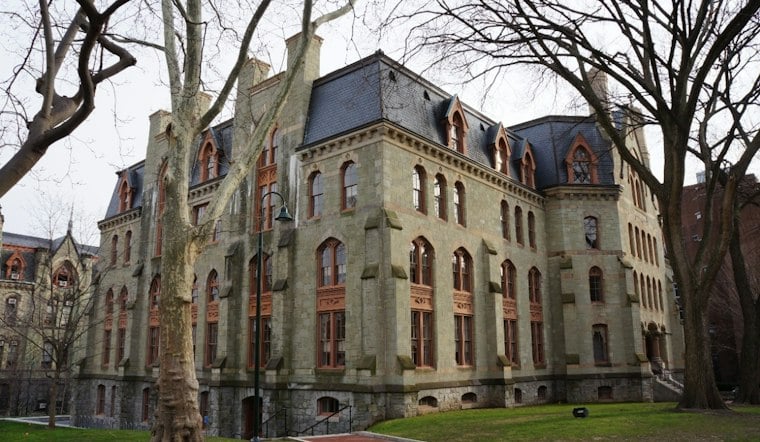
At 79, Susan Dannenberg and Michele Mathes have chosen a shared Chestnut Hill apartment that gives each a bedroom and bathroom — more privacy than their first shared home. The Philadelphia Inquirer reports that they first roomed together in a small third-floor room at the University of Pennsylvania’s Delta Phi Epsilon house in fall 1966.
Their decision came after decades of separate households, marriages, careers and family life, while they remained connected, according to the Philadelphia Inquirer. Their Penn sorority chapter, the Nu chapter of Delta Phi Epsilon, was founded on March 17, 1925, and remained active until the late 1960s, according to the University of Pennsylvania Archives.
A Decade of Distance, Then Reconnection
Their friendship included a roughly decade-long estrangement. Dannenberg has said she withdrew from Mathes from about 1977 to 1987 while dealing with personal struggles, according to the Inquirer.
They later reconnected and remained close through separate households and marriages. The Inquirer also reports that they shared the experience of caring for parents who had become frail or ill.
Blending Two Households Into One
Their arrangement has practical terms as well as personal ones: the two opened a joint bank account to cover rent and other shared costs, the Inquirer reports.
The move also requires ongoing negotiation. Both women have expressed concerns about adjusting to one another’s differences and are treating that adjustment as something to keep working on, according to the Inquirer.
Making a Shared Home Work
Their home includes a routine carried forward from college: the Inquirer reports that they take a break together at 4 each afternoon.
Dannenberg has said she did not want to move or place the burden of her care on her children, whom she believes are relieved she and Mathes have each other. Mathes has said she wants to live with someone she loves and make her own decisions about this stage of life. Their arrangement is part of a broader Inquirer series on life partnerships across the Philadelphia area.
Part of a Larger Shift Among Older Adults
Dannenberg and Mathes are hardly alone in choosing a housemate over living solo in their later years. Federal data cited by the Bowling Green State University National Center for Family and Marriage Research show that in 2022, more than 1.09 million older-adult household heads lived with an adult roommate, and the rate of older adults rooming together climbed from 10 per 1,000 household heads in 2012 to 16 per 1,000 a decade later. A separate analysis from the same center found that in 2016, 3.2 million adults ages 50 to 74 were living with a sibling or an unrelated roommate, nearly triple the 1.2 million recorded in 1990.
Researchers at the Harvard Joint Center for Housing Studies point to three main drivers behind the trend: affordability, social connection, and practical help with chores or home maintenance. The center's research notes that in 2016, 879,000 adults 65 and older were living with a non-relative as a roommate or housemate, up 88% from a decade earlier, and that just 29.3% of older roommate households were considered cost-burdened compared with 46.3% of older adults living alone, per the Harvard Joint Center for Housing Studies.
A National Snapshot of Living Alone
The available Census figures offer national context, not a Philadelphia-specific count: according to the U.S. Census Bureau, nearly 3 in 10 U.S. adults age 65 or older lived alone in 2022. Among women, the share was about 27% for those ages 65 to 74 and 43% for those 75 or older.
Other Supports for Aging at Home
Sharing a home is one option, but it is distinct from services designed to help someone remain in their own home. The Philadelphia Corporation for Aging says it provides eligible older adults with needs assessments and care management to coordinate services based on individual goals and needs.
For social connection outside the home, the Philadelphia Corporation for Aging says its funded senior centers offer programming that includes group activities, continuing education and fitness classes.
Women in particular are driving much of this shift. Four million women age 50 and older now live in households with at least one other woman in that age range, a figure expected to keep climbing, according to AARP. The outlet reported that at the home-sharing service Let's Share Housing, 80% of clients are boomer women, and that three women in their 50s once pooled their resources to buy and share a house together, each carving out a private bedroom and splitting costs through a joint checking account. For Dannenberg and Mathes, the arithmetic is less about a spreadsheet than about companionship, but their choice echoes a pattern turning up in roommate households from Chestnut Hill to Manchester, New Hampshire, as reported by New Hampshire Public Radio, where 63-year-old best friends Cherie Greene and Lauranne Wingard now split rent of roughly $400 and $500 a month after Wingard nearly ended up living in her car.




