

























































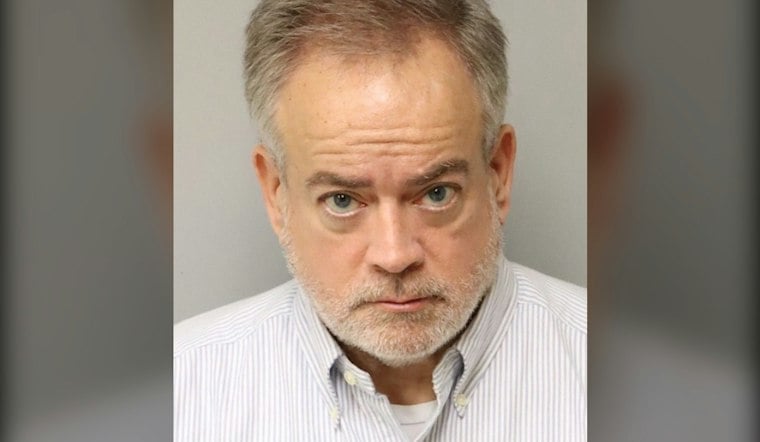
Criminal charges against a former Pinellas County sheriff’s deputy accused of obsessively querying a woman’s license plate hundreds of times through law enforcement databases have been dropped, with prosecutors saying Florida’s current laws simply do not cover what he did. Karl Gwynne, who resigned from the Pinellas County Sheriff’s Office in September, had been accused of using the agency’s automated license plate reader system to track the car of a woman he reportedly wanted to date.
No Information Filed Despite Admission
According to the Tampa Bay Times, State Attorney Bruce Bartlett wrote in a court filing that current Florida statutory provisions do not address Gwynne’s reported conduct. As reported by WFLA, prosecutors filed a No Information on Oct. 30 ending the case, which had included charges of official misconduct and four counts of accessing a computer network or electronic device without authority. WFLA reported that Gwynne used the agency’s automated license plate reader database to run 381 searches for one license plate, with 207 of those searches made while he was off duty.
Other reporting on the case describes the numbers differently. Florida Politics reported, based on the sheriff’s account, that Gwynne made 381 queries across five separate databases during the roughly 18-month span from January 2025 to July 2026, and that 300 of those queries specifically involved the automated license plate reader system, with 207 of the total 381 queries occurring while he was off the clock. The discrepancy in how the searches are categorized has not been resolved in public reporting.
Sheriff Says No Legitimate Reason for the Searches
Pinellas County Sheriff Bob Gualtieri has said the woman at the center of the case was not under investigation and that investigators found no legitimate law enforcement reason for Gwynne’s searches, according to the sheriff’s account reported by Tampa Bay 28. The station’s report also notes that a media inquiry about the unusually high number of searches is what prompted a deeper review of Gwynne’s activity in the first place.
Gualtieri acknowledged the sheriff’s office’s previous approach to auditing license plate reader use was inadequate, per the same account. The sheriff said the office’s existing audits simply were not designed to catch a pattern like Gwynne’s, telling Florida Politics, “The audits were there, but we were not focusing on high quantity. We are now.”
Resignation Followed Shifting Explanation
Florida Politics reported that Gwynne resigned on Sept. 11, the same day he first claimed his searches were for official purposes before admitting he actually wanted a relationship with the woman. The Pinellas County Sheriff’s Office’s own arrest listing identifies Gwynne as a deputy hired in January 2005 who resigned on Sept. 11, 2026, and lists four counts of accessing a computer electronic device without authority and one count of official misconduct.
The cameras at the center of the case are made by Flock Safety, whose automated license plate reader systems have become increasingly common across Tampa Bay; one such camera was photographed in a Home Depot parking lot in Pinellas Park in August, in an image credited to Luis Santana. Florida’s statute governing these systems, Section 316.0777, defines an automated license plate recognition system as one using mobile or fixed high-speed cameras combined with computer algorithms, and it classifies ALPR images and data containing personal identifying information as confidential and exempt from public-records disclosure, while barring retention beyond the maximum period set in the applicable schedule. The law also bars these systems from being used to issue traffic citations.
A Pattern Seen Beyond Pinellas County
Gwynne’s case is not an isolated data point in the broader conversation about license plate reader misuse. The Institute for Justice says it has identified well over 100 incidents of ALPR abuse nationally, according to the organization’s own database. In litigation against Norfolk, Virginia, the group found that three commonly entered search reasons accounted for nearly one-third of 230,000 searches conducted over two years, raising questions about how thoroughly agencies scrutinize officers’ stated justifications for running plates.
The scrutiny extends well past Florida. In Indianapolis, Police Chief Tanya Terry sought to reassure residents that officers were using the city’s 301 Flock cameras solely to investigate crime, according to reporting from the Washington Post, amid broader calls for tighter limits on how police departments deploy the technology.
In Pinellas County, the fallout from Gwynne’s case is expected to reach the state legislature. WFLA reported that the state attorney’s office said it will seek to have lawmakers correct the situation during the next legislative session, which is scheduled to begin in 2027.



