

























































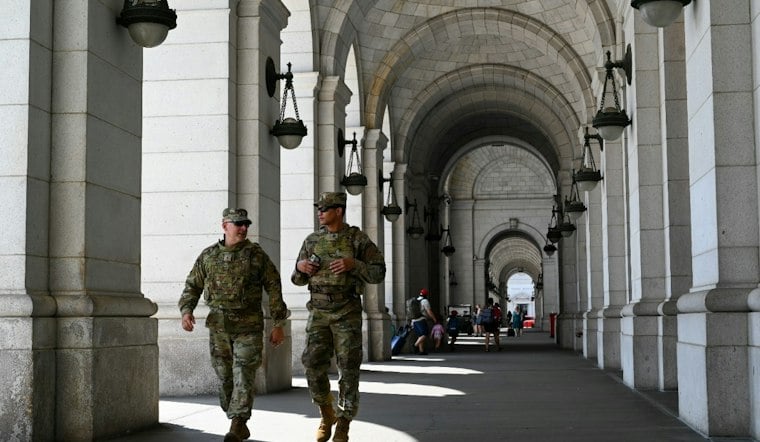
DC Councilmember Brooke Pinto used a council hearing Thursday to make a direct ask of five newly elected governors: send your National Guard troops home. Pinto said Georgia, Iowa, Nevada, Ohio and Texas together account for 628 active Guard troops still stationed in the District, and she argued the incoming governors could order them withdrawn on their very first day in office.
Pinto made the appeal during a public hearing on federal law enforcement and military activity in Washington, according to the Washington Examiner, which reported the hearing took place two days after the midterm elections. Democratic candidates Keisha Lance Bottoms, Rob Sand, Aaron Ford, Amy Acton and Gina Hinojosa won the governor's races in Georgia, Iowa, Nevada, Ohio and Texas, respectively, and Pinto told the council those victories create a fresh opening to recall the out-of-state units. “It's something they can do their first day in office,” Pinto said, adding that she is “very hopeful and optimistic that we now have the partners we need at the state and congressional level to push back.”
As FOX 5 DC first reported on the hearing, Pinto is also pressing congressional Democrats taking the House majority in January to open oversight investigations into federal operations in the District and to pass rules barring federal personnel from wearing face coverings on District streets. Mayor-elect Janeese Lewis George and Robert White have discussed defending the District's interests as the new government takes shape.
Troops Showing Up Outside Schools
The push comes after families and educators raised concerns about military operations near schools in Ward 8. Pinto cited a listening session at Bard High School Early College DC where students described armed troops preparing with weapons, staging near school entrances and bus stops, and walking past classroom windows during the school day. Pinto herself joined neighborhood parents protesting the deployments outside the school.
Those accounts echo reporting from the Washington Post, which found that National Guard members have twice in recent weeks appeared congregating outside DC public schools around student drop-off times. One parent, Jamais Burts-Parker, told the paper she encountered troops and FBI agents changing into tactical gear in the immediate vicinity of the school on a Monday morning. National Guard troops have also been spotted near election ballot drop boxes, according to the seed reporting cited by Pinto's office.
A Deployment Ordered More Than a Year Ago
The presence traces back to August 2025, when President Trump declared a crime emergency in Washington and ordered the National Guard deployed, according to the Washington Informer. Troop levels have fluctuated sharply since then: the Informer reported 2,921 Guard members deployed as of one recent Tuesday, down from a peak of 5,148 on July 10, even as more than 60 Louisiana Guard soldiers departed for Washington the same weekend that 11 other states withdrew their contingents. The Washington Examiner separately put the total above 3,000 troops as of this week, roughly 2,000 below the summer high.
The legal fight over the deployment is still unresolved. DC Attorney General Brian Schwalb has challenged the out-of-state Guard units in court, arguing the administration lacks legal authority to send them into the District without the mayor's consent. The District's complaint, filed with the Office of the Attorney General for the District of Columbia, alleges the deployment violates the Home Rule Act — an allegation, not yet a final ruling. The Department of Justice has countered that the president ordered the deployment to support federal law enforcement missions, and DOJ attorneys have warned that limiting presidential authority over the Guard could hamper future mobilizations for inaugurations, major protests and natural disasters.
What the Crime Numbers Actually Show
Administration and military officials have defended the deployment as a public-safety mission, but the underlying data tells a more complicated story. An analysis from The Trace found that DC shootings fell by roughly two-thirds year over year, but the decline began in mid-April, months before troops arrived — suggesting, in the outlet's words, that the military presence is probably not responsible for the drop. The Trace's own model estimated the deployment's first 11 weeks produced a difference of fewer than one shooting victim citywide compared with its projection without troops present. Criminologist Thomas Abt cautioned against drawing firm conclusions from such a small sample, and violence interrupters told the outlet that shootings appeared to rise again once federal agents pulled back from neighborhood patrols.
For now, whether any of the five incoming governors will actually act on Pinto's request remains an open question. What's clear is that the fight over the Guard's future in the District has shifted from the courts to the ballot box — and from there, back to Capitol Hill, where Pinto is counting on a new Democratic majority to keep pressing the issue.



