

























































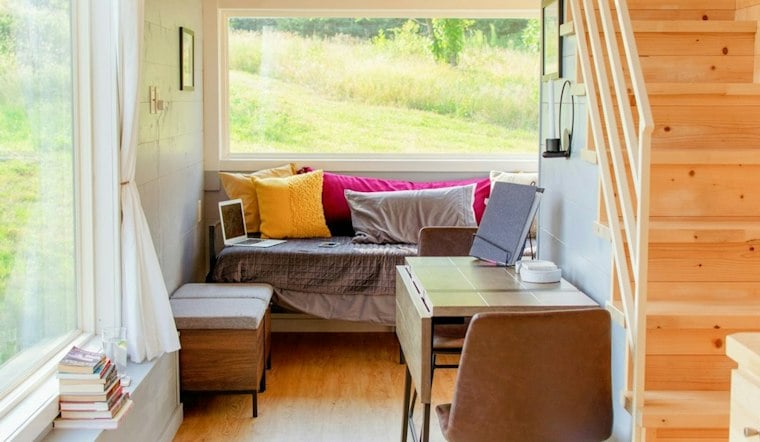
Whether Prince George's County can diversify its housing supply depends in part on what its zoning rules allow. County planners are studying options that include micro-apartments, tiny homes on wheels and compact houses clustered around shared courtyards. Council members Jolene Ivey and Sydney Harrison recently hosted a town hall on microhousing, according to Bisnow. County Executive Aisha Braveboy has also said the county is developing a plan for tiny homes and tiny-home communities, speaking at a Bisnow event in College Park.
A Housing Gap Officials Admit They May Not Close
The scale of projected demand is substantial. The Planning Department presented a figure of 36,000 additional housing units needed by 2030 to keep pace with projected demand, according to Bisnow. At the town hall, James Hunt said the county will likely fall short of that goal and that few microhousing developments have been built in Prince George's County so far. He also said the Planning Department needs to review the zoning ordinance to determine what changes would be needed to allow alternative housing types.
That zoning hurdle is not abstract. According to the Prince George's County Planning Department, roughly 89 percent of the county's residential land is zoned exclusively for single-family housing, leaving little room by right for the kinds of smaller, multiunit buildings officials are now discussing. The department defines this so-called Missing Middle Housing as house-scale buildings with multiple units, compatible in scale and form with detached single-family homes, located in walkable neighborhoods, with individual units typically ranging between 600 and 1,200 square feet.
Renters Feel the Squeeze Most
The affordability pressure driving the conversation is uneven across the county. As of 2023, 50.3 percent of Prince George's County renter households were cost-burdened, meaning they spent 30 percent or more of their income on housing, per the planning department study cited by Bisnow. Homeowners were cost-burdened at a lower but still significant rate of 28 percent that same year.
What the available housing figures show
Available county figures offer snapshots, but not a year-by-year count of all housing permitted or completed since 2020. The Planning Department’s 2022 Annual Report on Growth records occupancy permits for 1,802 dwelling units that year—a permit-based figure that is not directly comparable to the 36,000-unit projected-demand target for 2030. Separately, the county’s FY 2024 CAPER reported 35 HOME-assisted rental units constructed, equal to 13 percent of its five-year goal of 260 affordable rental units by 2025; that is a federally assisted subset, not a count of all new housing, according to the Prince George’s County Planning Department and the Department of Housing and Community Development.
Ivey said in an interview Tuesday that smaller, less expensive housing could improve affordability for some residents and that more affordable micro-units might attract buyers and developers who have largely stayed away from the format. She pointed to potential demand from seniors looking to downsize and young professionals just out of college seeking a foothold. Hunt said a wider range of development types could give residents options suited to different circumstances.
Residents Push Back on More of the Same
Part of the motivation is also about variety. Prince George's County residents have repeatedly protested seeing more townhomes built in their communities, and county officials are now weighing alternatives to both townhomes and detached single-family homes as the dominant housing types. That tension between what gets built and what residents say they actually want is part of what officials describe as a broader housing supply pipeline problem layered on top of existing affordability struggles.
The county's Planning Department has been working on the issue through a separate but related effort. Planning staff and Opticos Design Inc. briefed the County Council on a draft Missing Middle Housing Study in late June. The effort is intended to examine constraints and opportunities for housing development and ultimately produce a study and pattern book, according to the Prince George's County Planning Department. The department says it is exploring ways to expand attainable, market-rate housing options and that the study will evaluate which county policies and ordinances may need revision to allow and incentivize new unit types in various locations. Separately, a September 2024 Planning Department whitepaper recommended developing a county accessory dwelling unit policy, including identifying zones where ADUs could be permitted and drafting related zoning amendments, according to the Planning Department.
Zoning Limits Already Showing Up Elsewhere
Zoning constraints on smaller housing formats have surfaced in other corners of county government, too. A task force examining a rewrite of the master plan for Subregions 5 and 6 heard that current zoning often prevents clustering tiny homes across multiple lots, because lot density and zoning limits restrict that form, according to Citizen Portal. Separately, the county's housing department is studying potential development sites at different price points, including communities of about 20 compact homes, as reported by The Baltimore Banner. For broader geographic context, the Planning Department identifies more than 2,500 acres of undeveloped land within a half-mile of the county's 15 Metrorail stations as potential for mixed-use development; it does not identify those acres as approved microhousing sites, according to the Planning Department.
That outlet has also chronicled the county's recent hands-on experience with tiny homes. After a student-built tiny home failed to draw bids at auction, Braveboy pledged, alongside the county housing director, that the county would pay at minimum $55,000 to keep the home in Prince George's County, The Baltimore Banner reported. The episode underscored both the appeal and the uncertain market for tiny-home projects locally.
What Neighboring Jurisdictions Have Already Done
Prince George's County is not the first in the region to confront exclusionary zoning head-on. Montgomery County's council voted last year to enable multiunit homes on certain lots previously zoned for single-family housing, an effort aimed at addressing a shortage of middle-income housing, according to The Washington Post. Maryland has also expanded accessory dwelling unit options statewide, though building one is not cheap: a builder told The Baltimore Banner that constructing an ADU typically costs between $150,000 and $350,000 depending on size, finishes and amenities. In Silver Spring, homeowner Matthew Dalbey converted his garage into a 380-square-foot ADU in 2022 and now rents it for about $1,400 a month, the same outlet reported.
For now, Prince George's County's microhousing push remains in the discussion phase. Braveboy has said the county plans to host future meetings and conferences on alternative housing, and Ivey said she expects at least two more community forums before any legislative effort begins. Braveboy was not involved in the recent town hall hosted by Ivey and Harrison, but Ivey said she would be happy to collaborate with the county executive on the issue going forward.




