

























































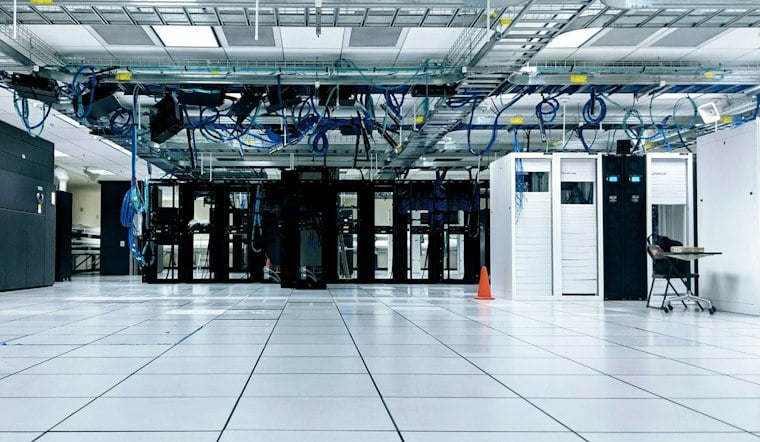
A pro-artificial-intelligence group called Build American AI has purchased at least $2.54 million worth of television ads that recently aired across Ohio, touting the economic benefits of the state's data-center boom without endorsing either candidate in the closely watched Senate race between Jon Husted and Sherrod Brown. The ad buy lands at a moment when dozens of Ohio communities have moved to restrict or ban the very facilities the ads celebrate.
Millions in Airtime, No Candidate Named
According to an analysis by DeSmog, the ads ran on at least 16 Ohio television stations between September 7 and October 21, and Federal Communications Commission filings described them as non-candidate issue ads. One spot claimed that Ohio data centers have brought more than $40 billion in investments and created over 95,000 jobs in the state, declaring that “the future will be built by American workers in Ohio.”
Build American AI ordered at least $2.5 million in Ohio airtime, $1.5 million in Wisconsin and $1.1 million in Kansas between September 7 and October 24, per the same DeSmog analysis. Jesse Hunt, the group's head of communications, confirmed the organization was spending more than $5 million across the three states but declined to comment on exact ad spending amounts.
Ties to a Silicon Valley-Backed Super PAC
Build American AI is linked to Leading the Future, a major AI-industry super PAC backed by Silicon Valley billionaires that was formed in 2025 to promote the industry's interests and has backed both Democratic and Republican candidates in primary races earlier this year. The DeSmog report notes that Leading the Future had received about $125.79 million in contributions during the 2026 midterm cycle as of October 29.
The scale of spending comes as two of the country's largest tech companies race to build out Ohio's computing capacity. OpenAI is part of a joint venture with SoftBank, Nvidia, the U.S. Department of Energy and other partners to build a sprawling data-center complex in Pike County. OpenAI has said the project would use about 8 gigawatts of power, according to WOSU, though other plans for the site described a 10-gigawatt complex powered in part by 9.2 gigawatts of new natural-gas plants — a discrepancy the available reporting does not resolve. Meta, meanwhile, is building its Prometheus data center in New Albany, a partially built complex that runs on natural-gas turbines.
A State Pushing Back
The ad campaign unfolds against a backdrop of significant public resistance. The count of local restrictions varies by source: DeSmog reported that Ohio had more than 125 local data-center moratoriums in place as of September, while the Ohio Capital Journal put the figure at 138 municipalities and townships with active moratoriums as of September 17. Ballot-measure counts also diverge, with DeSmog citing 21 measures across 16 counties and State News reporting 21 initiatives across 18 municipalities.
Polling underscores the depth of unease. A Bowling Green State University poll found 71% of Ohioans favored a temporary ban on new data-center construction, and a later report on the same research found 78% support for moratoriums until more information could be gathered. That same polling found 75% of Ohioans opposed data-center construction in their own communities, while 63% opposed construction elsewhere in the state, the Ohio Capital Journal reported.
Land Deals and Campaign Crossfire
The financial stakes extend to real estate near proposed sites. State News reported that a 32-acre parcel near a proposed Grove City data-center site sold for $1.5 million, or $46,875 per acre — well below the roughly $81,700 median per-acre sale price in Grove City over the prior three years, though parcels larger than 20 acres have typically sold closer to $20,000 per acre.
Data centers have also become a flashpoint in the Senate race itself. Sherrod Brown's campaign had spent $2.4 million on ads criticizing Jon Husted's support for data centers as of late August, according to DeSmog. A Brown campaign ad released September 3 said Husted “led the push to bring data centers to Ohio and gave billions of tax dollars to make it happen,” a claim PolitiFact rated Mostly True while noting it required clarification. Husted introduced the Ratepayer Protection Act in July to encourage states to require large electricity users, including data centers, to cover the costs of power generation and infrastructure needed to serve them.
Tax breaks for Ohio data centers predate the current boom. Google received a 15-year state sales-tax exemption estimated at $43.5 million for its New Albany facility, along with a local property-tax abatement, PolitiFact reported. The Ohio Capital Journal noted that Amazon received $81 million in state tax incentives for a Hilliard data center in 2014, and Meta's first New Albany facility came with a 40-year, $37 million tax break in 2017.
Broader Energy and Climate Stakes
The fight over data centers is tied to wider questions about electricity demand and emissions. The Electric Power Research Institute projects that data centers' share of U.S. electricity consumption could rise from 4% to 9% by 2030, the Ohio Capital Journal reported. A Nature Sustainability study cited by DeSmog found that new U.S. data-center energy demand could increase annual carbon emissions by 24 million to 44 million metric tons between 2024 and 2030.
Build American AI's television push arrives as Ohio communities weigh their options at the ballot box and in statehouse hearings alike. With moratorium counts, ballot measures and even the size of the Pike County project still subject to conflicting reports, the state's data-center debate remains far from settled even as the money keeps flowing into Ohio's airwaves.




