

























































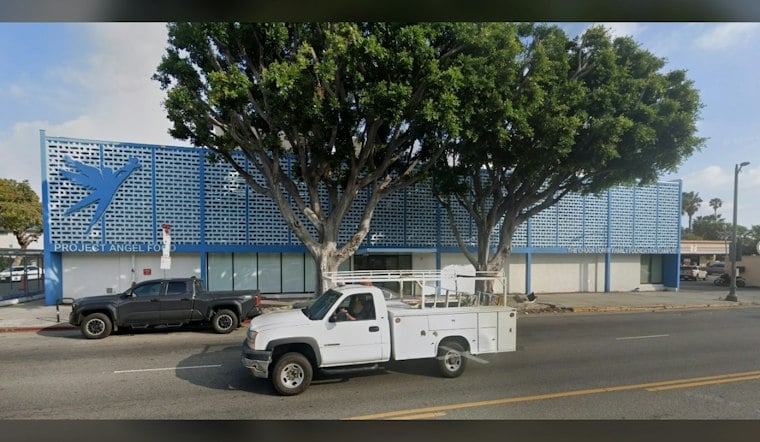
Project Angel Food has started work on the second and final building of its Hollywood campus, a Community Outreach Center that will house a demonstration kitchen, volunteer space, rooftop herb garden and a new research institute dedicated to medically tailored meals. The Hollywood-based nonprofit broke ground on the project as part of the second phase of its Chuck Lorre Family Foundation Kitchen and Campus development, with Chuck Lorre himself attending the ceremony.
The nonprofit began work on the Community Outreach Center portion of the development, according to the Los Angeles Business Journal, which reports the new structure will add a demonstration kitchen, volunteer center, rooftop herb garden and a research center to the campus. Project Angel Food itself describes the new building as launching “the second and final building of its Hollywood campus,” according to a statement on its website, angelfood.org. The Community Outreach Center is expected to expand the organization's client services.
What's Inside the New Building
The demonstration kitchen is designed to serve more than just Project Angel Food's own staff. Per the Business Journal's reporting, it will be available for other nonprofits as well as caregivers and clients looking to learn about practical nutrition and cooking processes. The rooftop herb garden tied to that kitchen will help augment it while also serving as a community gathering space.
Perhaps the most ambitious piece of the new building is its Research and Policy Institute. The institute will provide a space for researchers to study and advance medically tailored meals under Medi-Cal and Medicare coverage, the kind of policy work that could shape how government health programs pay for food as treatment going forward.
A Mission Rooted in the AIDS Crisis
Project Angel Food was founded in 1989 by political activist and two-time presidential candidate Marianne Williamson, the Business Journal notes, and it began life as a meal provider for HIV and AIDS patients in the early 1990s. The organization's mission has since broadened considerably: it now prepares and delivers medically tailored meals to people facing congestive heart failure, kidney failure, severe diabetes, cancer and Alzheimer's disease, delivering meals to thousands of critically ill patients each year.
Project Angel Food chief executive Richard Ayoub said the new building represents the organization becoming a national leader in the “food is medicine” movement, according to the Business Journal. The nonprofit has twice been named California's nonprofit of the year by the state legislature, per the same report.
Funding and a Personal Connection
The Chuck Lorre Family Foundation donated $10 million toward the Kitchen and Campus project, a gift that helped anchor the broader fundraising effort. Lorre, who founded the family foundation, told the Business Journal that his involvement with the organization was personal and humbling.
The Business Journal put the figure at $53.1 million raised toward a $55.1 million goal. Project Angel Food has also reported that the first building of the campus, its Kitchen and Operations Center, opened in February, completing Phase I of the overall project.
County Officials Weigh In
Los Angeles County Supervisor Lindsey Horvath, who represents the Hollywood area, praised Project Angel Food and its supporters as the kind of partners the county needs, according to the Business Journal. Horvath said the county wants to care for its most vulnerable residents, a goal that aligns directly with the population Project Angel Food serves: homebound clients managing serious, often life-threatening illness.
The nonprofit's meal totals also vary by source. The Business Journal reported that Project Angel Food has provided more than 21 million free meals to the seriously ill, while the Beverly Press & Park Labrea News previously reported the organization had served nearly 17 million meals since its 1989 founding, and CBS News Los Angeles has cited a figure of more than 20 million meals.
The Research Case for Food as Medicine
The push to formalize medically tailored meals as a health care intervention is backed by emerging research outside Los Angeles. A statewide Massachusetts Medicaid analysis examined by Tufts Now found that recipients of medically tailored meals had 31 percent fewer hospitalizations and 20 percent fewer emergency department visits than similar eligible members who did not receive the meals. The same analysis, which examined Medicaid data from 2020 through 2023 across 11 Massachusetts health care systems, found per-person health care costs declined by $3,433 during an average participation period of roughly six months.
That kind of evidence is central to the mission of the new Research and Policy Institute, which aims to study and advance how medically tailored meals are covered under Medi-Cal and Medicare. As Project Angel Food positions itself at the center of that national conversation, the Hollywood campus that began with a single kitchen now carries the added weight of shaping health policy from the ground up.





