

























































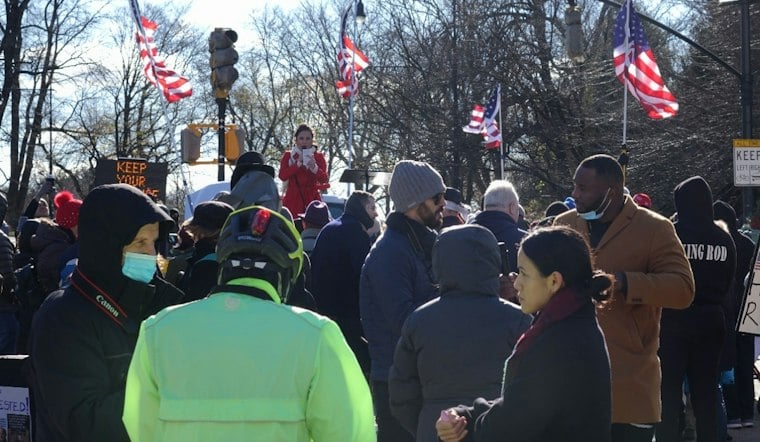
Demonstrators gathered outside Senate Minority Leader Chuck Schumer's home in Park Slope, Brooklyn, to protest proposed federal legislation on AI data centers, calling on him to halt an upcoming permitting bill that activists say would streamline the process for tech companies building AI data facilities.
The rally was reported by FOX 5 New York, whose Frances Wang covered the scene outside Schumer's home. The protest comes as New York-based climate and community groups have been urging House and Senate Democratic leaders to publicly oppose the bipartisan permitting legislation ahead of an expected Nov. 9 vote on the bill, according to Bloomberg Government.
Organizations planned to gather both at Schumer's Brooklyn home and at House Minority Leader Hakeem Jeffries's office to protest changes to environmental laws and what activists describe as the bill's potential to expand data centers, per the same Bloomberg Government report. Activists with Food & Water Watch, New York Communities for Change, 350Brooklyn, Climate Families NYC, and Indivisible Brooklyn planned to bring a large, smoking AI data center prop and a giant blank check to the demonstration outside Schumer's Park Slope apartment, according to Common Dreams.
What the Bill Would Actually Do
The legislation at the center of the dispute is known as the Bipartisan American Affordability and Jobs Act, or BAAJA, and is described as aimed at speeding the permitting process for energy infrastructure, Common Dreams reports. A Congress.gov text indicates the measure may be cited as the “Bipartisan American Affordability and Jobs Act of 2026.”
Separately, more than 160 environmental, health, consumer and religious groups called for a ban on all AI data center development on federal lands, as well as for rejection of the permitting bill, according to Food & Water Watch. The coalition's demand reflects a broader push among advocacy groups to keep large-scale computing infrastructure off public lands entirely, rather than simply slowing it down.
Data Centers Have Become a Flashpoint Nationwide
The Park Slope protest is part of a much larger national pattern of pushback against data-center construction. U.S. data centers consumed an estimated 183 terawatt-hours of electricity in 2024, more than 4% of the country's total electricity consumption, according to the Pew Research Center. That figure is projected to grow by 133% to 426 terawatt-hours by 2030, the same research center found.
That surging power demand has fueled political resistance well beyond Brooklyn. Data Center Watch reported that almost $200 billion in data-center projects were delayed, stalled, or blocked in the first half of 2026 because of political and community opposition, as noted by TechCrunch. States including Pennsylvania, Georgia, Texas, New York, and Virginia are considering additional guardrails and transparency requirements for data-center development, the outlet reports.
A Ballot-Box Backlash
The resistance has also shown up at the polls. Communities across 10 states passed 43 out of 44 initiatives proposing bans or pauses on construction of data centers or infrastructure of a certain size, according to Common Dreams. The Washington Post separately reported that voters in at least 38 jurisdictions nationwide passed bans or restrictions on data centers this past Tuesday, describing it as a nationwide ballot backlash.
For now, it remains to be seen whether the pressure campaign aimed at Schumer and Jeffries will shift the outcome of the Senate vote expected Nov. 9. Activists outside the senator's Park Slope home made clear with their smoking data-center prop and oversized blank check exactly what message they wanted delivered to his door.




