

























































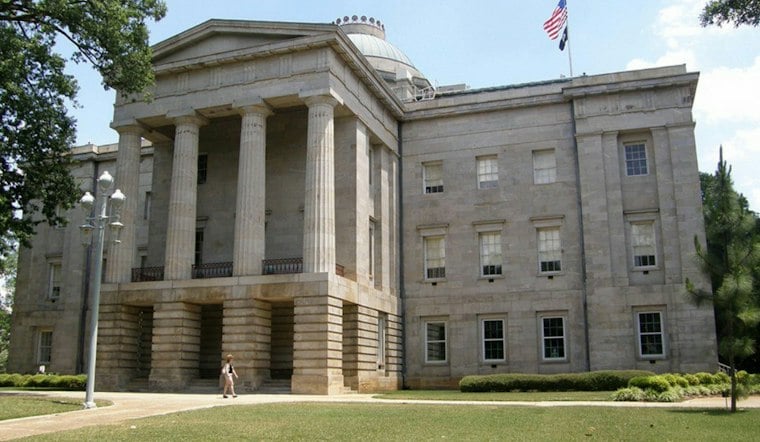
A monument meant to honor African Americans on the grounds of the North Carolina State Capitol still doesn't exist, despite years of recommendations and repeated funding proposals that have gone nowhere. The site, known as Union Square in downtown Raleigh, remains without the memorial even as state lawmakers this year found money for two other monuments entirely.
According to WUNC News, a planned African American monument on the southeastern portion of the Capitol grounds has never been built. The push for such a monument traces back to late summer 2017, when discussions began following the Unite the Right rally in Charlottesville, Virginia, where a white supremacist driver killed one person and injured dozens of others. Then-Gov. Roy Cooper called for Confederate monuments to be removed from the Capitol grounds in the aftermath of that rally, the outlet reports.
By 2018, a North Carolina Historical Commission committee had recommended building an African American monument without delay, and a state resolution later called on the governor and General Assembly to ensure one was constructed without delay. That resolution directed the Department of Natural and Cultural Resources to plan, design, and raise funds for one or more additional monuments on Capitol Square memorializing African Americans' accomplishments and contributions, per WUNC.
A Funding History Marked by Conflicting Accounts
What happened to the money set aside for the project is described differently by different outlets. WUNC reports that funding for the monument got nixed amid a budget fight in 2019. The News & Observer, however, reported that the African Americans monument was included in the 2019 state budget that Cooper vetoed, and that budget never became law. A separate 2019 News & Observer report noted that $2.5 million had been set aside for the monument in that year's state budget proposals from the governor's office as well as House and Senate drafts.
In 2021, after George Floyd's killing, protesters toppled a Confederate statue at the Capitol, and Cooper ordered the removal of Confederate memorials from the grounds. North Carolina legislators withdrew budgeted monument money following that incident, WUNC reports. That same year, the General Assembly allocated $1.5 million to Freedom Park, a separate downtown Raleigh public space dedicated to Black North Carolinians — money that did not fund the Capitol grounds monument itself.
The most recent attempt came in 2025, when Gov. Josh Stein proposed putting $5 million toward a monument, an idea that went nowhere in the legislature, according to WUNC. Then, in the state budget passed in July 2026, lawmakers finalized funding for monuments to Billy Graham and the Revolutionary War to be erected in Union Square instead. The News & Observer reports that the budget directs the state to purchase and place a monument celebrating North Carolina's contributions in the Revolutionary War as well as one honoring the Reverend William Franklin “Billy” Graham, Jr. on the Capitol grounds, with $15.5 million allocated for capital improvements to the Old State Capitol building and grounds and planning within the downtown complex.
Advocates Say the Omission Isn't an Accident
Dawn Blagrove, executive director of Emancipate NC — described by WUNC as a progressive anti-racism organization — said the state has the money but not the will. “Lawmakers simply aren't prioritizing it,” Blagrove told the outlet. She described the General Assembly's lack of political will to fund the monument and said lawmakers had no desire to acknowledge Black people's contributions or memorialize them.
Blagrove also said spending a few million dollars on a monument is not frivolous, arguing the state has spent money on things not objectively in North Carolina residents' interest. She said a monument would ceremonially demonstrate state leadership's respect for Black Americans, and that historically accurate monuments should replace monuments of hate.
What Stands at Union Square Today
In the absence of a new monument, Union Square today still features statues of Zebulon Vance and Charles Aycock, along with new interpretive signage detailing their histories, per the WUNC report. The signage states that the Vance family enslaved Black gardeners, cooks, domestic servants, and their families. Vance, who fought for the Confederate army and owned Black people as slaves, is also described by the North Carolina Department of Natural and Cultural Resources as having held a strong belief in white supremacy, even as he prioritized agricultural reform, railroad expansion, and school construction and defended slavery.
The Aycock monument also still stands at Union Square. Signage there notes Aycock was unwavering in his support for measures restricting voting access for Black North Carolinians such as poll taxes and literacy tests. The state DNCR describes Aycock as a white supremacist whose successful campaigns influenced the Wilmington massacre.
The North Carolina Historical Commission had considered the three Confederate-era monuments on the Capitol grounds an overrepresentation of a difficult era, but under state law the commission could not recommend removing or relocating them, WUNC reports. North Carolina General Statute 100-2.1, which the North Carolina General Assembly enacted, defines an object of remembrance as a monument, memorial, plaque, statue, marker, or display of a permanent character commemorating an event, person, or military service tied to the state's history, and requires such objects be relocated only to places of similar prominence or honor. The commission's resolution instead recommended historical signage alongside the Confederate monuments.
A Statewide Pattern of Removal
The Union Square standoff unfolds against a broader statewide reckoning over Confederate memorials. At least 24 Confederate monuments had been removed or approved for removal across North Carolina since May 25, 2020, according to an earlier WUNC report. Yet Southern Poverty Law Center data cited in that same report showed 77 Confederate monuments remained standing statewide as of June 2021 — the third-highest total of any state in the country. A 2015 state law, the Cultural History Artifact Management and Patriotism Act, limits the removal of objects of remembrance from public property, complicating efforts to take them down even where local support exists.
Not every North Carolina city has faced the same legal hurdles. In Asheville, the city council voted 6-1 on December 8, 2020, to accept a task force recommendation to remove the Zebulon Vance obelisk from that city, according to WUNC's earlier reporting. Meanwhile, North Carolina Freedom Park — a separate project honoring the Black experience built with public and private money a few blocks from the Capitol — has moved forward even as the Capitol grounds monument has stalled, the News & Observer reported in 2023.





