

























































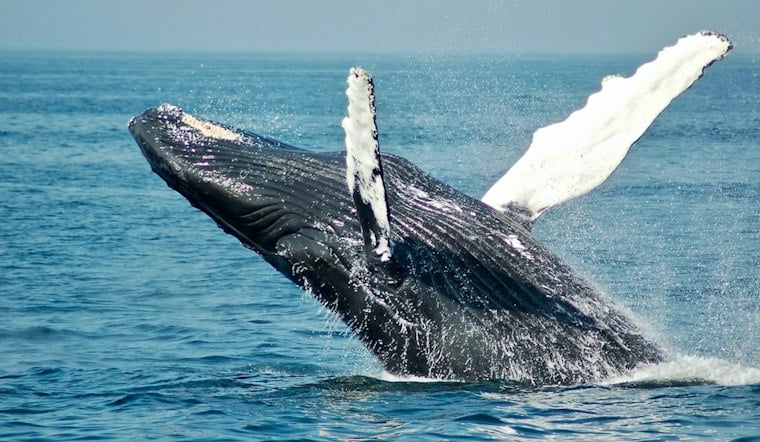
A crew of East Carolina University researchers doing routine fieldwork for a PhD project off North Carolina's Outer Banks heard a loud crash on the water, looked up, and found themselves watching something few people ever see: a pregnant North Atlantic right whale, one of the rarest large whales on Earth, breaching again and again just off Nags Head.
John Felter, a research operations technician at East Carolina University, said the whale breached roughly 15 to 20 times during the encounter, as reported by The News & Observer. Felter also said reducing speed is advisable whenever whales may be nearby, a caution that matters given how few of these animals remain. North Atlantic right whales number only about 380, with roughly 70 breeding females left in the entire population, according to the same report.
The sighting came one day after scientists in Norfolk, Virginia, spotted a right whale migrating south, and Felter's team suspects it was the same animal seen off Nags Head the next day. NOAA scientists have not confirmed the whale's identity, but Felter's team believes the whale could be Calvin, a well-known breeding female with a dramatic survival story stretching back more than three decades.
A Whale With a Hard-Luck History
Calvin's mother, Delilah, was killed by a boat strike in 1992 when Calvin was just eight months old, according to The News & Observer's reporting. Right whale calves typically need to nurse from their mothers for a year after birth, which made Calvin's early survival especially precarious. She has since survived multiple fishing gear entanglements, including one in 2000, when she became tangled in rope and swam for hundreds of miles before the trailing lines finally broke free of her body, according to Penobscot Bay Press.
Calvin has given birth to four calves over the years. But sightings of her went quiet for an extended stretch: following a 2022 sighting, Calvin failed to appear in any of the regular surveys, per the same outlet's reporting. Her reappearance last year, after researchers had not spotted her for almost three years, was documented by The Vineyard Gazette, which reported she turned up south of Martha's Vineyard. The April 23 survey recorded more than 60 whales.
Why North Carolina Waters Matter Right Now
The species' calving season runs from November through April. North Atlantic right whales migrate from New England to the southeastern United States to give birth in warmer waters, with their calving range stretching from Cape Fear, North Carolina, to Cape Canaveral, Florida, according to The News & Observer. That migration corridor puts pregnant whales like the one spotted off Nags Head directly in the path of heavy boat traffic along the North Carolina coast.
The species was nearly wiped out by commercial whaling in the 1800s and still has not recovered to pre-whaling numbers, though the population has been increasing slowly over the past few years. Right whales face ongoing threats from boat strikes and fishing gear entanglements, which combined caused 157 of the 176 right whale deaths or injuries recorded over the past 10 years, per The News & Observer's reporting. NOAA Fisheries separately notes that more than 85 percent of the population has been entangled at some point in their lifetime, and that reducing entanglements is necessary to mitigate extinction risk.
How to Spot One — and the Rules That Protect Them
Right whales are notoriously hard to see from a boat. They swim, feed and rest just below the water's surface, lack a dorsal fin, and can only reliably be told apart by the distinctive callosities, patches of rough skin, that differ on each individual whale. NOAA issues alerts when right whales are spotted heading toward a given area, part of an effort to warn mariners before a whale and a vessel cross paths.
Federal law requires vessels to stay at least 500 yards from North Atlantic right whales at all times. Under the applicable federal regulation, a vessel within that distance must take specified avoidance measures, and if underway, must steer away from the whale and leave the area at a slow, safe speed, according to eCFR. Boaters traveling south of Cape Fear must also reduce their speed from November to April specifically to avoid injuring right whales during calving season.



