

























































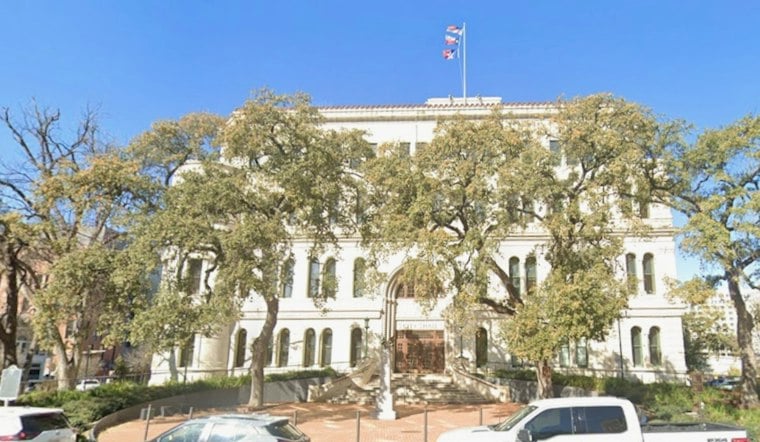
San Antonio Councilmember Marina Alderete Gavito filed a request last week asking the city to start coordinating with regional partners on a possible high-speed rail line connecting San Antonio to Austin, with potential expansion toward Dallas-Fort Worth. The request lands as a new state bill, House Bill 270, proposes directing the Texas Department of Transportation to strike a deal with a private company to build rail service along the entire Interstate 35 corridor, from San Antonio through Austin and Waco to Dallas.
What the City Council Request Would Do
Alderete Gavito filed her Council Consideration Request on November 16, according to mySA. The request calls for San Antonio to explore the feasibility of a rail line between the city and Austin's airport, with potential expansion to Dallas-Fort Worth, and it would bring together Bexar County, transportation agencies and rail advocacy groups to compile and evaluate options, per the request itself. Alderete Gavito said San Antonio, Austin, Bexar County and Travis County are aligned on the effort, and her request is intended to support House Bill 270 at the state level. Any resulting recommendations on local policy changes would be returned to city council, and the request is expected to go before the governance committee in January 2027.
Inside House Bill 270
The bill, filed by state Rep. John H. Bucy III of House District 136, would direct TxDOT to enter into an agreement with a private company to construct, maintain and operate a high-speed rail line connecting Dallas, Waco, Austin and San Antonio along I-35, according to FOX 7 Austin. The legislation defines high-speed rail as intercity passenger service capable of reaching at least 110 miles per hour. Bucy described the measure as directing TxDOT to find a private company and build the line through a public-private partnership. Crucially, the station's report notes the bill does not mean construction is approved or that funding has been secured — it would still need to clear the Legislature.
A feasibility study commissioned by Travis County estimated the Austin-San Antonio segment alone could cost about $13.5 billion, per mySA, with annual operations and maintenance running $140 million to $190 million, according to the same FOX 7 Austin report. That study projected trains could reach speeds up to 125 miles per hour, cutting the Austin-San Antonio trip to roughly an hour to an hour and a half.
A Shift in State Leadership
Bucy, speaking to WOAI, said Republicans have been lukewarm to a project like the proposed rail line and identified outgoing Lieutenant Governor Dan Patrick as part of that resistance, criticizing Patrick's leadership in the Senate. Patrick lost reelection in the midterms and will leave office in January 2027, when the Texas Legislature convenes for its 90th session on January 12 — the same date mySA reports as the session's start and the date newly elected Democrats will take their seats. Vicky Goodwin, who will replace Patrick in that post, signed a 2019 letter to lawmakers urging advancement of passenger rail between San Antonio and Austin, as did Senator-elect James Talarico. Bucy said supporters hope to gain broader backing if land rights are respected. WOAI reported that Patrick's office was contacted for comment but had not responded.
Why Earlier Texas Rail Efforts Stalled
This is not the first time Austin-San Antonio rail has been proposed. The Lone Star Rail District, established in 2015 to study the same connection, spent more than $20 million in state and federal funds without ever laying track, according to the San Antonio Current. A 24-member Central Texas Passenger Rail Advisory Committee, formed in 2024 with elected officials from both cities, has separately been exploring ways to reduce I-35 traffic, and grassroots group San Antonians for Rail Transit has been lobbying elected officials to act, the Current reports. Bucy also filed a nearly identical bill, HB 483, during the 2025 session; it passed the House Transportation Committee but never reached the House floor for a vote, mySA notes. A revised committee version of that 2025 bill added Waco to the route, which originally covered only Dallas, Austin and San Antonio, according to KPRC Click2Houston.
The long-running Texas Central project linking Dallas and Houston illustrates how costly these efforts can become. Valued at around $50 billion according to WOAI, the Dallas-Houston bullet train was unveiled in 2013 as a fully privately funded venture, per Reason. Its estimated cost climbed from an initial $10 billion to $20 billion by 2019 and $30 billion in 2020, and a 2023 analysis pegged total construction and operating costs at a minimum of $41.6 billion, Reason reported. The 240-mile railway was meant to connect the state's two largest cities in about 90 minutes, according to Houston Public Media, but the project was derailed by opposition, including rural concerns that the state would seize land for construction and that rail lines could disrupt farming operations. As of Reason's reporting, Texas Central had not laid a single foot of track or acquired the permits needed to begin construction. Patrick celebrated the project's failure on X in 2025, according to WOAI.
For now, House Bill 270 and San Antonio's council request represent early procedural steps rather than approved construction. Both would still require action — the bill through the Legislature convening in January, and the council request through the governance committee review set for the same month.





