

























































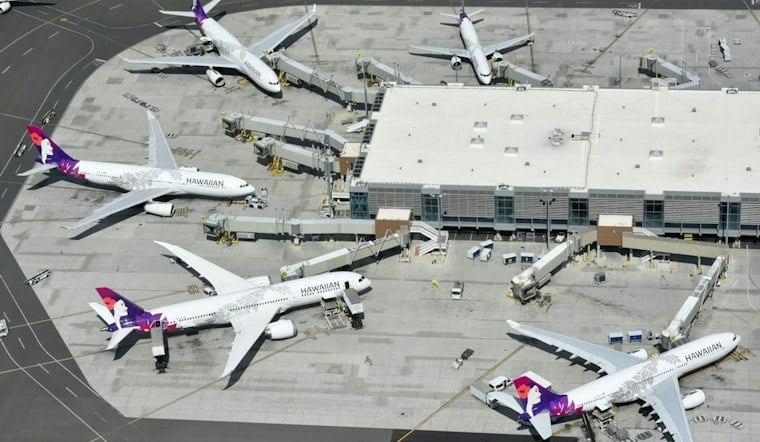
Travelers hoping to catch a quick nonstop from the South Bay to Hawaii have far fewer options than they did just two years ago. San Jose Mineta International Airport's Hawaii-bound seat capacity has fallen from 637,643 in 2023 to 440,757 in 2024, and down again to 306,173 in 2025 — a two-year drop of about 52% — while Oakland and San Francisco have seen smaller but still notable declines of their own.
San Jose's Steep Slide
The numbers, reported by SFGATE, show San Jose's Honolulu seats alone fell 37.1% in 2025, and seats to Kona dropped a steep 56.7% over the same period. Measured against pre-pandemic 2019 levels, San Jose's overall nonstop Hawaii capacity is down 24.5%. The pullback traces back partly to airline consolidation: aviation analyst Brett Snyder told the outlet that San Jose-to-Honolulu service effectively had one flight from each of Alaska Airlines and Hawaiian Airlines before their merger, and still just one flight afterward — a sign the combined carrier hasn't restored the frequency the two airlines once offered separately.
Alaska Airlines and Hawaiian Airlines completed their merger in September 2024. According to the same report, Alaska has made what it describes as tactical reductions in Hawaii flying from San Jose and Oakland to better align capacity with actual demand, cutting San Jose-to-Maui service from six flights a week down to just one. The airline maintains it still offers daily, year-round flights from San Jose and Oakland to Honolulu and Maui, and says it plans to pursue capacity additions once demand supports them.
Southwest's Hawaii Retreat — and Its New Expansion
Southwest Airlines has pulled back even more sharply in the Bay Area. The carrier reduced San Jose-to-Maui flights from seven per week to just two in early 2024, and cut Oakland-to-Honolulu and Maui service from twice daily down to once daily in April 2025, per SFGATE's reporting. Southwest discontinued its Oakland-to-Kona route entirely in March 2025, even though it had launched its first Hawaii flights out of Oakland back in 2019 and still offers year-round Oakland service to Oahu, Maui, and Kauai. Snyder said Southwest intentionally scaled back its Hawaii flying because the routes performed poorly financially, and the airline has said it evaluates routes based on customer demand and aircraft availability, which shifts by season and day of week.
Yet Southwest isn't abandoning Hawaii — it's redirecting where it flies from. The airline announced daily nonstop service between Ontario, California, and Honolulu set to begin June 4, 2026, along with peak-day nonstop service between Burbank and Honolulu starting August 4, 2026, according to a Southwest news release. The carrier also extended its booking window through September 2026 as of Tuesday, giving travelers a longer runway to lock in the new Southern California routes. Southwest currently serves eight California airports with Hawaii flights in total, per SFGATE's reporting.
San Francisco and Oakland Also Feel the Pinch
San Francisco International Airport hasn't been spared either. Its Hawaii-bound seat count fell from 1.24 million in 2024 to 1.18 million in 2025, a 4.6% decline, with Maui-specific seats dropping 19% in that span. Measured against 2019, SFO's nonstop Hawaii capacity is down 21.3%. Oakland's numbers tell a similar story: Hawaii-bound seats there fell from 552,716 in 2024 to 411,231 in 2025, a 25.6% decline, and Oakland's capacity is down 28.1% compared with 2019 levels.
A September 2026 report from Hawaii's tourism department found that San Jose and Oakland scheduled seats were down year-over-year even as San Francisco and Los Angeles gained capacity, the outlet reported. California, Snyder noted, sends more visitors to Hawaii than any other state, which raises the stakes for Bay Area travelers watching their nonstop options shrink.
What's Driving the Cuts
Snyder pointed to a mix of factors behind the shift: the Alaska-Hawaiian merger, Southwest's own flight reductions, changing travel demand, and heightened competition among carriers. He also cited severe weather, hurricanes, and the high cost of Hawaii vacations as ongoing challenges for the destination's tourism industry, noting that steep trip costs make family vacations difficult and push some travelers toward other destinations — a pressure that's especially acute for islands outside Oahu, where lodging tends to cost more. The August 2023 Lahaina fire on Maui also disrupted tourism to that island, the report noted.
Travel industry analyst Henry Harteveldt told SFGATE that airlines could add back capacity at Oakland and San Jose if profitable demand materializes. He also pointed to high jet fuel prices tied to the Iran war as a factor prompting airlines to manage their route networks and shift capacity toward more profitable routes. The University of Hawaii Economic Research Organization estimated in May 2026 that jet fuel price increases added $120 to $145 in fuel costs per West Coast-to-Hawaii round-trip economy seat, according to the outlet's reporting.
Winners Elsewhere in California
While the Bay Area has lost seats, several other California airports gained them in 2025. Ontario's Hawaii-bound seats rose 18.2%, Long Beach's climbed 7.6%, and Sacramento's jumped from 288,319 in 2024 to 372,497 in 2025 — a 29.2% increase — after Southwest began daily Sacramento-to-Kona and Maui flights in March 2025. Los Angeles and San Diego saw smaller declines of 4.5% and 5.8%, respectively, with Kona seeing the steepest available-seat drops from those two airports. Alaska and Hawaiian also added nonstop service to Kona and Kauai in 2025, giving those islands a capacity boost even as overall Bay Area numbers fell.
Orange County's John Wayne Airport remains without any Hawaii route at all. United Airlines discontinued its Honolulu service there — John Wayne's only Hawaii route — in February 2023, and Snyder attributed the loss partly to the airport's short runway, which makes it difficult to operate fully loaded Hawaii flights with larger aircraft. United had used its smallest aircraft on that route, which Snyder called inefficient. He said Southwest could theoretically launch nonstop Hawaii flights from Orange County using its FAA-certified Boeing 737 MAX 7, though the airline has not announced any such plans.
Fewer nonstop options generally mean less flexibility for travelers, according to the report — longer trips, drives to alternate airports, or connections routed through Honolulu. Still, Snyder maintained that Hawaii remains an important market for airlines despite the shuffling of routes, framing the competition between Alaska, Hawaiian, and Southwest as partly a fight for control of key airports rather than a retreat from the islands altogether.



