

























































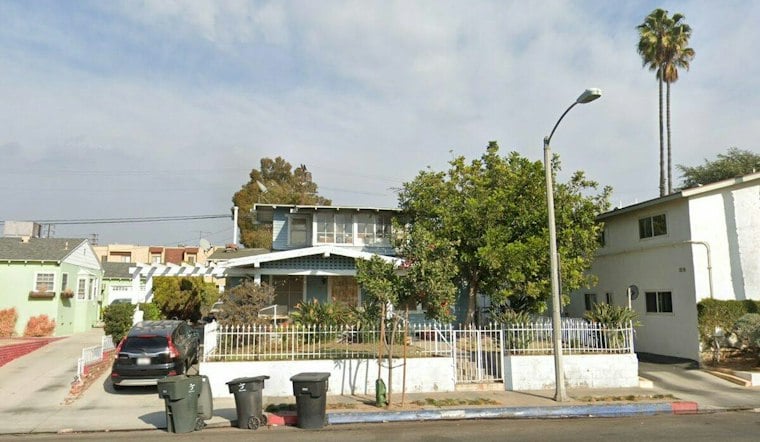
A vacant, century-old house on 20th Street in Santa Monica was on a path toward redevelopment until the City Council stepped in on October 27, voting 5 to 0 to designate it a city landmark and reverse a denial issued just weeks earlier by the city's own Landmarks Commission.
The council's decision overturned the commission's September 14 vote, in which members had rejected the Santa Monica Conservancy's application to landmark the property at 1921 20th Street, finding it met none of the six required criteria, according to surfsantamonica.com. That denial came despite an earlier finding by Historic Resources Group, the city's own consultant, that the single-unit residence was eligible for designation after meeting three of the six criteria needed, the outlet reported.
By the time the council took up the matter, the body overturned the commission's decision to deny the landmark designation in a 5 to 0 vote. Before the vote, surfsantamonica.com reported that the council would decide the house's fate on Tuesday. The council ultimately designated the house as meeting three criteria: its ties to city history, its aesthetic value, and its rarity as an architectural type, landing on the same three-criteria framework the consultant had identified months earlier.
A Rare Survivor of Santa Monica's Early Years
The house was built in 1913 by Simon and Anna Unfried, according to the Santa Monica Conservancy, which notes it is the only one of three structures the couple built on their parcel that still stands. The council's determination described it as an excellent and comparatively rare example of a Craftsman-style Airplane Bungalow in Santa Monica, the outlet reported — a house type named for the cockpit-like second-story sleeping porches that gave the style its name.
The main structure measures roughly 1,379 square feet. A dispute over that figure became a notable wrinkle in the case: the staff report had erroneously cited the dimensions of an added back house, which measures 612 square feet, as if they belonged to the main structure, surfsantamonica.com reported.
The Owner's Side: Mold, Break-Ins, and a Senior Center Plan
Owner Lydia King told the outlet she bought the house on January 2 and said she was never informed it was on a list of structures that could be designated as local landmarks. King described finding holes in the floor and roof, a strong mold smell, and break-ins at the property, and said she wants to replace the two structures on the parcel with a senior center at the front and housing in the back.
King has said she hoped to build affordable housing or a senior center on the R2-zoned lot. The property reportedly has just one full bathroom serving four or five bedrooms. Her stated plans ran directly counter to the landmark designation that the council ultimately approved.
Deeper History: A Jazz Club, a Zoning Fight, and a City Apology
The Unfrieds' connection to the neighborhood extends beyond the surviving bungalow. In 1927, the couple built a two-story brick business block that included four ground-floor shops and a banquet room known as Unfried Hall, according to the Conservancy. Police shut down the hall in 1932 because its use was found to violate the city's zoning ordinance, the Conservancy says.
That history connects to an earlier, more troubling chapter: the Conservancy states that in 1922 the city supported efforts by the Santa Monica Protective League to shut down a successful Black-owned jazz club by passing a restrictive no-dancing law. The episode is one piece of the broader historical record the Conservancy has compiled around the Unfried family's properties.
Landmark status for the house covers only the property's exterior, and the designation allows for interior remodeling and new housing to be built at the rear of the parcel. City staff are expected to return with a formal statement of official action following the vote.



