

























































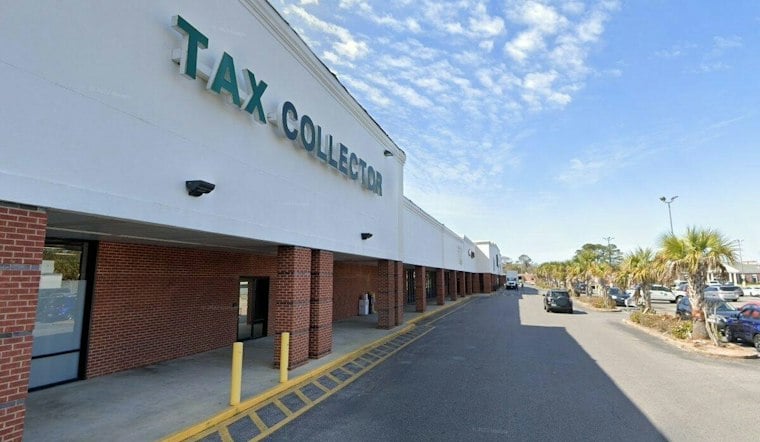
Santa Rosa County commissioners have approved incentives valued at about $1.12 million for a planned shopping complex in Pace. The five-unit project would total 160,000 square feet, and county documents estimate the finished retail development would generate $50 million in annual sales.
This is a property-tax reduction, not a withdrawal from the general fund. For 10 years, ad valorem taxes on the retail development property would be reduced, and Highway 90 Development LLC would save the taxes that development generates. Commissioner Rhett Rowell was the lone vote against. The Pensacola News Journal reported the decision in an account carried by Yahoo News.
A Corner Across From the Hospital
Highway 90 Development LLC, a company from Franklin, Tennessee, plans to build the complex on nearly four acres across from West Florida Regional Medical Center. The same company owns a 22-acre parcel at U.S. 90 and the Pea Ridge Connector. Those are different pieces of ground. The shopping complex is the nearly four-acre plan. The 22 acres are the company's holding at the intersection, with room around the retail boxes. County deal documents call the proposal Project Clerks.
The floor plan is more specific than the tenant list. A sporting goods store and a craft store are each planned at about 55,000 square feet. A decor store would take 25,000 square feet, and a discount store plus miscellaneous shops would occupy about 18,500. Developers have said the complex will house multiple nationally known retail and restaurant outlets. The county released no specific prospective tenants for the five units.
Restaurants are being discussed as neighbors, not as a printed menu. Commission Chairman Colten Wright said the developer is negotiating with restaurants for adjoining outlying properties south of U.S. 90, and that one prospect is a fast-food restaurant. Those sites can share the highway corner with the retail boxes without being one of the five units already drawn.
Economic Development Director Shannon Ogletree said approval of the incentive allows the developer to begin signing lease agreements with prospective tenants. The sequence is plain enough. Commissioners priced the tax break before the public had store names to attach to it.
Ten Years Off the Property Tax Bill
The $1.12 million figure is easy to confuse with the sales tax a shopper pays at the register. It isn't that. Ad valorem taxes are the property taxes tied to the value of the development, and those taxes on the retail property would be reduced for 10 years. Under the incentive agreement, Highway 90 Development LLC saves the taxes the development generates. Santa Rosa County will provide no general fund dollars. The foregone revenue is what the county has valued at approximately $1.12 million.
The company's savings and the county's revenue loss are the same dollars, seen from opposite sides of the bill. The developer keeps tax the project would have paid. The county doesn't receive it. Saying no general-fund check is involved is accurate on the county's terms. It doesn't change the amount.
State law already describes what an ordinance must contain when a local government grants an economic-development ad valorem tax exemption. Section 196.1995 of the 2025 Florida Statutes says the ordinance has to be adopted in the same manner as other county or municipal ordinances. It must include the name and address of the business receiving the exemption, specified current-year ad valorem revenue figures, and the estimated current-year revenue loss attributable to the exemption.
Those lines are how a resident is supposed to see who is relieved and what the relief is expected to cost the current-year tax roll. The terms announced with this vote are the 10-year reduction, the approximate $1.12 million value, and the assurance that existing general-fund money stays put. A tax on buildings that aren't up yet can be described as money the county doesn't have in hand. After the property is assessed, it is money the county has agreed not to collect from this development.
Why Rowell Voted No
Rowell didn't say the corner would stay empty. He said the project would eventually be developed without the incentive, and he called the package a development subsidy that wasn't needed. His other objection was the work. Retail and restaurant jobs, he said, aren't the high-paying jobs needed to attract young workers to Santa Rosa County.
Ogletree answered from the bottom of the pay scale rather than the top. Entry-level retail and restaurant jobs, he said, serve an important role in the economic hierarchy. He then made it local. When his children were 16 and 17, they had to go to Pensacola to find jobs.
The two arguments are about different hires. Rowell is asking whether a decade of reduced property tax buys the wages that keep a young workforce in the county. Ogletree is asking where a teenager gets a first shift without driving into the city. Wright, Commissioner Kerry Smith and Commissioner Bobby Burkett supported the development and the added places to shop and eat. Their stated case was the options, not a claim that retail wages match the jobs Rowell wants the county to chase.
The Escambia Receipt
Burkett supplied the rate on that trip. Some consumers, he said, shop in Escambia County and pay its 7.5% sales tax. That sales tax isn't the incentive the commission approved. The $1.12 million is a reduction in property tax on the development. The 7.5% is what Burkett says residents already pay when they spend the money somewhere else. County documents estimate $50 million in annual sales from the completed Pace retail project and say it would fill a significant retail void. The sales number is an estimate of transactions. It isn't a projection of sales-tax revenue for Santa Rosa County.
The next move Ogletree described is a lease, not a ribbon. The vote, he said, lets Highway 90 Development LLC begin signing agreements with prospective tenants. Restaurant negotiations for the adjoining property south of U.S. 90, including a fast-food prospect, are still negotiations. What Pace has in hand is a Tennessee company's corner across from the hospital, a 160,000-square-foot plan, and a 10-year property-tax reduction the county priced at about $1.12 million. The names on the stores are the detail the county hasn't released.



