

























































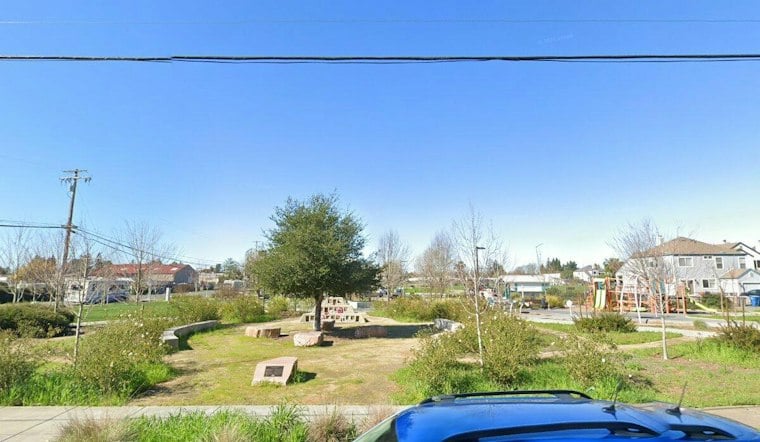
Students at Meadow View Elementary School in southwest Santa Rosa spent last Thursday getting their hands dirty for a project two years in the making: planting 2,245 native seedlings across a 22,000-square-foot patch of their campus using a dense Japanese forestry technique called the Miyawaki method. The schoolyard planting, drawn from 40 native plant species, is believed to be the first of its kind on a local school campus.
The effort was years in the making. According to The Press Democrat, Meadow View school board president Irene Rosario proposed the idea to a district superintendent after a community member raised it at a Moorland Neighborhood Action Team meeting, kicking off a process that began roughly two years before the planting. The school eventually partnered with Neelam Patil, founder of Green Pocket Forest, an organization that facilitates community-building planting efforts with schools, cities and landowners.
The Miyawaki method, which originated with Japanese botanist Akira Miyawaki, works by restoring soil health and then densely packing in only native plant species, a process CBS News describes as designed to encourage rapid growth and biodiversity. At Meadow View, that translated to roughly three seedlings packed into every 10 square feet of soil, a density meant to jumpstart competition and growth among the young plants.
A Classroom Growing Alongside Its Students
Meadow View serves students from transitional kindergarten through sixth grade, and the forest is intended to function as a hands-on outdoor education laboratory as it matures over the coming years. First-year principal Jeanine Wilson said she hopes to weave outdoor learning more broadly into the school's curriculum, and that students will track the forest's growth as they move up through grade levels. Wilson noted that transitional-kindergarten students enrolled this year could observe the forest for the next seven years as they progress through the school.
Students are expected to learn about native vegetation, local birds, butterflies, other species and climate change through the forest, the report notes. Kulbir Sandhu, a fifth-grade teacher at Meadow View, said many of her students do not always have access to green spaces, framing the campus forest as a rare chance for them to interact directly with nature close to home.
Bordering Protected Salamander Habitat
The new forest sits next to an area known as tiger salamander habitat, a protected species, adding an ecological dimension to the project's location in southwest Santa Rosa. Patil said the area around Meadow View and Santa Rosa is vulnerable to the broader urban heat crisis affecting cities across the region, part of why the project appealed to organizers. She built her first Miyawaki forest years earlier while teaching elementary science in Berkeley.
That Berkeley forest, now 4.5 years old, runs about 52.5 degrees cooler than the nearby roadside, according to Patil. Miyawaki forests more broadly are intended to provide habitat for birds, butterflies and other wildlife while replacing lawns that otherwise require extensive watering. Patil said she hopes other school districts adopt similar projects.
A Tribal Blessing Before the First Seedling Went In
Before students began planting, Melissa Elgin, a Bellevue Union School District alumna and secretary of the Federated Indians of Graton Rancheria tribal council, translated a Coast Miwok saying into English for the group. Elgin said projects like this one can strengthen relationships between school districts and tribal communities, framing the planting as more than a science lesson.
Meadow View's project follows a wave of similar plantings elsewhere. Students and volunteers have planted Miyawaki forests at four schools in Berkeley, where, according to Bay Nature, more than 4,000 trees now live across those campuses, per figures from the nonprofit SUGi. Cragmont Elementary students planted their own pocket forest in 2021, and SUGi surveys have since found that more than 90% of plants survived at Malcolm X Elementary and 83% at Cragmont. A 2023 survey at Cragmont's forest recorded Anna's hummingbirds, chickadees, towhees, butterflies, moths and leaf-cutting bees.
Beyond the Bay Area, similar projects have taken root. In Massachusetts, students and community members planted 550 native saplings in the once hard-packed soil of an old baseball field in Attleboro, as NPR reported. And in Berkeley, City Council member Sophie Hahn has recommended funding a pilot program to plant two new Miyawaki forests on city-owned sites, particularly near freeways.
The Science Behind the Hype Is Still Developing
The Miyawaki method's popularity has outpaced the research backing some of its more sweeping claims. CBS News has reported that studies show these tiny forests can grow 10 times faster and sequester more excess carbon than conventional plantings. But a review of 51 pieces of scientific literature, detailed by Mongabay, found that just 41% of those studies provided quantitative assessments, with only 33% of those including a control group and a mere 14% including replication.
That same review found the claim that Miyawaki forests grow rapidly was only partially supported by evidence, while the oft-repeated claim that the forests reach full maturity within 20 to 30 years had no empirical evidence behind it. NPR, by contrast, has reported that a fully mature pocket forest emerges within that same 20-to-30-year window. Of eight papers reviewed that claimed the method boosts carbon sequestration, only two actually estimated carbon stocks, and those two found no statistically significant difference compared to other planting methods over longer time periods, according to Mongabay.
None of that tempered enthusiasm on Meadow View's campus last week. The forest is still expected to mature over the coming years, and for the students who planted it, the payoff may be less about carbon metrics than about watching something they built with their own hands grow up alongside them.



