

























































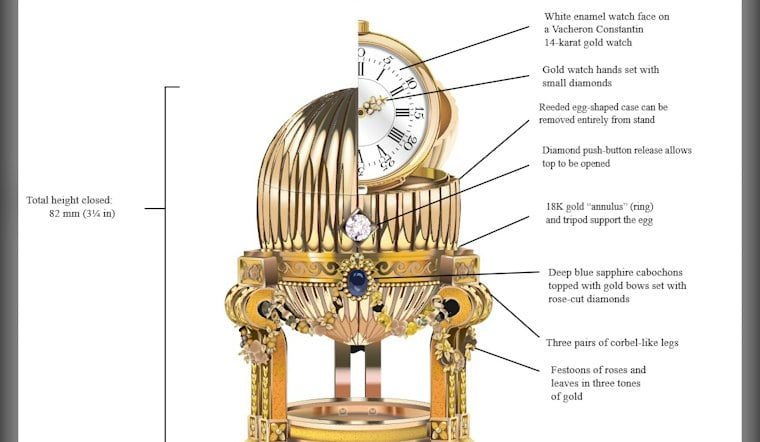
The Third Imperial Fabergé Easter Egg was once misidentified in an auction catalogue as a gold watch in an egg-shaped case. That description helps explain how an object made for the Russian royal family in 1887 could later be bought by an American scrap metal dealer for roughly $14,000, who considered selling it for its gold. He came close to having it melted down before its identity was established.
According to Wartski, the London jewelry firm that ultimately authenticated and sold the piece, the egg was crafted in the workshop of Fabergé's chief jeweller, August Holmström, in St. Petersburg between 1886 and 1887. Tsar Alexander III presented it to Empress Marie Feodorovna as an Easter gift in 1887, one of a long series of jeweled eggs Peter Carl Fabergé's workshop produced for the Russian imperial family between 1885 and 1916, as reported by Futura.
Inside the egg sits a miniature Vacheron Constantin watch, removed from its original case and mounted on a hinge so it can stand upright, Wartski notes. The egg rests on a Rococo Revival stand decorated with gold petals and rose-cut diamonds, supported by three lion-paw legs, per Futura's account of the piece.
From the Tsars to a Scrap Yard
The egg’s documented trail grows uncertain after the Russian Revolution. The provisional government took it from the imperial family’s possessions following the February Revolution of 1917; it remained under state control after the Bolsheviks seized power that year, and government records placed it in state hands by 1922, according to Futura. The outlet reports that the Soviet government later sold valuables from former imperial collections during the 1920s to raise foreign currency and acquire industrial equipment, but the egg’s specific route out of Russia remains unclear.
Kieran McCarthy of Wartski has suggested, as a hypothesis, that businessman Armand Hammer may have brought the egg into the United States through Soviet-era trade, since Hammer is known to have brought numerous Russian antiques into the country. The egg then surfaced at a Parke-Bernet auction in New York in March 1964, where, per Fabergé Discoveries, a March 6, 1964 catalogue listed it only as a gold watch in an egg-form case by Vacheron Constantin. Lacking any Fabergé marks, the piece went unnoticed for what it truly was and sold for $2,450, as Barnebys recounts.
A Near Miss With the Melting Pot
Accounts differ on how the scrap metal dealer acquired the egg and what he paid. Wartski says it remained in the United States and was eventually bought for $14,000 by someone unaware of its provenance; Barnebys says a Midwestern dealer paid $13,302 for it at a flea market in 2004. The dealer struggled to resell it and decided in 2012 to investigate its origins, according to Barnebys. He has said he considered having it melted down for its gold.
The auction description was one part of the trail that eventually led researchers to the egg. Wartski says Vincent and Anna Palmade determined in 2011 that the missing Third Imperial Egg had made it to the West and entered the collection of a New Yorker named Mrs. Rena Clark. Fabergé Discoveries reports that researchers had spotted an indistinct egg-shaped object in a photograph of an 1902 exhibition display in October 2007; they later matched it to the photograph in the 1964 auction catalogue.
Confirmation and a Quiet Sale
The scrap metal dealer eventually approached Kieran McCarthy at Wartski with photographs and documents, and McCarthy traveled to inspect the egg in person at the dealer's American home before confirming its identity. Wartski went on to acquire the egg and sold it to an anonymous private collector, with the financial terms of that sale undisclosed, Futura reports.
The egg and its stand were estimated to be worth around £20 million, or roughly $33 million at the time, according to Barnebys. The new owner allowed it to be exhibited at Wartski's London showroom for four days in April 2014, a brief public unveiling that writer Digby Warde-Aldam witnessed firsthand, Futura notes. The egg later went on public view again at the Victoria & Albert Museum's Fabergé in London: Romance to Revolution exhibition in 2021 and 2022, per Barnebys.
The rediscovery narrowed the list of unaccounted-for imperial treasures, but published estimates of how many eggs remain unlocated differ. The figures depend on how sources describe the collection and its surviving or missing eggs; the distinction is worth keeping in mind when comparing the counts.
What the Surviving Records Show
Wartski says seven of the 50 imperial Easter eggs remained missing after the Third Egg’s rediscovery. Barnebys gives a count of six undiscovered eggs, while CNN reports that eight, including the Third Egg, were once thought lost entirely. These accounts therefore do not give a single consistent number for how many remain unlocated. The available accounts describe Soviet-era sales of former imperial valuables but do not establish the Third Egg’s particular route out of Russia. A separate example shows one documented path: according to Russia Beyond, the Moscow Kremlin Armory sold a different Fabergé egg, originally given by Emperor Nicholas II to Alexandra Fyodorovna, to Wartski Gallery in London in 1927; it later became part of the Malcolm Forbes collection. That sale is an example involving another egg, not evidence of how the Third Egg left Russia.



