

























































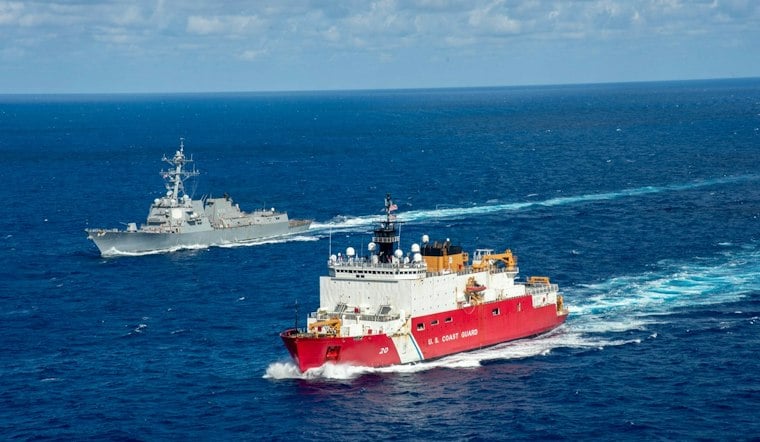
The Coast Guard Cutter Storis pulled back into its temporary Seattle home port after a 133-day deployment to the Arctic Ocean and Alaska's far northern waters, capping a stretch that included keeping tabs on four Chinese-flagged research vessels operating over the U.S. extended continental shelf. The 360-foot medium icebreaker covered more than 17,000 nautical miles during the mission, according to the seed facts behind this report.
According to the Coast Guard, Storis returned to Seattle on a Saturday after completing the deployment to the Arctic Ocean and Alaska theater of operations. As KIRO 7 News Seattle reported, the deployment included monitoring those four Chinese-flagged research ships, part of what the cutter's crew logged as more than 300 hours tracking foreign-flagged research vessels under Operation Frontier Sentinel.
A Packed Arctic Workload
Beyond shadowing foreign vessels, Storis served as the Coast Guard's newest icebreaker and the sole U.S. surface asset deployed to the high Arctic during the mission. The deployment also marked the first designated law enforcement mission by a polar icebreaker in more than two decades, and included the first live-fire exercise by a Coast Guard surface vessel in ice-covered Arctic waters in decades, carried out in the Arctic Ocean.
The crew's work ranged well beyond tracking foreign ships. They conducted fishing vessel inspections in the Bering Sea, tested unmanned aircraft systems in extreme cold, and assisted the grounded fishing vessel Aleutian Dream, eventually escorting it back to Dutch Harbor. Storis also took part in a combined sail under Operation Tundra Merlin in the Bering Sea, training alongside USCGC Munro, USCGC Fir and the Royal Canadian Navy's HMCS Max Bernays to sharpen multi-domain awareness across the Alaskan theater of operations.
Why the Cutter's Workload Keeps Growing
Storis's packed schedule comes as USCGC Healy, one of the Coast Guard's polar icebreakers, remains sidelined. Healy suffered an engineering casualty during sea trials off Washington state in July and had to be towed back to Seattle, according to gCaptain. The outlet reported that the Coast Guard has not publicly identified the cause of the casualty or given a timetable for repairs, and that a source's account describing a crankcase explosion in a diesel engine has not been confirmed by the service.
Healy will not complete its planned 2026 high-latitude summer mission as a result, the same report said, and more of the Coast Guard's Arctic workload has fallen to Storis in the meantime. The Coast Guard has said it is developing repair plans and evaluating whether Healy can still be used for additional operations. During its own 129-day Arctic patrol in 2025, Healy had covered more than 20,000 miles while monitoring foreign research vessels operating over the extended continental shelf and within the U.S. exclusive economic zone, per gCaptain's reporting.
China's Growing Footprint in the Arctic
The vessels Storis tracked are part of a broader pattern of Chinese activity in the region. Rear Adm. Bob Little said four Chinese research vessels worked offshore in the U.S. Arctic in 2026, compared with five across all of 2025, according to Defense News. That report described China as having stepped up its polar presence in recent years, at times operating jointly with Russia and at other times alone.
Last summer, China sent five research vessels — including several icebreakers — into Arctic waters simultaneously, in what gCaptain called the country's largest polar deployment to date, spanning the Bering Sea, Bering Strait and waters north of Alaska. The same report noted China conducted more than forty manned submersible dives in the Arctic last summer, and that Chinese vessels conducting scientific operations near Alaska's extended continental shelf have repeatedly been shadowed by U.S. Coast Guard cutters and maritime patrol aircraft. China's 16th Arctic scientific expedition, involving the vessels Xue Long, Xue Long 2 and Jidi, with Tan Suo San Hao also expected to join, departed China with plans to continue research through October focused on climate, marine, atmospheric, oceanographic and sea-ice conditions.





