

























































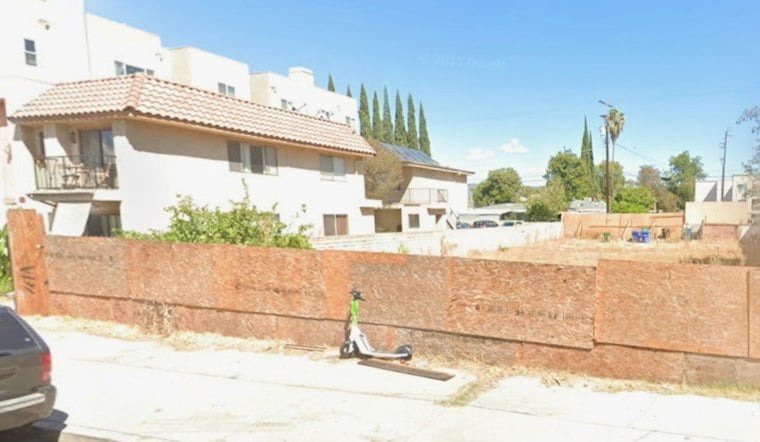
An empty lot near the G Line busway in Valley Village could soon become a six-story apartment building with 25 homes, including three units set aside for extremely low-income renters. The project, proposed by VLI Holding LLC, would rise at 5414 Bellingham Avenue, just two blocks west of the G Line's Laurel Canyon Station.
The Los Angeles Department of City Planning recently received a new application for the redevelopment, according to Urbanize LA, which reported the proposal. Notably, the outlet's own headline refers to the site as 5412 Bellingham Avenue, while the project details in its report place the building at 5414 Bellingham Avenue — a discrepancy that remains unresolved in the available records.
As described in the application, the proposed building would stack 25 one-, two-, and three-bedroom apartments above parking for just two vehicles. Three of those apartments would be reserved for extremely low-income renters, and the project is requesting city development incentives that would allow a larger building than current zoning would otherwise permit at the property. HRD Arch, Inc. is designing what's described as a contemporary, podium-type structure.
A Push Tied to Faster Buses on the G Line
The Bellingham Avenue proposal lands as Metro pours resources into the surrounding transit corridor. The agency is undertaking a $668-million project aimed at speeding up travel times along the G Line busway, the report notes. The G Line itself is a bus rapid transit line that runs across the San Fernando Valley, and that broader modernization effort is part of why land near its stations has become a target for new housing.
Construction on the busway speed-up broke ground in March 2025, according to Streetsblog Los Angeles, and includes grade separations at a few busy street crossings along with new railroad-type crossing gates. Bus and bike detours are currently in effect around the work zone, and the outlet reports the faster, safer busway is expected to open before the 2028 Olympics.
Part of a Citywide Pattern Near Transit Stops
The Bellingham Avenue pitch isn't an isolated case. A few miles away, LA Family Housing's selected concept would redevelop the G Line's Lake Balboa Station park-and-ride lot at 6338 Balboa Boulevard with 321 homes built in two phases, per the Lake Balboa Neighborhood Council. That plan calls for a seven-story building with 164 apartments followed by a six-story building with 157 more homes, plus parking for 312 vehicles and over 13,000 square feet of commercial space on the roughly 2.3-acre site. Those Lake Balboa apartments would be reserved for renters earning up to 70 percent of the area median income.
Metro identified 17 properties as possible joint-development sites back in 2023, part of a broader push by the agency to build at least 10,000 homes on land it owns, the neighborhood council's report notes. Outreach for the Lake Balboa site specifically ran through 2024 and 2025.
How the City's Transit-Oriented Incentives Work
Developments like the one proposed on Bellingham Avenue often rely on Los Angeles's Transit-Oriented Communities program, which city voters approved in 2016 and which took effect in September 2017, according to Streetsblog's earlier reporting on the program. The program offers affordable-housing incentives near qualifying transit stops.
The program has reshaped housing proposals across the city. In 2019 alone, more than 14,500 new units — 42 percent of all housing proposed citywide that year — came through the TOC program, the same Streetsblog report found. The program also incentivizes affordable housing near transit. The TOC program is one route for proposing affordable housing in Los Angeles.
The program also offers density bonuses. The program's rules include a five-unit minimum for covered housing developments.
A Newer State Law Looms Over the Corridor
Beyond the city's own program, a state law could eventually reshape density expectations near stops like the Laurel Canyon Station. SB 79, known as the Abundant and Affordable Homes Near Transit Act, was scheduled to take effect July 1, 2026, and establishes increased housing density within a half-mile of rail, bus rapid transit stations, and some full-time bus lanes, according to a Los Angeles City Clerk report. That same report identifies the G Line as a Tier 2 transit service eligible for transit-oriented-development treatment under the new law, and notes the city's broader eligibility analysis counted 141 eligible transit-oriented-development stops citywide.
Whether SB 79 will ultimately apply to the Bellingham Avenue proposal specifically isn't addressed in the available records. For now, the project remains an application before city planners, with its exact zoning path, entitlements, and timeline still unknown.





