

























































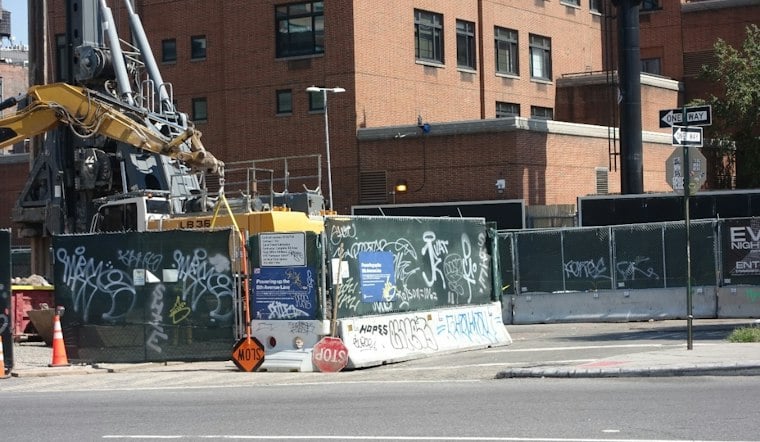
The dirt pit next to the Canal Street subway entrance at Sixth Avenue was supposed to be a basketball court again by now. Instead, as of early November, Grand Canal Court remains unpaved, with crews working in the pits on the Thursday before Gothamist's Nov. 2 report, while transit officials set yet another target date — the end of this month — to finally finish the job.
The site has not yet been paved, and none of the new amenities, including the basketball court and hoops, have been installed, according to Gothamist. The outlet reports the court is set to reopen at the end of November, per transit officials — the latest in a string of projected finish lines for a project that has dragged on for years. Construction crews have been working in timber-shored pits below the street, next to an entrance to the Canal Street station on the A, C and E lines, and straphangers currently must squeeze through a narrow passage just to reach the subway.
A Budget That Nearly Doubled
MTA workers ripped up the courts in 2022 to build a new substation meant to supply power to trains, and the project's price tag has climbed sharply since. The budget stood at $45 million in 2014 but has swelled to $83.7 million, according to MTA records cited by Gothamist, with the agency attributing the increase to a host of issues, including unforeseen utility work.
The timeline has been just as unstable as the budget. The MTA said in December 2022 that the project would be complete by the end of 2024, and a March 2023 resolution from Manhattan Community Board 2 noted construction was already underway and expected to continue through the end of 2025, with the surface-level park reopening in the third quarter of 2024. Separately, a sign at the site said the project should have been done by April 2026 — a discrepancy the agency did not explain, per the same Gothamist report. And in May 2026, Tribeca Citizen reported the MTA expected the court to fully reopen by the end of summer, a date that has since slipped to the current end-of-November projection.
Neighbors Push for a Dog Run Instead
Not everyone wants the basketball court back as-is. An online petition to replace it with a dog run has grown to 2,200 signatures, Gothamist reports — up from the 1,600 signatures Tribeca Citizen recorded in May, when the petition was led by Laura Smith. The worksite itself is currently surrounded by litter, a visible reminder of how long the block has sat in limbo.
Once finished, the refreshed court is planned to include new benches, a water fountain, upgraded lighting and new fencing, per transit officials. Alberto Roldan, the parks department's borough commissioner, said the community would be welcomed back to an upgraded space for activity and recreation. NYC Parks, which lists the site as the Grand Canal Court Basketball Courts at Grand and Canal streets, notes that organized leagues or special events need a permit to use the court.
Longtime Users Have Mixed Feelings
John Underwood, a 68-year-old retired city worker who has walked by the site for decades, told Gothamist he had forgotten it was even a basketball court and guessed it might open in a year or two. Herb Tam, an organizer with the Chinatown Basketball Club, remembered teenagers coming from the Canal Street station and nearby schools to play at the park, and said regular users might already have found other places to shoot hoops after years without a court.
Tam said a closed park changes the feel of the whole block, and that neighborhoods around active parks feel safer. He added that he could not imagine his own club's court closing for even a month, let alone the Canal and Sixth Avenue courts sitting shuttered for this long.
A Century of Shifting Uses on Sixth Avenue
Andrew Berman, executive director of Village Preservation, pointed out that the wedge-shaped parkland was created by Sixth Avenue's southern extension back in the 1930s. He said these oddly shaped Sixth Avenue lots have proven to be popular and resilient recreational spaces over time, comparing the shifting uses to how Manhattan bocce courts have given way to ballfields and playgrounds elsewhere in the borough. Berman noted that longtime uses sometimes disappear — a dynamic the dog-run push may now be testing at Grand Canal Court.
The underlying infrastructure work has a broader purpose beyond the park itself. Community Board 2 described the substation as a new subsurface power station for the Eighth Avenue A/C/E line, intended to increase subway service capacity by five trains per hour. It is a goal that dates back even further — a 2018 proposal had already sought to let the MTA use the court's ground level as a construction staging area for up to 45 months.





