

























































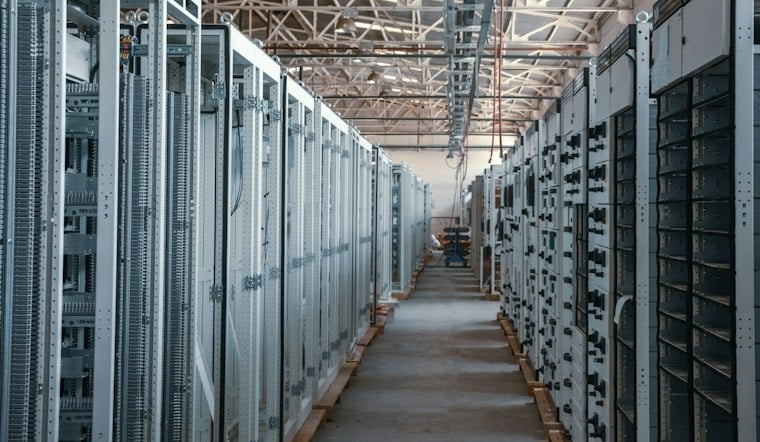
Soluna Holdings is laying the groundwork for a data center expansion in Willacy County that CEO John Belizaire describes as a nearly $4 billion capital investment, with construction expected to employ roughly 1,200 workers continuously over an estimated 14-month build. The project, known as Project Kati 2, would span hundreds of thousands of square feet and draw on wind power the Texas grid often cannot use.
According to the Rio Grande Guardian, Belizaire, the New York-based CEO of Soluna Holdings, said the figure reflects the scale of the planned AI and high-performance-computing facility, which would sit alongside the company's existing Project Kati 1 site. That first facility runs on 83 megawatts of capacity, occupies roughly 30 acres, cost tens of millions of dollars to build, and currently employs about 10 workers, the outlet reports. Kati 2, by comparison, is expected to consume 166 megawatts of electricity once fully operational and employ approximately 40 full-time staff.
A separate state filing paints a somewhat different financial picture. A Texas Department of Licensing and Regulation filing described Kati 2 as a planned, single-story, 471,884-square-foot AI data center near FM 1420 in the Santa Monica area, according to RGV Business Journal, which put the estimated construction cost at $471.8 million — a figure far smaller than the nearly $4 billion expansion total cited by the Guardian. It's not clear from available records whether the two numbers measure the same scope of investment. The filing report also listed critical IT load at approximately 112 megawatts for Kati 2, while Kati 1 has 83 megawatts of capacity.
Who's Building It, and Where the Power Comes From
The same filing named Soluna KK Energy Service Co. LLC as the project owner and Dallas-based HKS Inc. as the design firm, per the RGV Business Journal report. Soluna has built its business model around locating data centers beside renewable generators that face transmission bottlenecks, and Kati 2 is no exception: the Las Majadas wind farm is expected to supply clean, curtailed wind power directly to the facility, according to the Guardian.
Belizaire said about half of the power generated by the affected power plants never reaches the grid, framing Kati 2 as a way to put that stranded electricity to use. Soluna has applied the same strategy elsewhere in the Rio Grande Valley — the company previously announced Project Ellen, a 100-megawatt data center on a 145-megawatt wind farm in neighboring Cameron County, and Project Hedy, a 120-megawatt facility planned on a 200-megawatt wind farm in the same county, per earlier RGV Business Journal reporting.
Cooling Without Tapping Local Water Supplies
Soluna plans to cool Kati 2's AI servers using direct liquid cooling in a closed loop, relying on glycol-enhanced water trucked in from off-site suppliers rather than groundwater or local municipal water for daily operations, the Guardian reports. Belizaire said the cooling water circulates in a loop and pulls heat away from server chips, with the glycol-enhanced water recirculating continuously once the system is running.
Daily operations are expected to use water equivalent to about four homes' annual usage, while construction itself is projected to use water equivalent to roughly 75 homes' annual usage, according to the outlet. Running the facility will also require local electrical, mechanical, networking, security, and maintenance contractors, and the project is expected to support local technology careers for Willacy County graduates.
Tax Deal Still Being Negotiated
Soluna currently pays Willacy County $160,000 annually under its Project Kati 1 tax abatement, and the company is proposing a Chapter 312 tax abatement and payment-in-lieu-of-taxes agreement for Kati 2 as well. The annual pilot payment tied to the new project is expected to be significantly larger than the Kati 1 payment, though pilot terms are still being negotiated with the Willacy County Commissioners Court, per the Guardian's reporting.
Under Texas law, a property-tax abatement is a local agreement between a taxpayer and a taxing unit that exempts all or part of an increase in property value from taxation for no more than 10 years, according to the Texas Comptroller of Public Accounts. Soluna plans to submit a formal Chapter 312 application to the commissioners court, and the approval process includes five stages involving commissioner reviews, public hearings, and a formal comment period. Belizaire said Kati 2's investment will support local schools and county infrastructure through the proposed tax arrangement — notable in a county whose total assets run roughly $1.2 billion.
Soluna held a community open house in Raymondville on October 12, marking the first in a series of planned outreach sessions. The company aims to break ground on Kati 2 in early 2027 and bring the facility online in the second quarter of 2028, and says it will provide computing capacity to major enterprises, pharmaceutical companies researching therapies, and energy firms working on sustainable power solutions.
Part of a Statewide Power Crunch
Kati 2 lands amid a surge in data-center demand statewide. ERCOT's 2025 load forecast projected 218 gigawatts of demand by 2031, up sharply from the 150 gigawatts projected just a year earlier, with the grid operator attributing the jump to anticipated data-center growth, according to an ERCOT report. The grid operator was tracking nearly 238.6 gigawatts of large-load interconnection requests as of December 2025, though only 7,502 megawatts had been approved to energize since January 2022.
That bottleneck has left some renewable power going unused. Other Texas utilities are taking a different approach to the same demand crunch: in El Paso, the local electric utility has planned a 366-megawatt gas plant built from 813 small gas generators to supply a data center being built by Meta, according to The Texas Tribune. Soluna, by contrast, has staked its model on tapping power that would otherwise go to waste — a bet now being tested at a much larger scale in Willacy County.




