

























































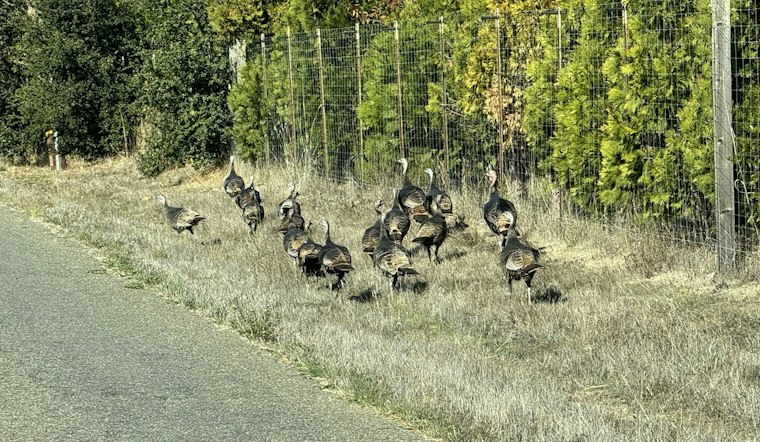
Those gangly flocks of wild turkeys strutting across Sonoma County vineyards and backyards this time of year are not a native species today; California had a native turkey species about 10,000 years ago, but it went extinct. Every bird roaming the county's oak woodlands today descends from turkeys deliberately brought in from Texas and Mexico during the 20th century, part of a decades-long state effort to establish a huntable population where none existed before.
Not a Single Native Bird in the Bunch
The California Department of Fish and Wildlife did not succeed in establishing wild turkey populations until 1959 and the years that followed, after several earlier attempts using farm-raised and wild-caught birds, according to the UC Statewide Integrated Pest Management Program. The modern wild turkey, Meleagris gallopavo, is itself a hybrid bred from subspecies collected in Mexico and the American Southwest, intentionally introduced to California and Oregon throughout the century as a game species for hunting and eating, per the Bay Area Nature Almanac.
That reintroduction effort has deep Sonoma County roots. Early efforts to establish turkeys in California preceded CDFW's eventual success in 1959 and subsequent years. From 1959 through 1999, the Almanac reports, the state continued trapping wild Rio Grande turkeys in Texas and re-releasing them across California, and that subspecies now has the widest range in the state, turning up in oak woodlands, agricultural land, and even urban areas.
A Cross-State Survey Puts a Number on the Flocks
Just how many turkeys call Sonoma County home became the focus of a two-woman graduate-course geospatial science research project at Oregon State University, with one researcher from Oregon and the other from Santa Rosa. The pair built a turkey-sighting survey in Sonoma County and Marion County, Oregon, two regions separated by more than 580 miles, as Sonoma Magazine reported. The survey drew 92 total responses, 79 of them from Sonoma County alone.
The Almanac's author extrapolated from turkey-hunting harvest data: spring 2024 figures show at least 750 turkeys were taken by hunters in Sonoma County, out of nearly 20,000 taken statewide, putting the county's share at about 4 percent of the statewide harvest. The author calculated that Sonoma County is likely home to well over 13,000 wild turkeys, more than any other Bay Area county.
Why the Habitat Is So Forgiving
A California Department of Fish and Game biologist told The Press Democrat in 2012 that the county's grasslands and rolling oak woodlands amount to ideal turkey habitat, saying, “You couldn't create better habitat for them.” That same reporting noted turkeys had been introduced to California on several occasions over the prior century. Sonoma County's expansive oak woodlands and grasslands supply the birds' preferred diet of acorns, nuts, seeds, berries, insects, and occasionally small animals, with turkeys foraging heavily in late fall to bulk up for winter.
Statewide population counts remain murky and inconsistent. The UC Statewide Integrated Pest Management Program puts the current statewide population at roughly a quarter million birds, while the Bay Area Nature Almanac reports that updated statistical methods suggest the number may now sit closer to 340,000, and cites an independent estimate as high as 400,000 attributed to agency spokesperson Peter Tira.
How Turkeys Behave in Late Fall
In late fall, the birds split into sex-specific flocks after breeding and rearing season, the Bay Area Nature Almanac notes, before reuniting for mating season in late winter and early spring.
The birds aren't without predators of their own. Local turkeys serve as prey for foxes, bobcats, coyotes, and mountain lions, a natural check on a population that otherwise shows little sign of retreating from the county's vineyards, roadsides, and backyards anytime soon. Nearby Marin County tells a similar origin story: officials there say most of its wild turkeys trace back to birds brought in by the state in 1988 to create hunting opportunities on private land, according to the Marin Independent Journal, while on the Peninsula, present-day flocks are described as a mix of various subspecies, per The Almanac.



