

























































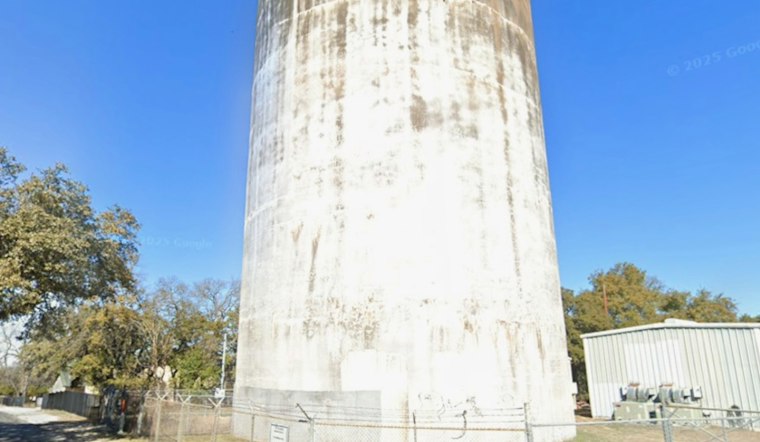
Rain didn't keep dozens of South Austin neighbors away Sunday as the city unveiled a sprawling new mural wrapped around the Armadillo Water Tank, a colorful landmark now celebrating the neighborhood's history, culture and community. Among those in the crowd was Wayne Schneider, whose family once lived on the very land where the 80-foot tank now stands.
A Family Reunion With a Water Tank
Schneider's father bought the property in 1938, and the family lived there until 1951, when they moved after the land was needed for water infrastructure, according to KVUE. The property eventually became part of Austin's water system. Schneider said he knew he would return to see the mural once it was finished, a small but personal homecoming to land his family hadn't owned in 75 years.
That family history is woven directly into the artwork. A small honeybee tucked into the design recognizes the property's earlier life as a beekeeping farm, the station reports. The tank itself sits at 910 Armadillo Road in Armadillo Neighborhood Park, standing 80 feet tall, as Austin American-Statesman noted in its earlier coverage of the project.
Armadillos, Instruments and a Nod to a Legendary Venue
The large-scale piece features armadillos, musical instruments, wildflowers and that lone honeybee, blending natural imagery with a wink at Austin's cultural past. The design references Armadillo World Headquarters, the influential music venue that closed in 1980, per the Statesman's reporting from August. It's a fitting tribute in a neighborhood where the tank and park bear the Armadillo name.
Austin artist Bill Tavis spent approximately 14 months on the project overall, including four months painting the tank on-site, the same KVUE report states. Tavis has said public art belongs to everyone, not just those with private homes to display it in — a philosophy that fits a mural meant to be seen by an entire neighborhood rather than a single collector. Reported figures for the mural's size differ: KVUE put it at approximately 14,000 square feet, while the Statesman reported Tavis saying it would wrap around the tank's 180-foot circumference and cover about 14,400 square feet.
Budget Grew as the Project's Scope Expanded
The project didn't start out as a full wraparound design. The initial plan called for painting only a portion of the water tank, but the scope later expanded to cover the entire exterior from ground to roof, per city documents. That expansion came with a bigger price tag: the project was initially authorized for $133,000, and the Austin City Council later authorized an additional $90,850, bringing the total contract authorization to $223,850, according to the same KVUE report. The Statesman had earlier reported that the city agreed in March 2025 to commission Tavis and set aside the initial $133,000 through the Art in Public Places program.
The project was funded through an Austin Water beautification initiative and administered by the city's Art in Public Places program, and city officials described it as an atypical project within that program, the station's report notes. The program, established in 1985, allocates 2% of eligible capital improvement project budgets toward public art, per the same account.
A Push for Art Beyond Downtown
District 2 Councilmember Vanessa Fuentes said the mural represents an opportunity to bring more public art into neighborhoods outside Austin's downtown area, according to the station's report. The unveiling turned the water tank into a storytelling centerpiece for South Austin — one that, for at least one former resident, carried the weight of family memory as much as civic pride.





