

























































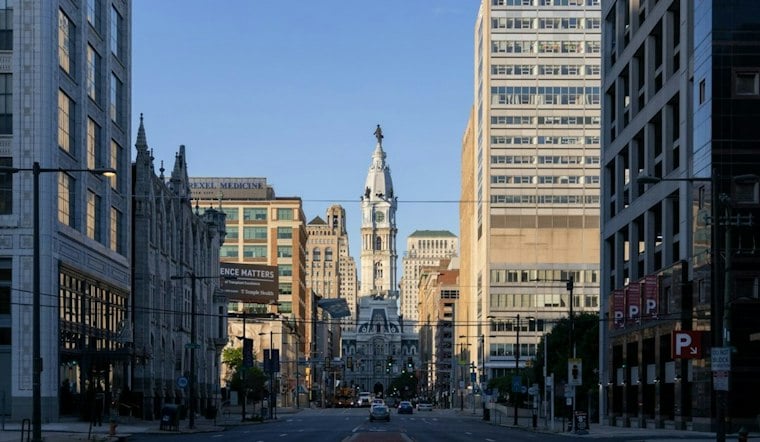
A four-foot-tall, tree-filled median has gone up on South Broad Street in front of the Kimmel Center, and it's already become a flashpoint in a fight over how Philadelphia should spend $150 million remaking its most storied boulevard. The planter is the first visible piece of a decade-long plan led by Avenue of the Arts Inc. to transform the one-mile stretch from City Hall to Washington Avenue, and residents, critics, and city boosters are far from agreement on whether it's working.
A Decade-Long Vision Takes Its First Steps
According to Axios, Avenue of the Arts Inc. is leading the revamp of 10 blocks along South Broad Street, with the project pitched as a once-in-a-generation effort to overhaul Philadelphia's premier public boulevard into a pedestrian-friendly arts park with improved stroll-ability. The nonprofit traces back to Ed Rendell's tenure as Philadelphia mayor, when the Avenue of the Arts concept was first created, Axios reports. The new median sits between Spruce and Pine streets, directly in front of the Kimmel Center, and according to NBC10 Philadelphia, the $150 million project will reshape the full one-mile corridor over the next decade.
NBC10's reporting describes a design that would eventually bring landscaped medians, seating, enhanced lighting, outdoor performance spaces, rotating public art, and sculptural elements to the corridor. The station also reported that construction on this first phase was scheduled to begin January 30, 2026, and was expected to wrap by June 2026. A planned sidewalk renovation for the same block between Spruce and Pine would add more greenery and sidewalk bump-outs at the corners while eliminating shoulder lanes, per Axios — though construction on that piece of the work could begin as early as fall 2027.
Sticker Shock Over a Single Block
The price tag on the first visible piece of the project has drawn scrutiny. The Philadelphia Inquirer reported that Avenue of the Arts installed a 230-foot-long planter in the median between Spruce and Pine, describing it as the first step — a so-called beta block — in the broader $150 million effort to green South Broad Street. The same Inquirer column put the cost of that median planter at $5 million, including $4 million from government sources, and reported that the nonprofit estimates it will cost another $10 million to build curbside planters on that single block, with board chairperson Carl Dranoff saying the organization had raised just $1.5 million toward that goal so far.
Those figures have fueled complaints that the spending is outsized for what's been delivered so far. The Inquirer noted that Philadelphia spent $14 million in 2015 on stainless steel light masts for North Broad Street, a comparison critics have used to question the scale of costs now attached to a single South Broad block. Design critic Inga Saffron has criticized the redesign, according to Axios, and a design advocacy group has also pushed back, arguing that the most successful civic spaces are often defined not by what is added but by what is left open.
Safety, Space, and a Missing Conversation
Critics cited by Axios argue the design provides too little open space and pedestrian flow, calling the median itself too high and overloaded — combining greenery, public art, and traffic control in a single structure. They've also said the sidewalk design planned for the block is crowded and leans on too many large raised planters, and that the broader project lacked sufficient public discussion before moving forward. A Bicycle Coalition representative went further in comments to the Inquirer, calling the shoulder-planting proposal a missed opportunity to make Broad Street safe for bicyclists and pedestrians.
Doubts aren't limited to design details. Laura Burkhardt, a former Avenue of the Arts director, told the Inquirer she questions whether the organization itself has the ability to execute a master plan of this scale. That skepticism lands at an awkward moment: Axios reports the nonprofit is still actively fundraising for the project, and that the ongoing public debate may be shaping how donors respond.
Rendell Defends the Long Game
Ed Rendell has pushed back hardest against the early criticism. Rendell wrote an essay backing the overall project, arguing in the Inquirer that judging the project by its first 230 feet is like reviewing a play after the overture. He's said it's too early to render a verdict, framing the new median as a signal that Philadelphia is investing in its future rather than a finished product to be picked apart.
According to Axios, Rendell has argued the focus should stay on making the Avenue of the Arts a true destination for businesses and people, not on relitigating a single traffic island. “We cannot let naysayers throw cold water on a new idea before it has a chance to take root,” he said, per Axios. Dranoff, who is also a major Philadelphia real estate developer, has echoed that long-view approach, telling Axios that each block along the corridor will ultimately carry a different design. “It won't be identical but it will be unified,” Dranoff said.





