

























































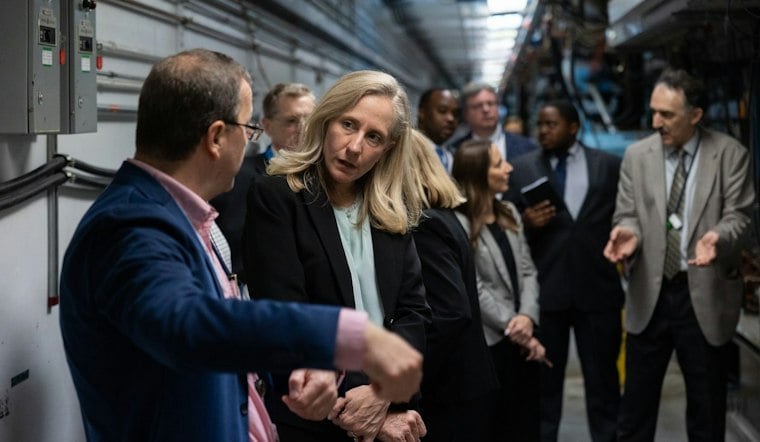
Governor Abigail Spanberger stood before a crowd at Ironclad Distillery in Newport News to rally support for Constitutional Amendment 3, the ballot question asking Virginians whether the state should automatically restore voting rights to people once they're released from incarceration for a felony conviction. She told the gathering that Virginia's history of disenfranchisement makes it essential to spell out voting rights explicitly in the state constitution, and that those rights shouldn't hinge on whichever governor happens to be in office at the time.
“In Virginia, we want to ensure that every Virginian has the ability and the right to cast their ballot,” Spanberger told the crowd, arguing that voting rights shouldn't depend on the governor's politics, according to 13News Now. Under current Virginia policy, voting rights are restored automatically upon release for most felony convictions; the governor must personally restore rights for people convicted of murder, voluntary manslaughter or involuntary manslaughter. Amendment 3 would make restoration automatic upon release for people convicted of those offenses as well. U.S. Rep. Bobby Scott also attended the Newport News rally, lending his support to the measure alongside Spanberger.
Newport News Delegate Marcia Price, a Democrat, joined the event and said many people don't realize voting rights aren't already written into Virginia's constitution, calling the amendment a way to close a longstanding gap in that document. Price described the measure as a step toward addressing the legacy of Jim Crow, framing it as a move that would push Virginia beyond that history of disenfranchisement and toward fuller democracy. Latonya Roberson, also at the rally, said generations of people fought hard for the right to vote.
What the Amendment Would Actually Change
The ballot question itself asks voters whether Virginia should automatically restore voting rights upon release from incarceration, rather than leaving that decision to the governor's discretion. As quoted by Cardinal News, the amendment's text would restore political rights “upon release from incarceration for that felony conviction and without further action required by him.” The measure would also write a fundamental right to vote into the state constitution, with language stating that “every person who meets these qualifications shall have the fundamental right to vote in the Commonwealth, and such right shall not be abridged by law,” according to WHRO.
WHRO also reported that the amendment wouldn't immediately change any voting laws on its own. Instead, the outlet reported, it could reshape how courts evaluate future challenges to state election rules. The same reporting noted the amendment would additionally require a court to find that a person doesn't understand what voting is before that person could be barred from casting a ballot on grounds of mental incapacity.
A Republican Leader's Case Against the Amendment
House Republican Leader Terry Kilgore has emerged as one of the amendment's most vocal opponents, and the station's report notes he supports giving people a second chance after a felony conviction, just not through this particular amendment. Kilgore argued that restoration of political rights should come only after someone has completed probation, parole, and paid restitution to victims — a sequencing the current amendment doesn't guarantee. Phill Kline argued in an opposition opinion piece for Cardinal News that the measure could restore rights to someone “still owing restitution, still under supervision.”
Phill Kline also questioned the amendment's use of the phrase “all political rights,” arguing it may extend further than just voting rights and needs clearer definition before Virginians vote on it. He warned that the amendment's protection against the right to vote being “abridged by law” could open the door to legal challenges against routine election procedures. As Kline wrote, “Every other rule — photo identification on an absentee ballot, a witness signature on an absentee ballot envelope, a defined election day, a receipt deadline — becomes a law that can be challenged.” Kline argued that voters should reject the current version so lawmakers can revisit and refine its language, adding he would support a revised amendment that addresses his concerns. Cardinal News solicited opinion pieces from groups on both sides of the ballot question to lay out these competing arguments.
How Restoration Already Works Under State Policy
Virginia's current practice has already shifted this year. VPM reported that, in response to a federal ruling, state policy now disqualifies only three felony convictions from voting — murder, voluntary manslaughter and involuntary manslaughter — a narrower list than in years past. Virginia Department of Elections guidance also states that the right to vote is restored automatically upon release from incarceration, except for people convicted of disqualifying offenses listed by the department, who need the governor to personally restore their rights.
The Brennan Center for Justice notes that the General Assembly voted in January 2026 to place this amendment on the November 3 ballot. Separately, in July, Spanberger used her executive authority to restore voting rights to 66,085 formerly incarcerated Virginians, according to the same report.
The Scale of Disenfranchisement in Virginia
The stakes behind the ballot question are tied to how many Virginians the current system excludes. The Sentencing Project estimated that more than 260,000 Virginians were barred from voting because of a felony-level conviction in 2024, and reported that roughly one in ten Black voting-eligible Virginians was disenfranchised that year — a rate the organization said was 3.5 times higher than for non-Black voters. VPM, meanwhile, cited a separate estimate of about a quarter-million Virginians unable to vote after leaving prison in 2024; the two figures count somewhat different populations and aren't directly reconcilable. The Sentencing Project separately reported that Virginia has the fourth-highest disenfranchised population in the country, trailing only Florida, Texas and Tennessee.
Virginia is one of 30 states with a free and equal elections clause in its constitution, according to Helen Brewer of the National Conference of State Legislatures, cited by WHRO. That broader legal context underpins much of the debate over how a fundamental right to vote might interact with existing election statutes if Amendment 3 passes. 13News Now reported that opposition to the amendment from various groups had already surfaced in October, and the outlet updated its original report to reflect that previously documented opposition.



