

























































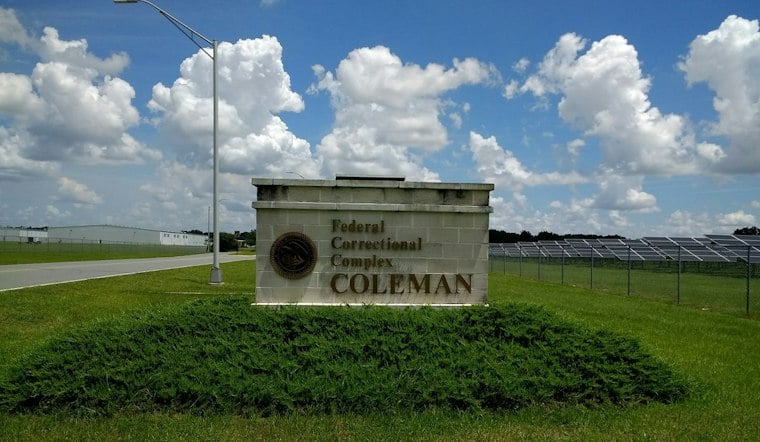
A 24-year-old inmate already serving nearly three decades behind bars has pleaded guilty to smuggling methamphetamine and marijuana into his federal prison cell block, with investigators saying the drugs were hidden inside his own hair. Charlie J. Williams admitted to federal drug distribution and contraband charges stemming from the discovery at Coleman Federal Correctional Complex in Sumter County.
The U.S. Attorney's Office for the Middle District of Florida announced Williams's guilty pleas on October 29, according to Orlando-News.com. Williams was already serving a 29-year, 4-month sentence stemming from prior robbery, drug, and firearm convictions at the time of the new charges. He pleaded guilty to possession of five grams or more of methamphetamine with intent to distribute, as well as one count of possession of contraband in a federal prison.
According to the Orlando outlet's reporting, a correctional officer noticed Williams concealing an item inside his hair on April 19 and recovered two plastic baggies as a result. Investigators reported that one baggie held a leafy substance consistent with marijuana, while the other contained more than 14 grams of methamphetamine that was intended for distribution within the prison. A Department of Justice statement similarly describes two baggies of contraband being recovered — one with over 14 grams of methamphetamine and one with a leafy substance consistent with marijuana — and says the Department of Justice determined the methamphetamine was meant for distribution inside FCC Coleman.
Decades More Could Be Added to an Already Lengthy Sentence
The math on Williams's potential exposure is steep. He faces a mandatory minimum five-year federal prison sentence on the methamphetamine charge, with a maximum of up to 40 years, per the Orlando outlet's report. The separate contraband offense carries a potential sentence of up to 20 years. No sentencing date has been scheduled yet, the same report states.
The Drug Enforcement Administration and the Federal Bureau of Prisons both investigated the case, according to the original reporting. Federal law governing contraband in prisons, codified at 18 U.S.C. 1791, notes that the statute was broadened at one point to also cover taking or sending contraband out of a federal institution, though it's unclear how that specific provision factors into the charges against Williams.
Not the First Meth Case to Surface at Coleman
Williams's case is not the only drug-smuggling prosecution tied to the sprawling Coleman complex in recent memory. In a separate case at the same facility, inmate Edwin Tollinchi-Rodriguez admitted to possessing more than 236 grams of methamphetamine hydrochloride, a quantity determined to be 99% pure, according to CBS12. That case stemmed from a routine pat-down on September 5, 2024, when a correctional officer discovered a wrapped package containing a white substance.
Tollinchi-Rodriguez faces a mandatory minimum of 10 years in that case, with the possibility of life in federal prison, and no sentencing date had been scheduled as of the station's report. The two cases are separate prosecutions involving different inmates, but together they point to the ongoing challenge of keeping narcotics out of one of Central Florida's largest federal lockups.




