

























































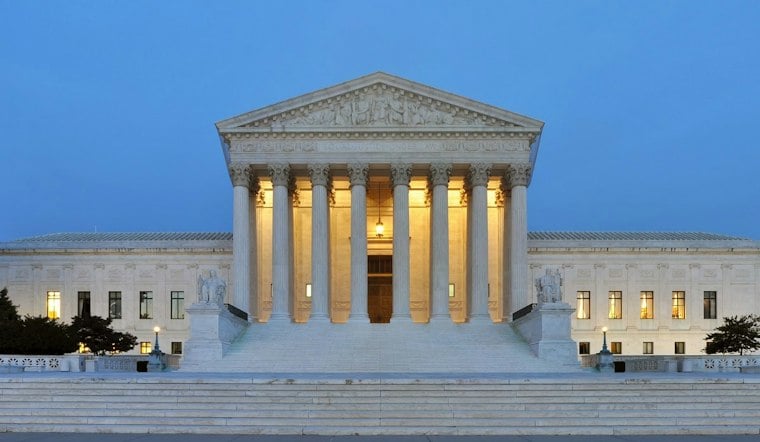
The Supreme Court has cleared the way for the Trump administration to resume construction of a 30-foot border wall in the Big Bend area of Texas, setting aside a lower court's injunction that had paused building along a 517-mile stretch of the Rio Grande. The decision reopens one of the most contested fronts in the administration's border-wall push, in a region known more for its canyons and desert quiet than migrant traffic.
According to the Los Angeles Times, the justices’ order undoes a federal judge’s block on further construction while the underlying lawsuit continues to play out. As reported by NBC News, the Supreme Court found that the judge lacked authority to rule on the matter and said the injunction impeded the government from advancing what it called its compelling interests in border security, a phrase also captured by CBS News in its coverage of the order. Justice Ketanji Brown Jackson dissented from the decision, per NBC News.
What's Actually Planned for the Big Bend Region
Federal contracting documents reviewed by Newsweek describe plans for roughly 68.2 miles of secondary border barrier in the Big Bend region, paired with a surveillance system built for round-the-clock monitoring. The documents describe the purpose of that camera network as providing what Newsweek quoted as “24/7 surveillance of the enforcement zone,” with motion detection, lighting and wiring infrastructure folded into the project.
CBP has said the broader project will include more than 200 miles of patrol roads and roughly 17 miles of vehicle barriers, and the agency maintains the work will not cut through Big Bend National Park itself, the station's report notes. NBC News reported the proposed construction section spans 341 miles and touches the park's footprint. Separately, a 47-mile stretch of wall in neighboring Hudspeth County, also part of the Big Bend region, began construction in September, according to immigration agencies cited by CBS News.
The Fight Over Waivers That Started It All
The legal dispute at the center of the case concerns waivers that allowed border projects in the Big Bend region to bypass numerous environmental and historic-preservation laws, according to Newsweek. NBC News reported the fight centers on three disputed waivers — one issued by then-Homeland Security Secretary Kristi Noem in February, and two more issued by her successor, Markwayne Mullin, in the months that followed.
U.S. District Judge Kathleen Cardone ruled on October 2 that challengers were likely to succeed in arguing the administration had exceeded its authority to waive those federal laws, Newsweek reported. NBC News reported that Cardone found the secretary lacked the sweeping powers claimed to issue the waivers and declined to put her own ruling on hold. The plaintiffs — including the nonprofit Friends of the Ruidosa Church, the Center for Biological Diversity, and river guide and area property owner Danny Miller — argued a 1996 law permits waivers only in areas where illegal crossings are pervasive, according to NBC News. Their lawyers said construction would permanently alter an irreplaceable landscape and threaten historic and cultural resources, the outlet reported. In court filings, Solicitor General D. John Sauer argued Congress gave the government broad authority to build border infrastructure without, in his words, red tape.
A Sector With the Border's Lowest Crossing Numbers
Part of what makes the fight notable is how little migrant traffic actually passes through Big Bend. The sector had the fewest migrant apprehensions, both overall and per border mile, of any Border Patrol sector, per Newsweek's review of federal data. The Texas Tribune reported that Big Bend covers about a quarter of the length of the U.S.-Mexico border; CBS News, citing court filings, put the sector's share of CBP's migrant apprehensions at 0.3% to 2.2% annually.
Newsweek reported that apprehensions in the roughly 517-mile sector fell from 37,266 in fiscal year 2021 to 3,096 in fiscal year 2025, a decline of about 92 percent from the 2021 peak. U.S. Customs and Border Protection, in its own release, put the more recent drop at 11,823 apprehensions in fiscal year 2023 falling to 3,096 in fiscal year 2025. The government has pointed to a separate figure — that more than 89,000 people had been detained trying to enter the country through this border segment in recent years — though sources describe the time period behind that number differently: the Los Angeles Times reported it as covering four years, while Newsweek attributed it to fiscal years 2021 through 2025.
Officials have warned that leaving the Big Bend area open while building wall sections elsewhere could be exploited by people entering the country illegally, according to NBC News. The Texas Tribune reported that a grassroots, bipartisan backlash formed across the region after plans for the barriers became public in January.
A Signature Promise Still Being Built Out
Trump first pledged to build a wall along the U.S.-Mexico border during his 2016 campaign, and the project has remained a signature piece of his immigration agenda, which has centered on border security and mass deportations, per NBC News. A Republican-controlled Congress has provided funding for the construction, and the administration has said it plans to complete a 2,000-mile border installation combining steel panels, vehicle barriers and new surveillance technology.
The Big Bend segment sits along a stretch of the Rio Grande that is sparsely populated, and the administration has faced opposition there from environmental groups and locals who argue construction would damage the landscape and historic sites, NBC News reported. With the Supreme Court's order now lifting the injunction, construction can move forward even as the underlying legal battle over the waivers continues.





