

























































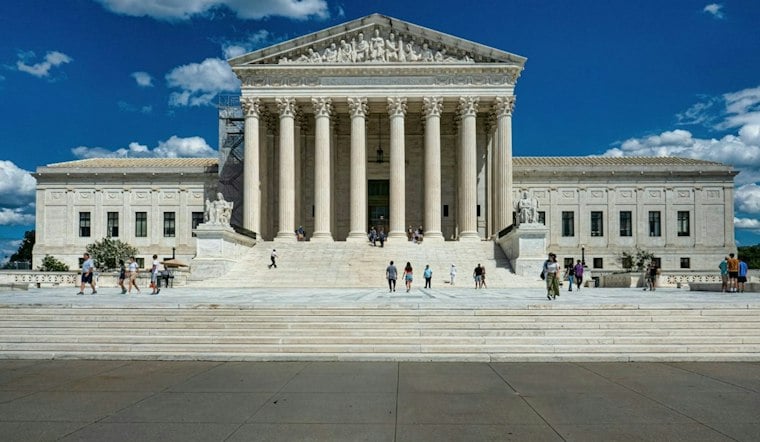
The U.S. Supreme Court is scheduled to consider on Wednesday a petition challenging whether a woman convicted in the 2019 kidnapping and death of three-year-old Kamille McKinney was properly prosecuted under federal law in the first place, even though the vehicle used in the crime never left Alabama. The case centers on Derick Irisha Brown, who along with her boyfriend abducted the toddler from a birthday party in Birmingham and drove her to nearby Center Point in Brown's Toyota Sequoia.
According to SCOTUSblog, a federal jury convicted Brown of kidnapping resulting in death and conspiracy to kidnap, and she received a life sentence. Brown and Stallworth were each sentenced in March 2023 on one count of kidnapping and one count of conspiracy to kidnap a minor victim, according to 1819 News. The jury found that McKinney's death resulted from the kidnapping, and she was found dead in a landfill, per the outlet's reporting.
Why a Car That Stayed in Alabama Matters
Federal kidnapping prosecutions can proceed when an offender uses a means, facility, or instrumentality of interstate or foreign commerce in committing or furthering the offense, a standard laid out in 18 U.S.C. § 1201. Brown has challenged the basis for her federal prosecution, arguing her vehicle never left the state, the 1819 News report notes. The Eleventh Circuit rejected that argument, holding that an automobile is per se an instrumentality of interstate commerce, according to the same account.
Brown's petition says the appellate court's ruling means Congress could criminalize a wide range of automobile-related conduct, right down to double parking, failing to signal, or driving with an expired license, if that conduct is somehow tied to a federal offense. Her appeal to the justices challenges that interpretation of the Commerce Clause amid what she describes as conflicting rulings among federal appeals courts, per the same report.
A Circuit Split Over What Counts as Interstate Commerce
A Circuit Split Over What Counts as Interstate Commerce
That argument has drawn pushback from the Cato Institute, which filed a brief supporting Brown, according to 1819 News. The group argues automobiles are not automatically instruments of interstate commerce and differ in kind from things like airplanes, shipping containers, railroad carriers, and telegraphs. Cato's brief further contends automobiles are routinely used in ways that have nothing to do with interstate commerce, and that stretching the Commerce Clause to cover them improperly intrudes on matters normally left to the states.
Elsewhere in the federal court system, the question has already produced mixed results. A 2025 ruling from the U.S. Court of Appeals for the Tenth Circuit involved a federal kidnapping-resulting-in-death case in which a district court dismissed the indictment after finding it insufficiently alleged the use of an instrumentality of interstate commerce. Separately, a 2025 opinion from the U.S. Court of Appeals for the Eleventh Circuit concerned the Arbery defendants’ federal convictions and whether Travis McMichael’s truck was an instrumentality of interstate commerce.
What a Ruling for Brown Could Mean
Brown's petition and related briefs were sent to the justices for consideration on September 30 and again the Friday before publication, 1819 News reports, and her case was relisted after the justices' October 16 conference, according to SCOTUSblog. It is now scheduled for the justices' conference Wednesday. The evidence reviewed does not show whether the Supreme Court has granted review or acted on the petition since that conference.
A ruling in Brown's favor would likely confirm that not every activity involving an automobile automatically falls under Congress's Commerce Clause power, narrowing the reach of federal kidnapping prosecutions built on that theory. Brown and Stallworth are separately awaiting a state trial on the murder, 1819 News reports, though the evidence reviewed does not establish the current status or dates of those proceedings.





