

























































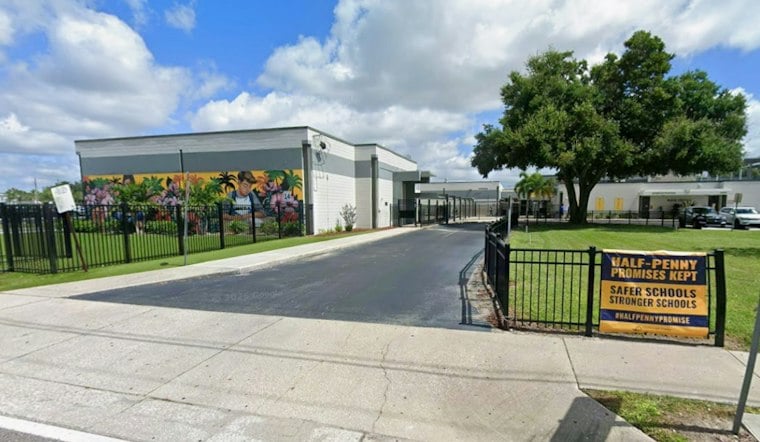
Students at Webb Middle School in Tampa now have to keep their phones zipped inside their backpacks for the entire school day, and the principal says the payoff has been noticeable: behavior referrals are down roughly 20% from the previous school year, and the cafeteria sounds like a cafeteria again, full of kids actually talking to each other instead of staring at screens.
Principal Glenda Vinueza said the shift has been dramatic. Before the policy, as reported by Bay News 9, Vinueza said there were “just too many distractions at school, too much drama, and kids just not paying enough attention in class.” She said students now understand the expectations from the moment they step onto school grounds — phones simply do not belong in the classroom.
The exact timeline of when Webb's phone rule began is murky. Bay News 9's latest report places the ban's start in 2022, four years before publication, while a 2024 Bay News 9 account said Vinueza had implemented the “no cell phone” policy the year before, which would put its start in 2023. Either way, Vinueza said the school has seen a decline in behavior referrals over that period, with the steepest single-year drop — about 20% — coming between the previous school year and the current one.
Cafeteria Conversations Return
Beyond the referral numbers, Vinueza pointed to a less measurable but, in her view, meaningful change: kids are talking to each other again. She said the policy made students “talk and interact with one another in the cafeteria,” a shift she credits to removing the easy distraction of a phone at the lunch table. Teachers, she added, are also benefiting — the policy frees them from constantly nagging students to put devices away, giving them more time to actually teach.
Webb's rule requires phones to stay in backpacks throughout the day, which goes further than the baseline policy Hillsborough County Public Schools rolled out in the summer of 2024. That districtwide rule, according to Bay News 9's earlier coverage, required students to silence their phones and keep them out of sight during the school day, while still letting high schoolers use devices at lunch. Pinellas and Pasco County Schools adopted similar policies around the same time, Bay News 9 reported.
A New Harvard Study Adds Data to the Debate
Webb's experience lands alongside a new national report. Researchers from Harvard University's Center for Education Policy Research, along with NWEA and Dartmouth, analyzed data from 3.3 million students at 4,600 schools nationwide between the 2021–22 and 2025–26 school years, according to the Harvard Center for Education Policy Research. The study found that schools requiring students to secure phones in lockable pouches throughout the day saw academic gains equivalent to roughly one to two additional weeks of learning each school year.
The center's press release noted those gains showed up in math and reading achievement growth of about 0.01 standard deviations per year, and that the improvement appeared to begin in the first year of a ban and continue three years later. A similar pattern turned up in a separate national analysis reported by NPR, which found that gains linked to phone pouches appeared to continue for up to three years after schools adopted them.
Not every study agrees, however. NPR also reported on a separate study released in April that found close to zero impact from cellphone pouches on test scores, with benefits that were not statistically significant — and noted that while the April study had been peer-reviewed, the newer research had not. That same April study found that high-school math gains tied to phone pouches were offset by learning losses in middle school, according to NPR's reporting.
Mixed Results Elsewhere, and a Statewide Rule Already in Place
The uneven picture extends beyond Florida. In Los Angeles, a survey covered by LAist found that middle school staff estimated two-thirds of their students “mostly” followed phone restrictions, compared with just over half of high school students. The same spring 2026 survey found fewer than half of high schoolers said they focused better in class without their phones all or most of the time, compared with nearly 58% of their middle school peers, LAist reported.
Hillsborough County school board members considered expanding the district's cellphone restrictions but ultimately decided against it, according to the Tampa Bay Times. Florida's statewide law, meanwhile, prohibits elementary and middle school students from using cellphones throughout the school day and bars high school students from using them during instructional time. The Hillsborough County Public Schools wireless-devices page says that state requirement took effect July 1, 2025, and that the district was adjusting its own rules to align with it.
School Board Chair Says Results Are No Surprise
Hillsborough County school board chair Nadia Combs said she was not surprised by the Harvard findings. Combs said the district adopted stricter cellphone restrictions ahead of Florida's statewide requirements and has since seen fewer fights and behavioral issues districtwide. Still, she cautioned that the benefits do not necessarily follow students home.
Combs said excessive screen time remains a concern once students leave school grounds. She said kids spend many hours on screens and do not read, socialize, or engage with one another, calling it a major issue beyond the classroom. Harvard researchers themselves cautioned that evidence about broader statewide cellphone restrictions is still developing, and TIME reported that recent large-scale studies have produced differing estimates of the academic benefits of such bans — even as at least 40 states and Washington, D.C. now require districts to ban or restrict student cellphone use, according to TIME.




